
The precious metals market just experienced one of its most notable weeks in years—and it was driven by clear, observable shifts in global capital flows.
Gold briefly climbed above $4,800 per ounce, setting another record high, while silver pushed toward $95. This was not a speculative spike or a purely technical move. Rather, it was a direct response to rising concern about foreign selling of U.S. debt, a trend quietly reshaping global markets.
When confidence in government bonds begins to crack, investors often act before headlines appear.
A Small Sale That Sent a Big Message
Last week, AkademikerPension—one of Denmark’s largest pension funds—publicly announced it will sell its entire $100 million U.S. Treasury position by the end of the month, citing concerns about U.S. government finances.
In absolute dollar terms, $100 million is small. The global Treasury market is dominated by much larger holders:
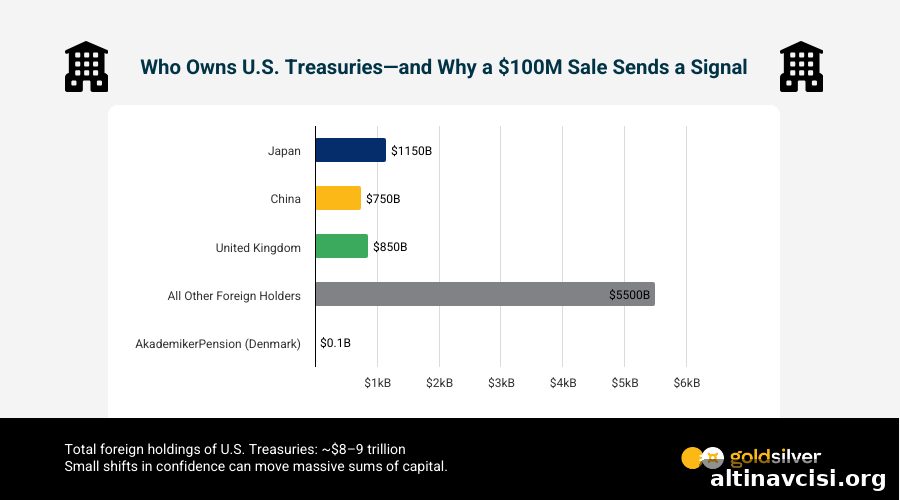
That tiny slice represents the Danish fund. But markets are sensitive to signals, not just size. When a conservative European pension fund publicly exits Treasuries over solvency concerns, it prompts other institutions to ask the same question: should we?
If even a modest share of foreign holders—say 2–3%—follow, the ripple effects could be substantial.
Why Foreign Selling U.S. Debt Matters More Than the Size
Markets respond to direction and momentum. A high-profile sell decision from a conservative institution changes the risk calculus for peers and can trigger broader reallocations.
If more foreign investors reduce Treasury exposure, several outcomes could follow:
- Higher borrowing costs for the U.S.
- Thinner market liquidity
- A weaker dollar
- Increased pressure on the Federal Reserve
Such developments erode confidence, and confidence rarely returns quietly. This is the environment to which gold is currently reacting.
The Timing Isn’t Coincidental
These events did not occur in isolation. The same week AkademikerPension announced its exit, diplomatic tensions between the U.S. and parts of Europe flared. Political friction compounds investor uncertainty about government finances and policy stability.
For a Danish pension fund to cite concerns about U.S. finances amid heightened diplomatic tensions suggests a real-time breakdown in trust that affects capital allocation decisions. Markets often react to the early signs of eroding confidence rather than waiting for formal policy changes.

The Financial System Isn’t Safer — And You Know It
As risks mount, see why gold and silver are projected to keep shining in 2026 and beyond.
The Path Toward $5,000 Gold
Major financial institutions have begun to acknowledge scenarios the market is already pricing in. Several banks have discussed $5,000-per-ounce targets for gold. After this week’s moves, those forecasts are taking on the character of lagging indicators rather than pure speculation.
Gold’s advance reflects structural forces rather than a fleeting panic:
- Ongoing geopolitical instability
- Long-term pressure on the U.S. dollar
- Growing skepticism toward sovereign debt
Foreign selling of U.S. debt is a symptom of a deeper loss of confidence in paper promises—exactly the environment where physical gold has traditionally outperformed.
What This Means for Investors
When global capital questions the safety of government bonds and foreign selling accelerates, diversification becomes essential rather than theoretical.
Physical gold and silver do not rely on fiscal discipline, political stability, or counterparty solvency. They are stores of value that function independently of government promises.
If you’ve been considering adding precious metals to your portfolio, the current market signals are the kind experienced investors monitor—early and deliberately.
Our specialists are available to help you evaluate how physical metals could fit into a balanced allocation.
Stay On Top of Gold & Silver Prices
Get important market alerts sent straight to your inbox.
People Also Ask
Why are foreign countries selling U.S. Treasuries?
Foreign investors are trimming Treasury holdings because of concerns about U.S. fiscal sustainability, rising national debt, and geopolitical uncertainty. The high-profile decision by Denmark’s AkademikerPension to exit its $100 million position highlights those concerns. While individual sales may be small, they can signal a broader shift in institutional confidence.
What happens if foreign countries stop buying U.S. debt?
If foreign demand for Treasuries weakens, the U.S. government would likely need to offer higher yields to attract buyers, increasing borrowing costs and fiscal strain. Such a shift typically weakens the dollar, reduces market liquidity, and places upward pressure on inflation. Historically, declining confidence in sovereign debt has driven flows into alternative stores of value like physical gold and silver.
How much U.S. debt do foreign countries own?
Foreign investors have held several trillion dollars in U.S. Treasury securities. Even small percentage changes in those holdings can move hundreds of billions of dollars and materially affect Treasury markets.
Why is gold surging when foreign investors sell U.S. Treasuries?
Gold tends to rise when confidence in paper assets and sovereign debt declines. When institutions question the safety of government bonds, many investors allocate to physical assets that do not depend on government solvency. Gold’s recent surge reflects growing concern about Treasury dynamics and long-term dollar stability.
What does Denmark’s pension fund selling Treasuries mean for the dollar?
Denmark’s $100 million sale is small in isolation but carries symbolic weight. It signals a public vote of no-confidence from a conservative institution. If other funds, sovereign wealth funds, or central banks follow—even modestly—the cumulative effect could pressure the dollar, raise U.S. borrowing costs, and accelerate shifts toward alternative reserve assets. Markets often move in response to these signals before capital reallocation is complete.
You May Also Like:
- Why Metals Dominated Every Asset Class in 2025 [and What It Means for 2026]
- Why New CME Trading Rules Could Push Silver to $100
- Why Silver Prices Are Rising — And What Comes Next
- Best Investment Of 2026: Silver’s Setup Is Hard To Ignore
- What the Falling Gold-to-Silver Ratio Means for Investors