Key Takeaways
- A Silver IRA holds physical silver bullion inside a self-directed IRA — not ETFs, futures, or mining stocks — giving you tax-advantaged ownership of a tangible asset.
- The IRS requires silver held in IRAs to have a minimum fineness of .999, be held by an approved custodian, and be stored at an approved depository. Home storage is a prohibited transaction with significant tax consequences. [IRS IRC §408(m)]
- Annual contribution limits apply across all your IRAs combined, with a catch-up allowance for investors aged 50 and older. Refer to IRS guidance for current figures. [IRS Publication 590-A]
- Typical annual fees on a $50,000 Silver IRA run roughly $450–$600, higher than ETFs but covering physical ownership, storage, and custodian services. Whether the premium is worthwhile depends on your objectives. [GoldSilver analysis]
- Silver carries both monetary and industrial demand — it serves as a store of value and a critical input for solar, EVs, electronics and other technologies, giving it a dual role in portfolios. [Silver Institute, World Silver Survey 2024]
The US dollar has lost substantial purchasing power over recent decades. Your 401(k) or IRA is denominated in those same dollars. Learning the Silver IRA rules won’t eliminate currency risk, but it lets you hold physical silver inside a tax-advantaged account. That places part of your savings in a form no central bank can create by adjusting ledgers.
Below is a clear, practical guide to IRS requirements, typical costs, and the steps to set up a compliant Silver IRA.

Your Gold Buying Guide Most investors overpay when they buy gold and again when they sell. This guide explains what to own and why.
What Is a Silver IRA?
A Silver IRA is a self-directed Individual Retirement Account (SDIRA) that holds physical silver bullion rather than stocks, bonds, or mutual funds. The emphasis is on physical metal stored in a vault and held by a qualified custodian on your behalf. [IRS IRC §408(m); Taxpayer Relief Act of 1997]
This matters because physical silver carries no counterparty risk: the metal itself exists in a depository. Paper instruments — ETFs, futures, or mining stocks — depend on third parties. A properly structured Silver IRA gives you ownership of tangible metal within the IRA framework.
What Are the Silver IRA Rules Set by the IRS?
The IRS enforces four core requirements for silver IRAs. [IRS IRC §408(m)(3)]
1. Purity Requirement
Silver held in an IRA must have a minimum fineness of .999 (99.9% pure). Most investment-grade bars and coins meet this standard. The American Silver Eagle, for example, is .999 fine and is explicitly acceptable for IRAs. Numismatic coins, pre-1965 US “junk silver” at 90% purity, and sterling silverware do not qualify.
2. Approved Coins and Bars
Beyond purity, eligible coins must be produced by a national government mint and bars must come from accredited refiners or manufacturers. Common IRS-approved coins and bars include:
- American Silver Eagle (US Mint) — 1 oz, .999 fine
- Canadian Silver Maple Leaf (Royal Canadian Mint) — 1 oz, .9999 fine
- Austrian Silver Philharmonic (Austrian Mint) — 1 oz, .999 fine
- Perth Mint coins like the Kookaburra and Koala — 1 oz, .999 fine
- Reputable bars from refiners such as Sunshine, PAMP, Credit Suisse, Engelhard, and others
If a product isn’t on the approved list, it cannot be placed into an IRA. These standards stem from the Taxpayer Relief Act of 1997 and subsequent IRS guidance.
3. Custodian Requirement
A qualified custodian is required. You cannot simply buy silver through a brokerage account and claim it as an IRA holding. Self-directed IRA custodians handle compliance, reporting, and required IRS filings (Form 5498, Form 1099-R). They hold assets on your behalf but do not provide investment advice.
4. Storage Requirement — No Home Storage
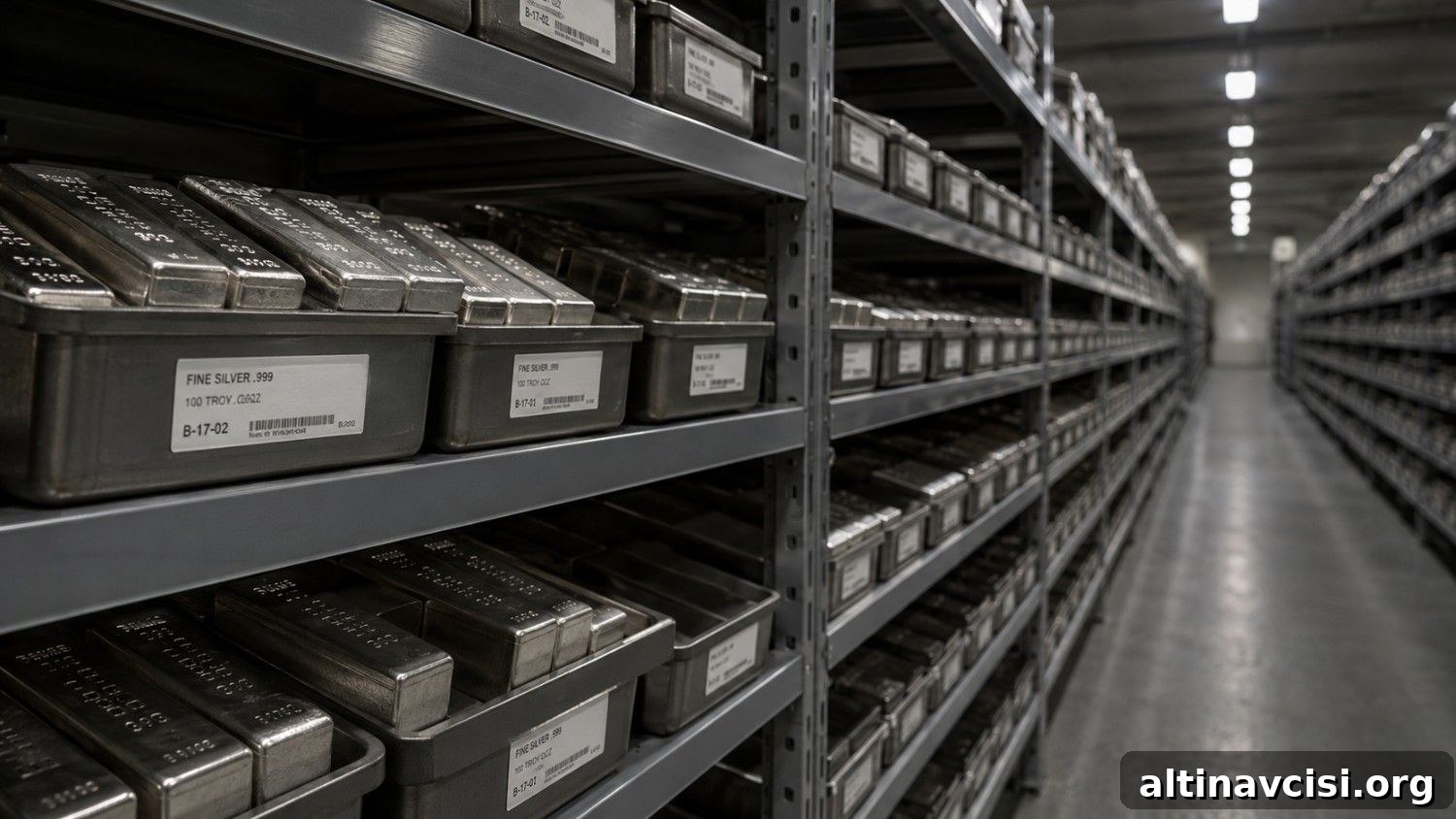
IRS rules mandate storage at an approved, third-party depository. Home storage is a prohibited transaction that can trigger full taxation of the IRA and additional penalties. Approved depositories include well-known providers such as Delaware Depository, Brinks, Loomis, and International Depository Services.
Depositories offer commingled storage (lower cost) or segregated storage (your metal separated and identifiable) for a higher fee. Avoid home-storage claims — they are not compliant and carry severe tax risks. [IRS IRC §4975; McNulty v. Commissioner]
What Are the Silver IRA Contribution Limits?
Contribution limits for Silver IRAs follow standard IRA rules. Annual limits apply across all IRAs you own, with a catch-up amount for those aged 50 and over. Traditional and Roth IRAs share the same contribution ceiling; consult current IRS Publication 590-A for up-to-date figures. Deductibility and income limits depend on your filing status, income, and whether you or your spouse have a workplace retirement plan.
Traditional vs. Roth Silver IRA: Which Is Better?
Both account types hold the same physical silver. The difference is tax timing:
Traditional Silver IRA
- Contributions may be tax-deductible
- Assets grow tax-deferred
- Withdrawals are taxed as ordinary income
- Required Minimum Distributions (RMDs) apply in retirement under current law
Roth Silver IRA
- Contributions are made with after-tax dollars
- Qualified withdrawals are tax-free
- No RMDs during the original owner’s lifetime
- Income limits for contributions may apply
If you expect higher taxes or higher purchasing power of silver in the future, a Roth structure — paying tax now on a smaller base — can be advantageous. If you expect lower taxes in retirement, a Traditional IRA may fit better. Choose based on your expected tax situation and goals. [IRS Publication 590-A]
How Do You Open a Silver IRA?
Opening a Silver IRA involves a few clear steps:
- 1. Choose a custodian: Compare setup fees, annual admin fees, storage fees, and transaction costs. Request a full fee schedule before committing.
- 2. Fund the account: Use annual contributions (within IRS limits), a custodian-to-custodian IRA transfer (no taxes or penalties), or a direct 401(k) rollover from a former employer’s plan.
- 3. Select eligible silver: Work with a dealer to choose IRS-approved coins or bars. The custodian purchases the metal and directs delivery to an approved depository.
- 4. Depository storage: The depository verifies and stores the metal, and you receive statements of holdings.
- 5. Ongoing maintenance: The custodian files required IRS forms. At retirement you can take a cash distribution or an in-kind distribution of the physical metal, taxed at fair market value on the transfer date if applicable.
Silver IRA: Typical Annual Fee Ranges
Based on a $50,000 account — total annual cost typically $450–$600 with segregated storage
Source: Fee ranges reflect typical self-directed IRA custodians. Individual custodians vary.
On a $50,000 account, custodian plus segregated storage typically runs $450–$600 per year, roughly 0.9%–1.2% of account value. By comparison, some silver ETFs charge lower ongoing fees but do not provide physical ownership. Decide whether paying for physical metal and storage aligns with your objectives.
Why Does Silver Belong in a Retirement Account?
Silver is often labeled an inflation hedge, but its investment case is broader. It fulfills two distinct roles simultaneously: monetary and industrial demand.
Monetary role: Silver has historically functioned as money and can preserve purchasing power against monetary debasement.
Industrial role: A large share of silver demand is industrial — photovoltaic cells, electric vehicles, electronics and medical devices — creating a structural floor to demand that can grow with technological adoption. This dual demand structure differentiates silver from pure monetary metals.
Supply-side constraints matter too: mine production and recycling have struggled to keep pace with rising demand in some years, and new mines take time to develop. That dynamic can exert upward pressure on prices when demand grows faster than supply.
Is a Silver IRA Right for Everyone?
Not necessarily. Silver IRAs carry higher fees than ETFs and are less liquid. Silver can be volatile and does not generate income while stored. IRA restrictions, custodian coordination, and storage requirements add complexity.
Silver is best viewed as a preservation and diversification tool — an asset to protect purchasing power and hedge monetary risks alongside stocks, bonds, and cash rather than replace them entirely. Many investors allocate a modest percentage of retirement assets to precious metals and build positions gradually.
Stay On Top of Gold & Silver Prices
Get important market alerts sent straight to your inbox.
People Also Ask
Can I convert my existing IRA or 401(k) into a Silver IRA?
Yes. You can fund a Silver IRA through a direct rollover from a former employer’s 401(k) or a custodian-to-custodian IRA transfer without taxes or penalties when the transfer is handled correctly. Indirect rollovers are possible but require redeposit within 60 days and care with withheld amounts. [IRS IRC §402(c); §408(d)(3)]
Do I receive the physical silver at retirement?
You can either take a cash distribution after the custodian liquidates the metal or request an in-kind distribution where physical silver is transferred to you. In-kind distributions are taxed at fair market value on the transfer date if taxable under your account type.
Is a Silver IRA safe if the financial system fails?
The metal held at a regulated depository is separate from a custodian’s assets and would generally survive a custodian bankruptcy. However, the IRA itself remains a tax-structured vehicle subject to US tax law and regulation. For complete independence from the financial system, direct personal ownership outside an IRA is the alternative.
How much of my portfolio should be in a Silver IRA?
There’s no one-size-fits-all answer. Many advisors suggest 5%–20% in precious metals depending on risk tolerance and goals. Silver’s higher volatility suggests building positions gradually rather than allocating a large sum at once.
Can I add more silver to the IRA after the initial purchase?
Yes. You can make annual contributions up to IRS limits, use transfers or rollovers, or reinvest cash inside the IRA to buy additional approved silver products through your custodian. [IRS Publication 590-A]
What Most Silver IRA Guides Don’t Tell You
Many guides are produced by companies selling silver IRAs and emphasize buying now. The Silver IRA is a hybrid: it uses the tax and regulatory framework of an IRA to hold an asset that exists physically outside the banking system. That creates both benefits (tax efficiency, inflation protection) and trade-offs (custodian rules, storage, costs).
If your primary concern is inflation and preserving purchasing power, a Silver IRA can be an appropriate, IRS-sanctioned tool. If your goal is to hold metal entirely outside the financial and regulatory system, direct ownership outside an IRA is the simpler choice.
SOURCES
1. US Bureau of Labor Statistics — CPI data
2. IRS — Internal Revenue Code §408(m) and related guidance
3. IRS Publication 590-A: Contributions to Individual Retirement Arrangements
4. Taxpayer Relief Act of 1997, Pub. L. 105-34
5. SECURE 2.0 Act (RMD updates)
6. McNulty v. Commissioner, 157 T.C. No. 10 (2021) — home storage ruling
7. Silver Institute — World Silver Survey(s) and industry reports
8. iShares — Silver ETF fee information
9. Industry fee analyses and custodial disclosures
Disclaimer: This article is for informational and educational purposes only and does not constitute investment advice. Consult a qualified financial adviser before making investment decisions.
You may also like:
- Silver’s Tesla Moment: The Solid-State Battery Thesis
- Physical Gold vs. Digital Gold: Which Is the Ultimate Safe Haven?
- BRICS Is Hoarding Gold. Here’s What It Means for Your Portfolio.
- Gold to Oil Ratio: The Ultimate Guide for Economic & Portfolio Analysis
- Dollar-Cost Averaging Into Gold and Silver: The Investor’s Practical Guide
- The Silver-to-Dow Ratio: How to Spot the Shift from Paper to Physical
- What Moves Gold Prices? 6 Key Gold Price Factors Explained
- World Bank: Precious Metals to Surge 42% This Year