It’s not just online trends or short-lived market frenzies driving changes in silver demand. A significant structural shift is underway—one that will persist for years or even decades. This built-in demand will increasingly strain supply and will have real consequences for consumers and investors alike.
What is causing this shift?
The Green Revolution = the Silver Revolution
Today, the largest industrial use of silver is in the photovoltaic (solar) sector. The Silver Institute projects that within a few years the automotive industry will become the second-largest industrial consumer of silver.
Research indicates that demand from both solar and automotive sectors is poised to grow substantially. That growth is driven by the global move toward green technologies and by the fact that many clean-energy applications require more silver than their conventional counterparts. In many cases silver is also more cost-effective and technically superior.
Below are the key trends that will shape how you are affected as a consumer and as an investor.
Automotive Demand for Silver
Global electric vehicle (EV) sales reached 3.24 million in 2020, a 43% increase over 2019 despite the pandemic. Analysts noted that the second half of 2020 marked the start of serious disruption to internal combustion engine vehicle dominance.
Major consultancies expect EV sales to continue rising rapidly. BloombergNEF forecasted a 60% surge and IHS Markit projected a 70% rise in global EV sales in a single year—large increases that reflect accelerating adoption.
Automakers are responding aggressively:
- Elon Musk has said Tesla aims for 20 million annual EV sales by 2030, a dramatic increase from recent production levels.
- BMW planned to double its EV model lineup to 25 models by 2023, with more than half fully electric.
- Daimler announced an investment of €70 billion ($85 billion) for EVs between 2021 and 2025.
- Volvo committed to tripling electric production capacity in Ghent after strong EV sales.
- Volkswagen increased planned spending on digital mobility to €150 billion.
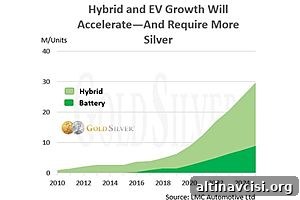
These moves matter because EVs use substantially more silver than internal combustion engine (ICE) vehicles—roughly double the amount per vehicle—while hybrids use about 22% more silver. As EV and hybrid production rises, so will automotive silver demand.
Recent projections of silver usage in the automotive sector are likely conservative. They were prepared before a record month for EV sales in December and before new technological developments. For example, Samsung researchers recently described a silver-carbon composite layer for solid-state batteries, a material application that could address safety and longevity issues for batteries. This is a newly emerging use for silver that was not widely considered months ago.
The Samsung discovery raises an important question: what other silver applications remain undiscovered? Given silver’s unique properties, further innovations in green technologies could drive demand higher than current forecasts.
The takeaway: automotive demand for silver is on the verge of a long-term surge.
Solar Demand for Silver
Photovoltaic demand for silver has already expanded rapidly over the past decade. Solar installations have proliferated across advanced and emerging economies, driven by the falling cost of photovoltaic systems.
The decline in solar installation costs has made rooftop and utility-scale projects much more affordable, accelerating adoption among governments, businesses, and consumers. As solar deployment grows, so will silver consumption in the photovoltaic supply chain.
Investment Implications
Silver demand from automotive and solar sectors is set to rise steadily. Added to that are numerous other industrial uses—and new applications that may yet emerge. This broad, sustained industrial demand will pressure supply if production cannot keep pace.
Preliminary data for 2020 indicate a decline in global mine output. Consultancy Metals Focus estimated a noticeable drop in production over recent years. Global mine reserves and average ore grades are falling, and investment in exploration, development, and expansion has been limited over the past eight-plus years. Low silver prices discouraged exploration budgets, and reduced exploration means fewer future discoveries and lower long-term output.
These factors make the supply issue structural: mining capacity cannot be increased overnight. New mines and expanded production require years of planning and millions of dollars of investment. Historically, production lags behind price signals—output often increases only after extended periods of higher prices that spur investment.
That lag is important: even if silver prices rise, it will take time for mining investment to translate into significantly greater output. For investors, that raises the specter of a supply/demand imbalance as industrial consumption expands.
While no one can predict exact price movements, a sustained supply squeeze could support materially higher silver prices. For those who already hold physical silver, that scenario offers potential gains. For investors considering accumulation, current price weakness can be seen as an opportunity to build positions before industrial demand exerts stronger upward pressure.
(Follow Jeff on Twitter @TheGoldAdvisor)