Does US debt drive gold prices? The CBO confirmed the U.S. paid $529 billion in interest in just the first half of fiscal 2026 — $88 billion a month. Gold is at record highs and climbing. Here's the fiscal mechanism every saver needs to understand before the next $88 billion bill arrives.
A striking figure is circulating this week that every saver should notice: $88 billion.
That is the approximate amount the U.S. government now pays each month in interest on the national debt — not for infrastructure, education, or defense, but solely to service roughly $39 trillion of outstanding debt. The Congressional Budget Office’s Monthly Budget Review (April 8) shows the government paid about $529 billion in interest in the first half of fiscal 2026. At the same time, gold is trading near record highs, up more than 46% year-over-year. These trends are connected, and savers should understand the fiscal dynamics behind them.
Does US debt drive gold prices?
Yes — the relationship is visible today. Monthly interest payments of about $88 billion annualize to more than $1 trillion. Combine that fiscal burden with a softer dollar, energy-driven inflation, and heavy central-bank purchases of gold (over 1,000 tonnes in 2025), and you get strong upward pressure on gold prices. Investors are pricing in accelerating monetary debasement; gold’s roughly 46% year-over-year gain reflects that concern.
To put the scale in context: the monthly interest bill is roughly equal to what the federal government spends on defense and education combined. With the national debt above $39 trillion, CBO projections indicate interest costs could double to about $2.1 trillion by 2036, a faster pace of growth than any other budget category.
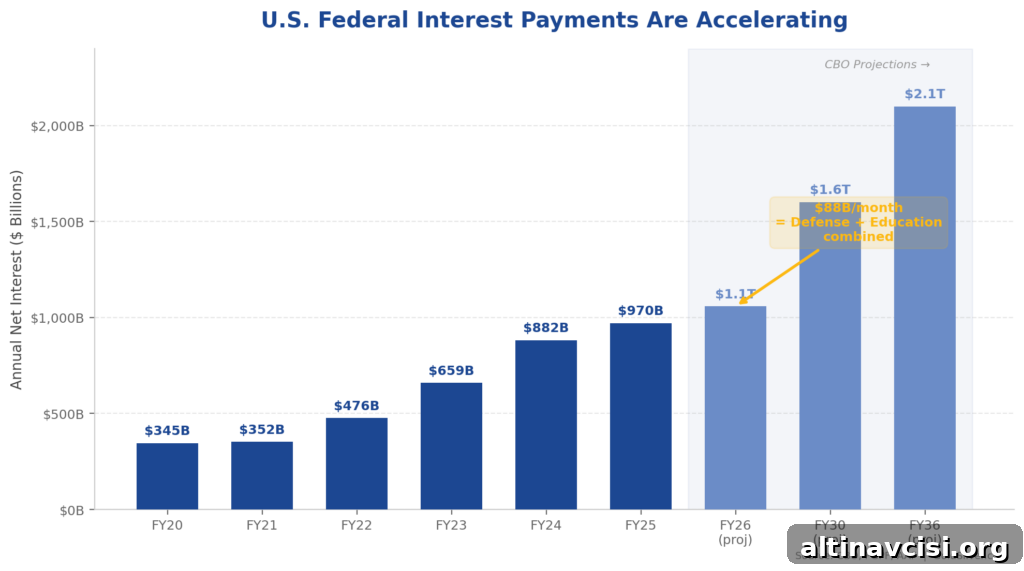
U.S. Federal Interest Payments Are Accelerating | Source: CBO, PGPF
This rising interest burden is a core mechanism of monetary debasement and it appears to be accelerating.
Gold has reflected these pressures. The metal traded near $4,749 on April 10 and has held elevated levels despite episodic volatility tied to geopolitical developments. Year-over-year gains for gold are outpacing equities, bonds, and most other asset classes.
Recent events show why fiscal dynamics matter for precious metals. Markets briefly rallied on the April 8 ceasefire announcement between the U.S. and Iran, but that relief proved short-lived. The Strait of Hormuz remains effectively closed for most shipping; only a small number of tankers have passed since the truce. Significant oil shipments remain delayed, and energy markets are reacting — another factor that tends to support precious metals amid inflationary pressure.
Oil, after a sharp drop on ceasefire headlines, has rebounded near $97 per barrel — still well above pre-conflict levels — reinforcing inflation risks that complicate monetary policy and encourage safe-haven demand for gold.
The Edge Every Investor Needs
Smarter precious metals investing starts here. The Nuggets Newsletter brings you essential market insights, Fed updates, global trends, educational videos, and much more.
Why isn’t the Fed cutting rates to ease the debt burden?
Inflation dynamics constrain Federal Reserve action. At the March FOMC meeting the Fed left the policy rate at 3.50%–3.75% and raised its 2026 inflation forecast to 2.7% for both headline and core PCE. The policy trade-offs are clear: energy-driven inflation argues for tighter policy, while a softer labor market argues for easier policy. Large federal borrowing makes rate cuts politically attractive but could be fiscally risky. Several FOMC members now see no rate cuts this year. Meanwhile, a weaker dollar — which fell more than 1% on April 9 alone — tends to support gold by boosting dollar-priced commodity values.
Is silver a better buy than gold right now?
Silver currently looks inexpensive relative to gold on a historical basis. The metal jumped above $76 per ounce on April 8, its highest level since mid-March, though it remains well below the January record of $121.67. Silver experienced a sharp drawdown early in the Iran conflict, and the gold-to-silver ratio near 63 suggests silver could outperform if the broader precious-metals rally continues.
Beyond short-term moves, structural demand for gold is important. Central banks added over 1,000 tonnes of gold in 2025 — the second-highest annual total on record — driven by reserve diversification and de-dollarization trends that persist into 2026.
The U.S. fiscal path underscores the same message from another angle. When a country spends more to service past borrowing than on major priorities like defense or education, it signals a shift in the expected purchasing power of its currency. Gold and silver have a long history as stores of value: they cannot be printed or debased by policy decisions. Each monthly interest bill — the recurring $88 billion — reinforces the logic for a deliberate allocation to physical precious metals as part of financial preservation, not pure speculation.
The core question for investors is not whether gold is expensive at current quotes; it is whether the dollar remains sound when the nation carries tens of trillions in debt.
Stay On Top of Gold & Silver Prices
Get important market alerts sent straight to your inbox.
SOURCES
1. Congressional Budget Office — Monthly Budget Review: March 2026, April 8, 2026
2. Matt Smith, Lead Oil Analyst, Kpler — reporting on Strait of Hormuz oil traffic, April 9, 2026
3. Sultan Ahmed Al Jaber, CEO ADNOC — quoted on Strait of Hormuz, April 9, 2026
4. Kpler vessel-tracking data and related reporting on shipping in the Strait of Hormuz, April 10, 2026
This article is for informational purposes only and does not constitute financial or investment advice. Always consult a qualified financial advisor before making investment decisions.
You May Also Like
- CPI Hits 3.3%, GDP Stalls — Is Stagflation 2026 Here?
- War Risk, Stagflation Signals, and a $6,300 Gold Target
- Gold and Oil Brace for the Strait of Hormuz Deadline
- Iran War Deadline Puts Gold and Silver Prices on Edge
- Why Is Gold Falling When the World Is on Fire?
- Gold Jumps 2% as Trump Plans Iran War Address Tonight