Gold and silver moved sharply on Thursday — initially falling at the open and then rallying later in the day, even as several bearish catalysts hit simultaneously.
May’s Producer Price Index rose 6.5% year-over-year, the hottest wholesale inflation reading since November 2022 and slightly above the 6.4% forecast. Most of the rise was driven by energy after Iran’s partial closure of the Strait of Hormuz. At the same time, the European Central Bank raised rates by 25 basis points to 2.25% — its first hike since September 2023. U.S. and Iranian forces exchanged strikes for a second night. Iran said the Strait was fully closed; U.S. Central Command disputed that assessment.
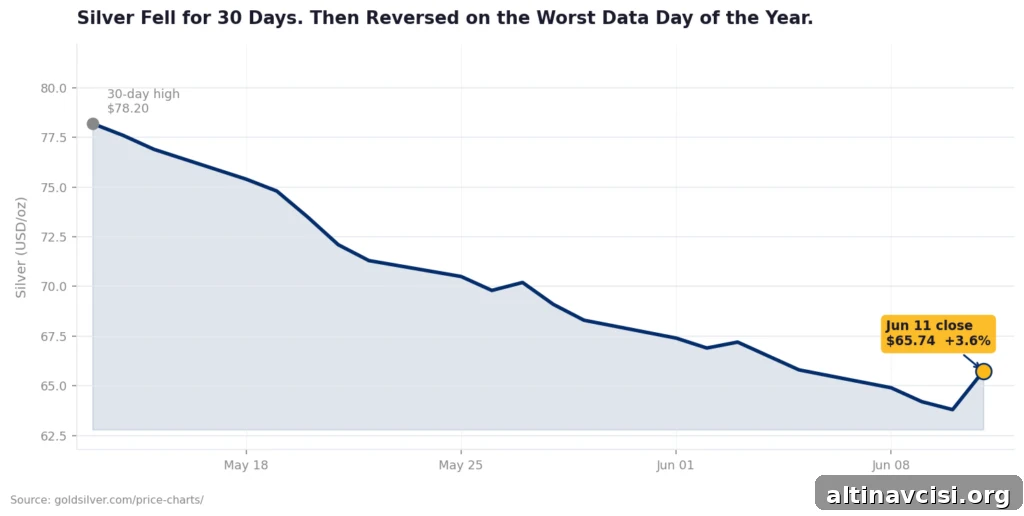
Gold hit a session low around $4,023, while silver opened at $63.52 — its weakest level since December 2025. By the afternoon both metals reversed: gold rallied to about $4,133 and silver recovered more than 3.5% from its intraday low.
What Does It Mean When Silver Holds on the Worst Data Day of the Year?
Silver had fallen for five consecutive sessions as traders positioned ahead of weak data. Once the report confirmed what that selling had already priced in, there was little left to push prices lower. The metal dipped to $61.49 before rebounding to close up over 3.5%. Gold climbed from roughly $4,023 to $4,133 after U.S. officials indicated strikes were complete, reviving hopes for de-escalation and talks.
This is a classic example of seller exhaustion: bad news had already been reflected in the market, so the immediate downside was limited. For a sustained move higher, markets will need a new catalyst — and one arrives in six days.
The Edge Every Investor Needs
Smarter precious metals investing starts here. The Nuggets Newsletter brings essential market insights, central bank updates, global trends, educational videos, and concise analysis.
Why Did the ECB Hike — and What Does It Mean for Gold?
The ECB raised rates for the first time in nearly three years, a move that some outlets have treated as a minor development. It matters more than that. The bank raised its 2026 eurozone inflation forecast to 3.0% from 2.6% while trimming growth expectations to 0.8%. The ECB explicitly cited the energy shock from the Iran conflict as a driver. In plain terms, that is stagflation: slowing growth and rising prices.
An ECB rate increase does two important things for gold. First, tighter euro-area policy typically strengthens the euro and weakens the dollar over time, and a weaker dollar tends to support gold prices. Second, a central bank raising rates because of a supply-driven energy shock signals a global monetary problem — not a domestic policy issue. When multiple major central banks tighten into an inflation caused by external shocks, the environment becomes more favorable for precious metals: they hedge against inflation that central banks cannot directly control.
These are precisely the conditions that increase the appeal of gold and silver.
What Does Core PPI Tell Us That the Headline Doesn’t?
The 6.5% reading is the headline PPI. The Federal Reserve focuses more on core measures that exclude volatile food and energy. Core PPI for May came in at 4.9%, below the 5.4% consensus. That divergence is important: the headline is elevated by oil and energy, while core inflation — which would indicate broader price pressures spreading into wages, services, and shelter — is notably cooler. In short, the report was distorted by energy and was not as broadly inflationary as the headline suggests.
What Should Physical Holders Watch Before the FOMC?
Central banks remain significant buyers: the World Gold Council reported 244 tonnes of official sector purchases in Q1 2026. The Silver Institute projects a sixth consecutive annual supply deficit in 2026 driven by industrial demand for solar panels, electric vehicles, and electronics. These structural factors continue to support both metals even while prices fluctuate.
The key event ahead is the Fed’s June 17 projection — the dot plot. The rate decision itself is expected to be a hold, but the Fed’s forward path is what will move precious metals. If the dot plot signals a likely December hike, that could cap rallies; if it leaves room for cuts or signals a less aggressive path should the Strait reopen, that would be constructive for gold and silver.
News that strikes were complete pushed gold up more than $100 in hours. Past ceasefires or de-escalation moments have triggered sharp rallies; that trade remains available. Physical holders benefit in either scenario: if the conflict drags on, metals act as an inflation hedge; if it ends, they gain from favorable monetary conditions. Short-term price swings change, but the long-term thesis for owning scarce, non‑printable assets remains intact.
Stay On Top of Gold & Silver Prices
Get important market alerts sent straight to your inbox.
SOURCES
1. GoldSilver.com — Price Charts
2. U.S. Bureau of Labor Statistics — Producer Price Indexes, May 2026
3. European Central Bank — Monetary Policy Decisions, June 11, 2026
4. CME Group — FedWatch Tool
5. World Gold Council — Gold Demand Trends Q1 2026
6. The Silver Institute — World Silver Survey 2026
7. U.S. Central Command — Press Releases
8. U.S. Department of Labor — Unemployment Insurance Weekly Claims
Disclaimer: This article is for informational purposes only and does not constitute financial or investment advice. Always consult a qualified financial adviser before making investment decisions.
You May Also Like:
- Gold at Seven-Month Lows: Why Geopolitical Fear Is Not Enough
- Gold Slides to $4,130 as Iran War Turns Inflation Against It
- May CPI Printed 4.2%. Core Inflation Beat. So Why Did the Gold Price Drop?
- Gold Is Down 9%. The CPI Print That Could Either Extend the Drop — or End It.
- Gold Price News: Goldman, China, CPI, and the Fed Explained
- Gold Near $4,330 as Rate-Hike Bets Hit 70% and China Acts
- Gold Is Down 22% — The Same Drop as 2022. The Floor Is Not the Same.
- Silver Falls 6% on Jobs Beat. The Six-Year Deficit Didn’t.
- Gold Rate Hike Fears Are Weighing on Prices. Here’s the Full Picture.