Why $4,454 Gold Means the Fed Is Trapped
ADP reported 122,000 private-sector jobs added in May this morning — the strongest reading since January 2025, according to ADP Research. Gold is trading near $4,450 at the open. Friday’s official U.S. nonfarm payrolls report is due at 8:30 a.m. Eastern. On June 16–17, Kevin Warsh will preside over his first Federal Reserve meeting.
Before markets react and positions shift, here is a concise framework to interpret the data and the likely reaction in gold.
Key Takeaways
- Friday’s NFP report will shape the narrative heading into Warsh’s first FOMC meeting on June 16–17. Three plausible outcomes: a hot print could push gold down $30–$50 short-term; a consensus print is likely to create noise but no clear trend; a weak print could reopen the path toward $4,600 as rate-cut odds return.
- The Fed is effectively stuck: inflation remains too high to justify cuts, while growth is too fragile to support hikes. That stalemate is the backdrop gold has been trading within for weeks.
- Watch gold’s $4,400 level on any hot-print selloff. If that floor holds, it signals structural demand is absorbing rate-sensitive selling — a more important signal than the raw jobs number.
Why Does This Week’s Jobs Number Matter More Than Usual?
Under typical conditions, a single payroll print nudges gold by roughly $15–$30 and those moves reverse within a couple of days as leveraged traders reset. This Friday is different for three reasons that converge at once.
First, the Fed leadership transition matters. The committee faces a higher level of internal disagreement than usual, and Kevin Warsh inherits a divided FOMC. That increases the importance of incoming data for shaping forward guidance.
Second, inflation is still elevated. The latest readings show annual inflation well above the Fed’s target, keeping policy makers cautious about easing prematurely.
Third, upstream price pressures are persistent. Manufacturing input-cost indices remain high, indicating raw-material inflation hasn’t clearly rolled over. That gives the Fed reason to keep a restrictive posture until a convincing disinflation trend appears.
Markets largely expect the Fed to hold rates at the June meeting. What Friday’s NFP number will change is the committee’s forward-looking language — the guidance that determines how quickly rate expectations shift. The jobs report won’t break the larger problem, but it will determine which facet of the policy “trap” investors focus on.
What Happens to Gold in Each NFP Scenario?
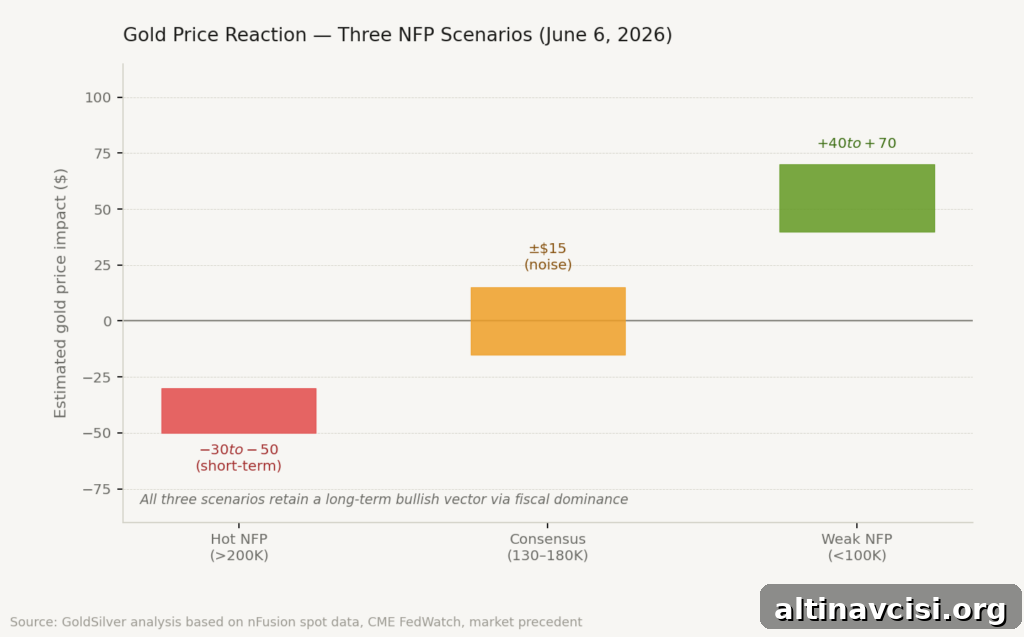
There are three clear scenarios, each producing a distinct near-term trajectory for gold: a hot print that pressures gold lower, a consensus print that creates noise but no decisive trend, or a weak print that lifts gold higher as rate-cut probabilities rise.
Scenario one: Hot NFP — above 200,000 jobs
A print north of 200,000 would confirm a tighter labor market than the Fed wants to see. Pricing for additional rate hikes would spike, pushing the 10‑year Treasury yield higher and lifting real yields further into restrictive territory. The dollar would strengthen and gold would likely fall $30–$50 intraday as rate-sensitive investors reduce exposure.
Even so, long-term structural buyers—central banks and long-horizon investors—can and often do step in on such dips. The conditions that make gold a global reserve asset aren’t erased by a single strong payrolls release; the short-term selloff should be viewed as market noise rather than a change in the long-term case.
Scenario two: Consensus NFP — 100,000 to 115,000 jobs
This is the market’s baseline and reflects the “low-hire, low-fire” labor dynamic many Fed officials have described. It neither intensifies recession fears nor signals a return to overheating. The June hold at the Fed would be confirmed and gold would likely move only $10–$15 either way — more noise than signal.
In this outcome, attention shifts quickly to the June 16–17 meeting and Warsh’s press conference. A consensus print keeps the debate unresolved: real yields remain elevated but stable, creating a neutral-to-supportive backdrop for gold. That has been the environment for weeks, during which gold has held roughly between $4,400 and $4,500 despite firm data and geopolitical-driven energy uncertainty.
Scenario three: Weak NFP — below 100,000 jobs
A weak payrolls print would reopen the path to $4,600 and higher. It would signal that the labor market is finally feeling the effects of restrictive policy, sending rate-cut probabilities back into market prices. Real yields would fall as nominal Treasury yields decline, the dollar would soften, and gold could rally $40–$70.
The mechanism is straightforward: lower real yields reduce the opportunity cost of holding non‑yielding assets like gold. When yields fall below inflation, the case for preserving purchasing power outside cash and short-duration bonds strengthens, making gold more attractive.
What Do All Three Scenarios Have in Common?
Regardless of the near-term outcome, one structural condition persists: the Federal Reserve is operating within constraints created by fiscal realities. Large deficits and rising interest costs limit the central bank’s freedom to move rates sharply without feedback effects on government financing costs.
That fiscal-monetary interaction helps explain why real interest rates are likely to remain compressed or volatile over the medium term. It’s also the core rationale for including physical gold in a long-term allocation: the multi-year monetary dynamic is what matters most—not any single jobs report or FOMC meeting.
What Should You Watch This Week?
Focus on two dates and one critical price level:
- Friday, 8:30 a.m. ET: U.S. May Nonfarm Payrolls. Consensus expectations are roughly 100,000–115,000 jobs, with the unemployment rate near 4.3%.
- June 16–17: FOMC decision and Kevin Warsh’s press conference. The market will parse any change in the committee’s guidance on the likely pace and direction of future rate moves. Language matters more than the rate decision itself.
- The $4,400 floor: Watch whether gold holds that level on a hot-print selloff. If it does, structural demand is absorbing rate-sensitive selling — a stronger signal about the market’s underlying health than the payrolls figure alone.
Stay On Top of Gold & Silver Prices
Get timely market alerts delivered to your inbox.
SOURCES
1. ADP Research — ADP National Employment Report: Private sector employment increased by 122,000 jobs in May.
2. Bureau of Labor Statistics — Consumer Price Index summary, April 2026.
3. Institute for Supply Management — ISM Manufacturing prices paid and PMI releases for May 2026.
4. Federal Reserve — FOMC statement and meeting calendar, April 29, 2026.
5. CME Group — Fed funds futures and pricing tools for June 2026 meeting probabilities.
Disclaimer: This article is for informational purposes only and does not constitute financial or investment advice. Consult a qualified financial advisor before making investment decisions.
You May Also Like:
- Central Banks Picked Gold Over Treasuries. Should You?
- Central Banks Just Crossed a Line Not Seen Since 1996
- Factory Costs Hit 82.1. That Number Is Now Working for Your Gold.
- Gold at $4,500: What Fort Knox, China, and Silver Are Telling You
- Silver Has Two Engines. Stagflation Is the One Condition That Fires Both at Once.
- The Buyer List for Gold Just Got Longer. These Countries Have Never Bought Before.
- PCE Hit 3.8%. GDP: 1.6%. Gold Went Up. Here’s the Mechanism.
- Gold Targets Are Falling. The $8,000 Forecast Isn’t.
- Gold Radar: 5 Stories the Price Chart Isn’t Telling You
- Silver Lost 3.3% While Gold Lost 1.6%. That Gap Is Not Random.
Popular Topics
Picked from the archive
-
01
 Topics
Gold Market Cycles: Investor Lessons from Past Bull Runs
-
02
Topics
Silver Price Nears $64 as Fed Debate Intensifies
-
03
Topics
Why the Fed Says Gold Will Stay Resilient
-
04
Topics
CPI-Adjusted Silver vs Spot Price: What the Ratio Reveals
-
05
Topics
Inside the Fed’s Most Contentious Jackson Hole Meeting
-
06
Topics
Fed Study: 5 Countries Cashed In on Gold Reserves in 30 Years
-
07
Topics
U.S. Gas Prices Fall to 12-Month Low Despite Heat; Storage Up 6%
-
08
Topics
Silver Price Falls on Index Rebalancing Ahead of Jobs Report