US Economic Outlook: Surface Strength Masks Deep Risks
Morning News Nuggets | Today’s top stories for gold and silver investors
March 18th, 2026 | Brandon Sauerwein, Editor
The U.S. economic outlook heading into spring appears resilient on the surface. But with oil trading near $100 a barrel, the Federal Reserve announcing its interest rate decision today, and the Strait of Hormuz effectively out of normal commercial use, structural risks are growing more visible. Below are the developments moving precious metals and markets this morning.
Is Gold’s $5,000 Floor About to Be Tested?
Gold briefly slipped below $5,000 on Wednesday morning ahead of the Federal Reserve meeting, unnerving some investors. While that intraday move mattered, the metal’s recovery and broader trend are more important to follow. After peaking above $5,500 in late February, gold has pulled back — a meaningful correction — yet it remains well above levels seen earlier this year.
Two opposing forces are defining the market. Safe-haven demand related to the Iran conflict and disruptions near the Strait of Hormuz are supporting prices and creating a firm floor. At the same time, investor caution ahead of the Fed’s decision is limiting upside momentum.
A hawkish tone from Chair Powell could strengthen the U.S. dollar and weigh on gold, while a dovish or uncertain stance — especially around growth expectations — could quickly push bullion higher. The short-term path for gold will depend heavily on how markets interpret the Fed’s message, not just the formal decision itself.
Technical indicators suggest the market is consolidating rather than collapsing. Gold remains up significantly year-to-date, and the $5,000 level has emerged as a key psychological and technical support to watch over the coming days and weeks.
Gold Prices: Three Month Chart
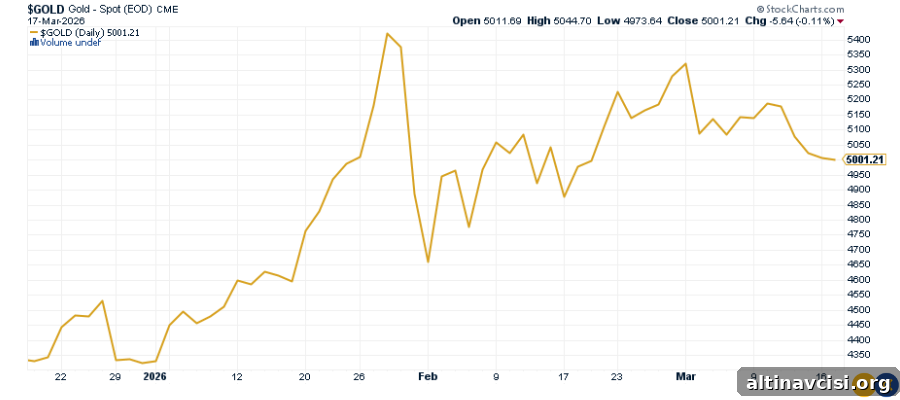
Gold has climbed nearly 15% since January and is now testing the $5,000 floor.
Source: StockCharts.com, data until March 17, 2026
Why Won’t Any U.S. Allies Help Reopen the Strait of Hormuz?
President Trump asked international partners to assist in securing the Strait of Hormuz; most declined. Major powers including China, France, Germany, Japan, Australia, and the United Kingdom have either explicitly said no or avoided joining a new naval coalition. Their reluctance is shaped by diplomatic, legal, and domestic constraints.
For several allies, the decision reflects more than politics. Some governments say they were not consulted before the conflict escalated, which makes immediate operational support politically hard to justify. Others face legal or constitutional limits on military deployment abroad. The result is the United States finding itself increasingly isolated in an operation it initiated without clear consensus.
This diplomatic isolation has market implications. Oil prices near $100 are signaling not only supply concerns but also waning confidence that the situation will be resolved quickly. When geopolitical risk is combined with limited international backing, energy markets and risk assets often respond with higher volatility — a dynamic that typically benefits safe-haven assets like gold.
The Edge Every Investor Needs
Smarter precious metals investing starts here. The Nuggets Newsletter delivers concise market insights, Fed updates, global trend analysis, and practical education for bullion investors.
Subscribe on our site for timely alerts and in-depth market commentary.
If Oil Stays at $100, What Does That Mean for Interest Rates?
The conflict in the Middle East has pushed crude toward the $100 mark, which complicates the Federal Reserve’s policy outlook for the year. With benchmark crude trading around the high $90s, markets are focused on the $100 threshold as a potential game-changer. Persistent oil above that level would intensify inflationary pressure and cloud the Fed’s path.
Before the shock, the internal Fed debate centered on how close rates were to neutral and when to begin cuts. Now that conversation has broadened: some officials still favor easing if inflation cools, while others are openly considering further tightening if energy-related inflation persists. That split increases policy uncertainty.
Historically, supply-driven oil shocks tend to slow economic growth by raising costs for households and businesses, though the impact on core inflation can be mixed. Forecasts vary, and officials have emphasized there are many moving parts, from labor market dynamics to demand resilience. Analysts warn that several months of oil at or above $100 could push the economy closer to recessionary conditions, presenting a no-win scenario for policymakers: cutting rates risks reigniting inflation, while holding or raising them risks tipping growth into contraction.
Gold occupies the center of this policy and growth tension. Rising inflation fears tend to support bullion, while a stronger dollar or higher Treasury yields — possible outcomes of tighter Fed language — can exert downward pressure. For investors, the core takeaway is that sustained oil strength amplifies uncertainty for both growth and inflation, and uncertainty is typically supportive for precious metals.
What Will the Fed Signal at 2PM Today — and Why Does It Matter?
The rate decision itself is widely expected to be a pause at 3.5%–3.75%. Where the market will look for direction is in Chair Powell’s remarks and the updated economic projections, including the dot plot. Investors will scrutinize tone and nuance: even subtle shifts in language can alter expectations for the timing and pace of future policy moves.
A hawkish tilt — signaling a greater willingness to defend against inflation — could lift the dollar and reduce some of gold’s near-term allure. Conversely, a cautious or growth-focused message would likely relieve pressure on precious metals. The Fed faces a difficult balancing act: act too soon and inflation might reaccelerate, delay too long and economic momentum could falter. In that context, the central bank’s communication is as important as its actions.
Market participants have learned that when central-bank messaging is unclear, volatility tends to rise. For gold investors, that uncertainty often creates opportunities as capital seeks hedges against policy and growth risks.
The U.S. Economy Outlook Looks Strong. So Why Are Economists Nervous?
On the surface, the U.S. economy heading into spring 2026 looks resilient: growth is positive, unemployment is low, and headline data remain intact. Yet many economists describe the expansion as “delicate” because underlying indicators are showing strain. Consumer spending is softening, households are dipping into savings and relying more on credit, and borrowing costs are increasingly constraining activity.
Housing markets remain subdued in many regions, business investment is cautious, and credit demand has softened. That combination suggests momentum could slow quickly if conditions deteriorate. The Federal Reserve is acutely aware of these dynamics, which helps explain why both cutting and holding rates carry risk.
Investors often look past surface-level strength and price in the friction beneath. When the gap between headline data and underlying fundamentals widens, market volatility and risk-seeking shifts are more likely. That environment typically benefits assets that shine during uncertainty, such as gold and, in some cases, silver.
Stay On Top of Gold & Silver Prices
Get important market alerts and concise analysis sent to your inbox.
To receive market alerts and timely analysis, subscribe on our website.
You May Also Like
- Gold Price Today Holds at $5,000 — What’s Driving It
- Gold and Silver Prices Today: Stagflation, the Fed, and What Comes Next
- Gold Supply Outlook: As Prices Rise, Producing Nations Want a Bigger Share
- Why Oil Is Surging and Gold Isn’t (Yet)
- Gold Price Rises as Iran War Escalates
Popular Topics
Picked from the archive
-
01
 Topics
Why Trump Cannot Fire Federal Reserve Chair Jerome Powell
-
02
Topics
Gold and Silver Outlook: Fed Moves, Inflation and Global Supply
-
03
Topics
How the Current Gold Rally Compares to Past Bull Markets
-
04
Topics
Invesco Quarterly Gold Report: Gold Performance Drivers
-
05
Topics
Dollar Surges After Strong Jobs Report, Fed Rate Cut Delayed
-
06
Topics
Gold Price Slides Today Amid War and US Debt Reaches 39 Trillion
-
07
Topics
Gold Rises 0.4% as Traders Weigh Mixed Fed Policy Signals
-
08
Topics
Oil Drops 12% as Iran-Israel Ceasefire Eases Supply Fears