JPMorgan Predicts $6,300 Gold Price After Historic Crash
Daily News Nuggets | Today’s top stories for gold and silver investors
February 2nd, 2026
Gold and Silver’s Historic Crash
Gold and silver experienced their sharpest declines in decades this week. Gold dropped below $5,000 on Friday — roughly $1,000 below Thursday’s record near $5,600. Silver recorded a steep one-day drop of about 31%, the largest single-session fall since 1980.
The immediate catalyst was President Trump’s nomination of Kevin Warsh for Federal Reserve chair. Warsh’s hawkish reputation eased investor concerns about central-bank independence and pushed the U.S. dollar higher, prompting widespread profit-taking after a parabolic run in both metals. That run had been extraordinary: gold surged roughly 66% in 2025 and silver rose about 135% during the same period.
Beyond the nomination, many analysts had warned that the rally was overstretched. Technical indicators signaled overbought conditions, volatility spiked, and liquidity evaporated. Banks reduced market-making activity, margin calls forced leveraged positions to unwind, and a crowded trade reversed quickly once market conditions turned.
Despite the violent selloff, both metals remain higher year-to-date: gold is still up around 8% and silver about 16% for the year. The longer-term drivers — geopolitical tension, concerns about fiat currencies, and rising debt levels — remain in place. But what exactly set off the cascade of selling?

The Edge Every Investor Needs
Smarter precious metals investing starts here. The Nuggets Newsletter delivers market insights, Fed updates, macro trends, educational videos, and practical analysis for gold and silver investors.
Subscribe to the Nuggets Newsletter for concise, timely coverage of gold and silver markets.
China’s Speculative Frenzy Fueled the Metals Crash
Chinese retail investors, equity funds, and trend-following algorithms were central to the metals’ ascent and its sudden reversal. Reports described a wave of hot money from China that drove buying into both gold and silver, echoing the retail-driven scenes of 1979–1980 when consumers queued for bullion.
Silver’s relatively small market amplified the moves. Annual supply flows for silver are much smaller than for gold — the market size differences made price swings more extreme. On Friday, the iShares Silver Trust traded more than $40 billion in volume, a level comparable to large equity ETFs. Options and leveraged positions added fuel to the rally, and some retail traders posted outsized gains during the run-up.
When the dollar rallied on the Fed-news pivot, Chinese participants began taking profits instead of adding exposure. The result was a violent unwind: one-day losses in silver topped 30% for some measures and intraday volatility pushed prices sharply lower. Market strategists called January 2026 one of the most volatile months in precious metals history.
January 2026 Returns — Gold and Silver
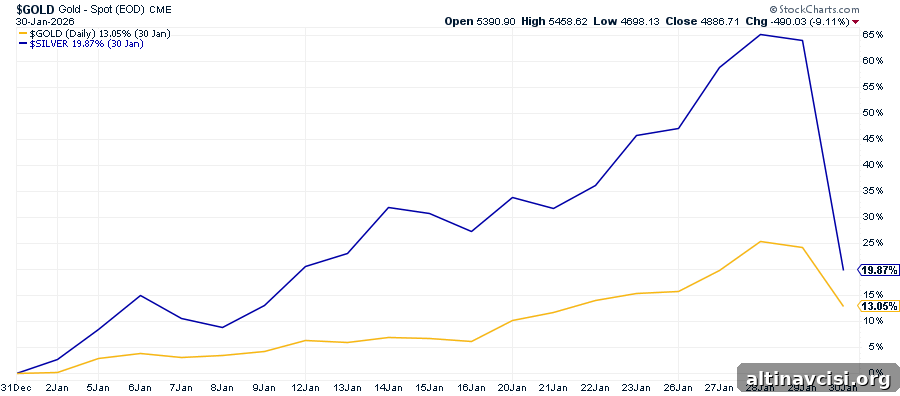
Despite the turmoil, a significant portion of investors viewed the selloff as a buying opportunity rather than a signal to exit the sector completely.
Singaporeans Queue to Buy Gold Despite the Crash
While prices sank in New York, retail demand in Asia held firm. Customers queued at United Overseas Bank’s headquarters to buy physical bullion even as prices fell — a sign of persistent retail appetite. UOB reported large increases in gold savings account activity and physical sales through late 2025, reflecting a broader regional preference for tangible assets amid currency and market uncertainty.
This pattern—Western traders reducing exposure while Asian retail and private buyers step in—caught the attention of major banks and dealers, who noted the divergence in sentiment across regions.
JP Morgan Sees Gold at $6,300 Despite the Crash
Major banks see the selloff as a corrective shakeout rather than a reversal of fundamentals. Hours after gold’s worst single day since 1983, JP Morgan raised its year-end target to $6,300 per ounce, arguing that central-bank buying and reserve diversification will support prices over the medium term. The bank forecasts substantial official-sector purchases in 2026 and framed gold as a strategic reserve asset rather than a speculative play.
Deutsche Bank also reiterated a bullish stance, maintaining a $6,000 target despite the sharp pullback. Both institutions emphasized that the recent volatility primarily removed leveraged, speculative positions and left the underlying demand picture intact.
Morgan Stanley Breaks With 60/40, Recommends 20% Gold
Morgan Stanley’s Chief Investment Officer Mike Wilson recommended a notable shift in portfolio construction: a 60/20/20 allocation of stocks, bonds, and gold — replacing the traditional 60/40 blueprint. Wilson argues that bonds no longer reliably hedge equity risk and that gold has shown resilience when both stocks and bonds face stress.
The bank treats gold as portfolio infrastructure, not a speculative add-on. In scenarios where growth falters and real rates decline, gold can protect purchasing power while equities benefit from expansion. The recommendation follows a visible shift in official reserves: for the first time since 1996, many central banks hold more gold than U.S. Treasuries, a development that supports the view of enduring strategic demand for bullion.
You May Also Like
- Gold’s Week: $9T Swing, Trump’s Fed Pick, and Record Premiums
- Gold Breaks $5,500 as Metals Rally Accelerates
- Gold Passes $5,300 as Fed Meets, Dollar Craters
- Why Gold Just Hit $5,100 and Where It’s Headed Next
- Gold Breaks $5,000 as Bond Markets Crack
- Gold Price Eyes $5,000, Silver Nears $100
Popular Topics
Picked from the archive
-
01
 Topics
Gold Price Could Reach USD 5,000 by 2026: Institutional Forecast
-
02
Topics
Silver Squeeze Pushes Silver Prices Above $51
-
03
Topics
Gold Rises as Bitcoin Slips and Bubble Fears Grow
-
04
Topics
Bessent Urges 1.5% Rate Cut, Boosting Gold Prices
-
05
Topics
Tariff Deadline Fears Push Gold Prices Up as Other Metals Slide
-
06
Topics
Gold Fields Urges Major Miners to Boost Gold Exploration
-
07
Topics
Tech Giants Drive 90% of Earnings Growth Despite Trade War Fears
-
08
Topics
Brazil Threatens Retaliation After Trump Imposes 50% Tariff