ISM Index Barely Moves While Underlying Gauge Surges

Gold is trading in a narrow, frustrating range this morning, pinned near $4,166 per ounce on the live gold price chart. It remains shut out of the $4,200 area after a rejection on Wednesday. Silver is steadier, trading around $60.67 on the silver price chart. When the morning’s main economic release arrived, neither metal moved much. That apparent calm masks an important detail many traders overlooked: the headline number was less relevant to market direction than one internal gauge that actually moved a lot.
What Did Today’s ISM Report Actually Show?
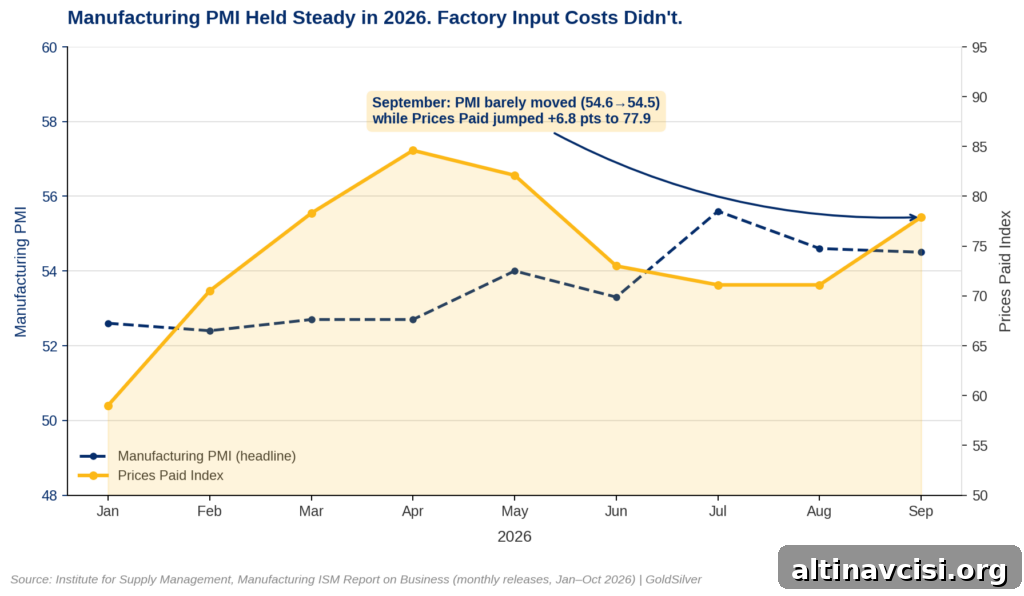
The Institute for Supply Management’s Manufacturing PMI slipped to 54.5 in September, down marginally from August’s 54.6 and below the 55.0 economists had expected. On the surface that reads as steady expansion—manufacturing is still growing, just a touch slower than forecasts suggested. New orders improved, rising to 55.3 from 53.7, and supplier deliveries eased slightly. Taken alone, the headline PMI isn’t alarming and would typically be interpreted as a modest sign of cooling growth.
The Edge Every Investor Needs
Smarter precious metals investing starts here. The Nuggets Newsletter delivers market insight, Fed updates, global trends, and timely education for investors.
Why Does the Prices Paid Number Matter More Than the Headline?
Hidden inside the ISM release is the gauge that should have triggered a bigger market response: the Prices Paid index jumped to 77.9, up from 71.1 in August. This index measures what manufacturers are paying for raw materials and inputs. A one-month jump of this size signals pressure at the factory gate — a clear indicator of pipeline inflation rather than a random blip. This reading lines up with other evidence: earlier in the month, S&P Global’s flash Composite PMI showed input costs accelerating at the fastest pace in four years. Two independent surveys, separated by a few weeks, are pointing in the same direction: input-cost inflation is building even while headline growth appears only modest.
How Is Gold Reacting Right Now?
So far, gold’s reaction has been muted. That makes sense when you separate the headline PMI from the inflation signal buried inside the report. A softer headline PMI would normally help gold because slower growth suggests the Federal Reserve could ease policy sooner. At the same time, stronger input-cost inflation works against gold by giving the Fed reason to keep nominal rates higher for longer. Right now those forces are roughly offsetting each other.
Other market variables reinforce the headwind for gold. The 10‑year Treasury yield is near 5.34%, a level not seen since 2002, and the dollar index is close to a year-to-date high near 101.85. Higher nominal yields and a firmer dollar raise real yields or at least sustain them at elevated levels, which makes it harder for gold to break above $4,200. That combination — stronger yields plus a stronger dollar — has been the key drag on gold this week, not the headline PMI alone.
What’s the Mechanism Connecting Factory Inflation to Gold’s Real-Yield Math?
The Prices Paid surge matters to gold because gold is a non-yielding asset whose appeal depends on real yields: nominal Treasury rates minus expected inflation. When expected inflation rises, real yields tend to fall, supporting gold. But if rising input inflation convinces the Fed to hold or raise nominal rates, that keeps real yields elevated or prevents them from falling. Market lore suggests a 25-basis-point move in real yields typically moves gold by roughly $40 to $60 per ounce — a useful rule of thumb when weighing these opposing forces.
The Federal Reserve is already in play. It lifted its target range to 3.75%–4.00% on September 16 — the first hike since 2023 — and policymakers’ median projections still point to another move by year-end. With a second inflation signal arriving weeks after the first, the data could keep the path to additional hikes open. Silver is exposed to these same dynamics but carries extra sensitivity to industrial demand, so its price may follow both the inflation and growth narratives.
What Happens Next?
The next major test is the September employment report due Friday. A strong payrolls print combined with today’s Prices Paid spike would strengthen the case for additional Fed tightening, likely keeping yields and the dollar high and capping gold. Conversely, a softer jobs report would complicate the hawkish narrative and give gold more upside potential. The broader takeaway is that headline indicators and the internal inflation measures that really move metal prices aren’t always the same. Traders should watch the gap between those readings each month, because that divergence often signals where gold and silver are heading.
Stay On Top of Gold & Silver Prices
Get important market alerts sent straight to your inbox.
SOURCES
1. Reuters via Investing.com — US manufacturing steady in September, input prices increase
2. FXStreet — Gold struggles as rising US Treasury yields outweigh dovish Fed repricing
3. Yahoo Finance — Gold price today, October 1, 2026
4. U.S. Bureau of Economic Analysis — Personal Income and Outlays, August 2026
5. Investing.com — Jobless claims, manufacturing PMI, and ISM data due Thursday
Disclaimer: This article is for informational purposes only and does not constitute investment advice. Past performance is not indicative of future results. Always consult a qualified financial advisor before making investment decisions.
You May Also Like:
- Morgan Stanley Just Named Gold’s Floor. Here’s the Number.
- Gold Steadies Near $4,180. A GDP Upgrade Just Undercut the Inflation Miss.
- BlackRock Called It a Supercycle Today. The Mines and Vaults Already Agree.
- Gold Jumps as Core PCE Cools More Than Expected, Overshadowing the ADP Jobs Beat
- Job Openings Missed Today. That’s Exactly Why Gold Caught a Bid.
- Gold Fell Again. Five Wall Street Desks Can’t Agree on Why.
- Gold Just Hit a Two-Month Low. Yields, Not Iran, Are Why.
- Gold’s 7-Week Low: What the Chart Says Happens Next
- Gold Sank 4% Today. Five Other Signals Point to a Steadier Market Underneath.
Popular Topics
Picked from the archive
-
01
 Topics
Why Investors Choose the Vienna Philharmonic Gold Coin
-
02
Topics
Stablecoin Issuer Outspent Central Banks on Gold Last Year
-
03
Topics
Why Gold Prices Are Falling Amid the Oil War
-
04
Topics
How to Buy Gold in 2026: Step-by-Step Guide for Beginners
-
05
Topics
Silver Appears Weak, Silver-to-Gold Ratio Signals Accumulation
-
06
Topics
Why Gold Prices Are Falling: What Most Investors Get Wrong
-
07
Topics
Should You Still Hold Gold in Your Portfolio?
-
08
Topics
Gold Bars vs Jewelry: Why Investors Choose Bullion