
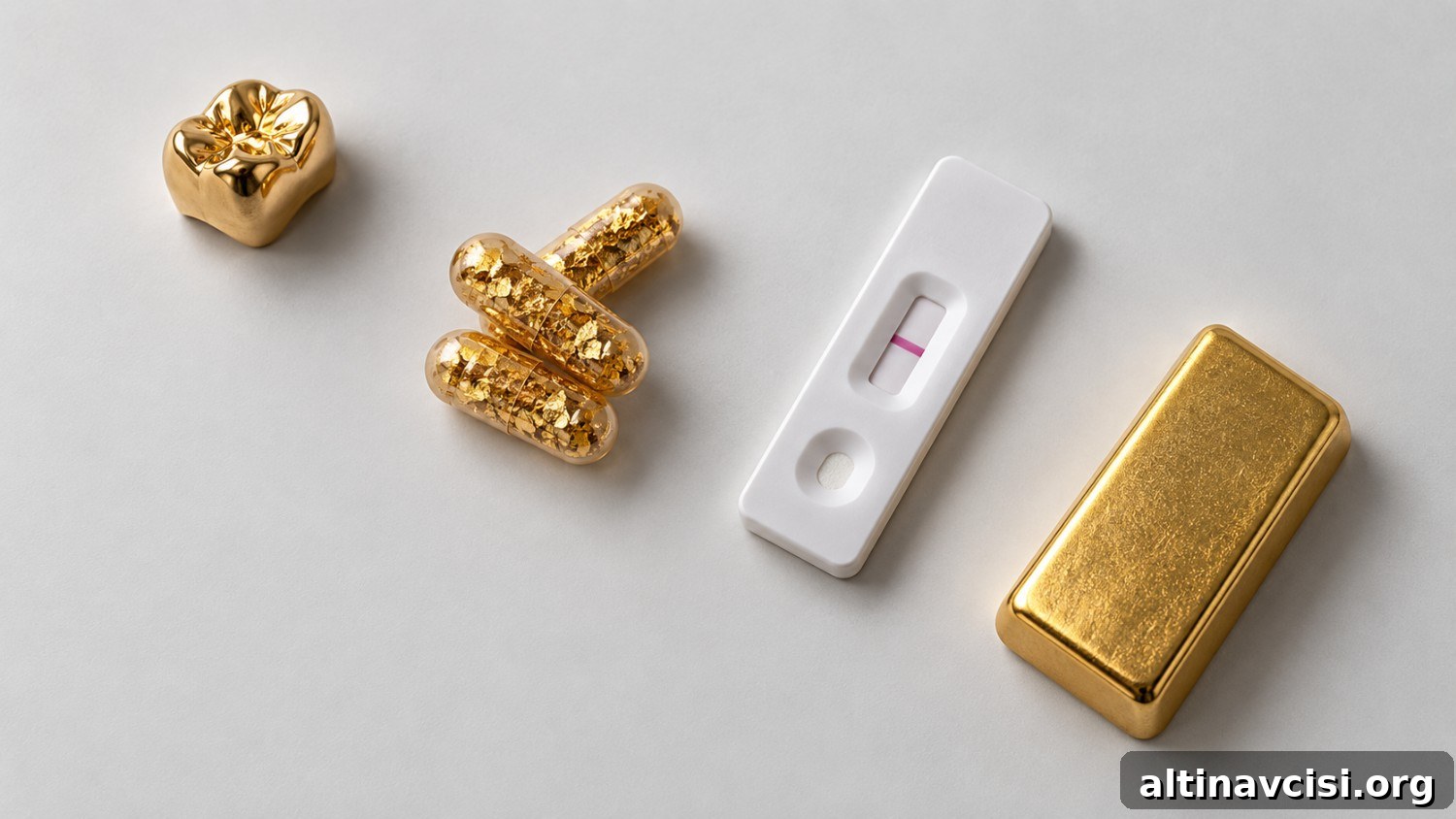
Gold’s role in medicine extends far beyond ornamentation. For over a century dentists have cast gold into crowns and fillings. Surgeons have implanted a radioactive isotope of gold into tumors for targeted radiation treatments. Rheumatologists still prescribe an oral gold compound for certain cases of arthritis. And millions of people see gold at work every week in the form of gold nanoparticles that make the line appear on pregnancy tests and many rapid antigen tests. These are documented, practical medical uses that stem from gold’s chemical stability, its low reactivity inside the body, and its ability to bind with other molecules.
Key Takeaways
- Dental gold alloys have been used since the late 1800s because they resist corrosion and wear at a rate similar to natural tooth enamel.
- Gold-198 is a radioactive isotope used in brachytherapy; it has a half-life of roughly 2.7 days and has been implanted into tumors since the 1960s.
- Auranofin, an oral gold compound, has treated rheumatoid arthritis for decades and is under investigation for potential anticancer activity.
- Gold nanoparticles are the visible signal in many lateral flow diagnostics, including pregnancy and COVID-19 antigen tests.
- Medical and dental uses account for only a small fraction of global gold demand and have little influence on gold’s investment value.
Why Is Gold Used in Dentistry?
Gold has a long dental history. Archaeological finds show ancient civilizations using gold in early dental repairs, and modern dental use solidified in the late 19th century when dentists began casting gold into crowns and inlays. The choice is practical: pure gold is too soft for chewing, so dentists use alloys that combine 60–78% gold with other metals such as palladium or copper. These alloys wear at almost the same rate as enamel on the opposing tooth, reducing the chance of excessive wear on natural teeth the way harder materials can.
Gold alloys also resist acids and the corrosive environment of the mouth better than many base metals. A well-made gold crown can last decades—commonly 15 to 30 years—when properly cared for. While advances in ceramic and composite materials have reduced gold’s visibility in modern dental practice, many clinicians still prefer gold for back molars and for patients who grind their teeth because of its durability and forgiving wear characteristics.
How Is Gold Used in Surgery and Medical Implants?
One of gold’s most important surgical uses is in brachytherapy, a form of internal radiation therapy. In this approach, a radioactive source is placed inside or next to a tumor to deliver a concentrated dose of radiation with limited exposure to surrounding healthy tissue. Surgeons began implanting gold-198 seeds into prostate tumors in the mid-1960s. Gold-198 decays with a relatively short half-life and emits radiation that treats the tumor from within, making it a useful option for certain cancer cases.
Beyond radioactive seeds, gold appears in other surgical and implant applications because of its conductivity and corrosion resistance. It is used in circuitry for pacemakers and defibrillators and as tiny markers that show up on X-rays to identify the position of stents or other devices. Not every experimental use has succeeded: for example, early attempts to coat coronary stents with gold increased the risk of re-narrowing in some trials, which curtailed that approach. Still, gold remains valuable where long-term stability and biocompatibility are required.
What Is Gold Used for in Pharmaceutical Treatments?
Gold compounds have a long record in treating inflammatory conditions. Chrysotherapy—treatment with gold compounds—began in the early 20th century. The oral drug auranofin became available in the 1980s and has been used for rheumatoid arthritis. It has fewer discontinuations from side effects than some earlier injectable gold therapies.
More recently, researchers have explored auranofin for oncology because it inhibits thioredoxin reductase, an enzyme involved in cancer cell survival. Laboratory studies have reported activity against several tumor types, and clinical research continues. However, auranofin is not a standard cancer cure today; it remains under investigation and any off-label or experimental use should only occur under medical supervision and within clinical trials.
How Do Gold Nanoparticles Work in Medical Diagnostics?
Gold nanoparticles are the visible engine behind many lateral flow assays, the paper-strip tests used for pregnancy detection and rapid infectious disease screening. Manufacturers attach antibodies to gold nanoparticles; when a sample contains the target molecule—such as a hormone or viral antigen—the particles bind and aggregate on the test strip, producing a colored line visible to the naked eye. This method requires no electricity or complex instruments and is robust, inexpensive, and easy to use at home or in low-resource settings.
Gold is well suited for this role because it is chemically stable and retains its optical properties over time. That stability ensures that the test provides a clear, reliable visual signal rather than degrading before a result appears. The scalability and reliability of gold-based lateral flow assays helped diagnostics expand rapidly during recent public health events and they remain the default choice for many point-of-care tests.
Does Gold in Medicine Affect Its Value as an Investment?
While the medical uses of gold are important, they represent only a small portion of global demand. For context, dentistry consumed a few tonnes in a recent year while total annual demand for gold numbered in the thousands of tonnes. Industrial and medical applications together account for a modest percentage of total demand; the dominant drivers are jewelry, investment, and central bank reserves.
As a result, medical and dental consumption does not materially influence gold’s market value. Instead, gold’s price responds to macroeconomic factors such as real interest rates, currency strength, and investor confidence. What the medical uses do demonstrate is gold’s enduring chemical stability and biocompatibility—qualities that explain both its practical role in medicine and its longstanding appeal as a store of value.
The Knowledge That Changes Everything

Two essential guides — yours free. Understand why gold matters and why fiat currencies face recurring challenges.
Stay On Top of Gold & Silver Prices
Get important market alerts sent straight to your inbox.
People Also Ask
Yes, in the specific forms used clinically. Dental alloys and approved drugs such as auranofin have long records of medical use. Any gold-based therapy should be prescribed and managed by a licensed health professional.
Gold alloys wear similarly to natural enamel and resist corrosion, protecting opposing teeth. They often cost more up front but can outlast less costly alternatives.
Yes. Radioactive gold-198 seeds have been implanted into tumors for targeted brachytherapy, and gold-containing drugs like auranofin are under research for anticancer activity.
Only a trace amount—typically measured in nanograms—but that tiny quantity of gold nanoparticles produces the visible line that signals a positive test.
SOURCES
1. World Gold Council — Gold Demand Trends Full Year 2025
2. Wikipedia — Gold Teeth, sourced to contemporary references
3. Wikipedia — Crown (dental restoration)
4. Garfield Refining — The History of Dental Gold
5. Baylor College of Medicine — clinical records of seed implantation
6. Journal of Contemporary Brachytherapy — studies on Au-198 dosimetry
7. Brazilian Journal of Radiation Sciences — work on gold nanoparticles for radiotherapy
8. Cleveland Clinic Journal of Medicine — oral chrysotherapy and auranofin reviews
9. PMC — reviews of auranofin in oncology research
10. PMC / Nature Scientific Reports — studies of gold nanoparticle lateral flow assays
11. Circulation / American Journal of Cardiology — randomized trials on gold-coated stents
12. U.S. Geological Survey — metals and minerals in medical implants
Disclaimer: This article is for informational purposes only and does not constitute investment or medical advice. Always consult qualified professionals for investment or healthcare decisions.
You May Also Like:
- What Is Gold Backwardation? The Rare Signal That Struck 3 Times in 2025
- A Bank Just Said the Fed Isn’t Done Hiking. Here’s the Math on What That Does to Gold.
- Gold Fell 23% This Year. One Number Explains Why.
- What Is the Debt-to-GDP Ratio, and What the US Number Tells You About Gold
- The World’s Last Zero-Rate Anchor Is Rising, and Gold Should Care
- What Is a FOMC Meeting? What the Fed Decides and How Gold Reacts
- Gold in Your Phone: How Much Gold Is in Electronics and What It Means for Demand
- Real Yields vs. Nominal Rates: The Number That Actually Moves Gold