Gold-Silver Ratio Signal: Why Silver’s Lead Matters
Gold and silver market update — April 22, 2026
Key Takeaways
- The gold-silver ratio signal cuts both ways. When silver outperforms gold, it indicates that both industrial demand and safe-haven demand are active — a combination that has historically preceded sustained momentum in precious metals.
- The supply deficit is structural, not cyclical. The Silver Institute projects a sixth consecutive annual deficit in 2026, with about 762 million troy ounces drawn from above-ground stocks since 2021. Physical silver is becoming harder to source while the buyer base expands.
- Silver’s 34–35% discount from its all-time high sits against a tightening market. The Fed is on hold, real returns on cash are negative, and industrial demand from solar and AI continues to rise. Short-term price moves reflect geopolitical noise, but the underlying fundamentals remain intact.
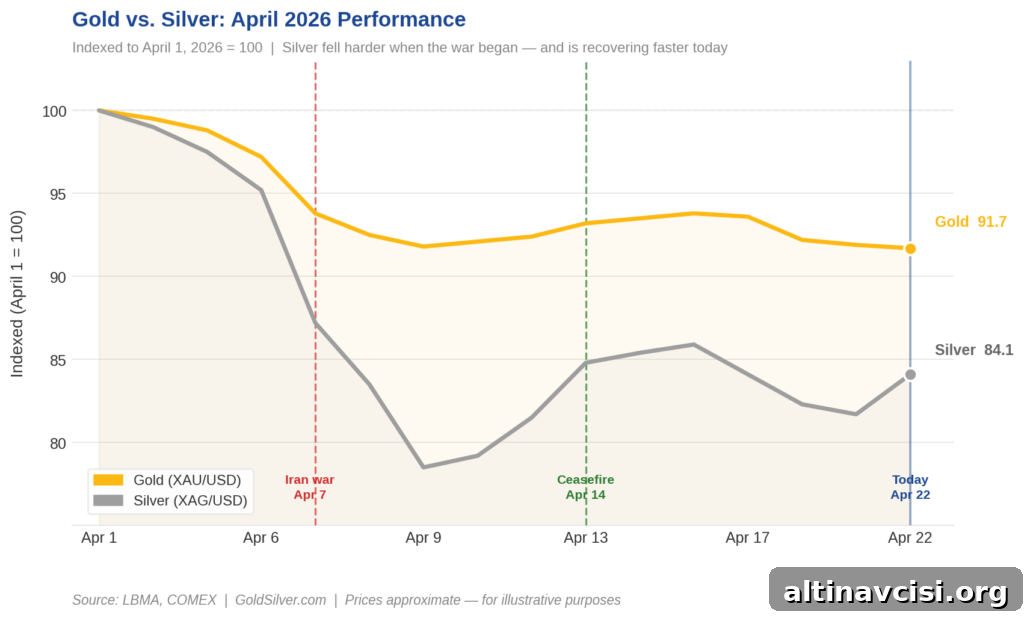
Silver is up more than 2% this morning while gold is up about 1%. That relative strength is meaningful: it shows the market pricing two stories at once — one safe-haven driven, the other industrially driven. For the first time in weeks, both forces are pushing prices in the same direction.
Gold is trading near $4,770 per ounce early Wednesday ET, recovering from Tuesday’s sell-off after news of an extended US-Iran ceasefire. Silver is trading around $79–$80 per ounce — roughly twice gold’s percentage gain on the same headline.
When silver outperforms gold, it’s a specific signal that many investors overlook.
What Does the Gold-Silver Ratio Actually Signal?
The gold-silver ratio measures how many ounces of silver are required to buy one ounce of gold. It’s one of the oldest indicators in the precious metals market and is frequently misinterpreted.
When gold outperforms silver, investors are typically rotating toward pure monetary safety. When silver outperforms gold, the safe-haven bid remains active while industrial demand is also being priced in. That latter scenario is rarer and often more consequential.
Today fits that second pattern.
Silver serves two roles that gold does not. According to the Silver Institute’s World Silver Survey 2025, industrial demand accounts for roughly 58% of annual silver consumption — notably for solar panels, electronics, AI data center components, and medical devices. This industrial demand is structural rather than cyclical.
The supply side reinforces the story. The Silver Institute’s World Silver Survey 2026 (released April 15, 2026) projects a sixth straight annual supply deficit — a shortfall of 46.3 million troy ounces, up 15% from the prior year. Since 2021, global above-ground silver stocks have been reduced by approximately 762 million troy ounces, roughly equivalent to one year of global mine production. Supply has not caught up with demand and shows little sign of doing so.
So when silver rises 2% in an environment of eased geopolitical risks — a ceasefire extension combined with persistent supply tightness — the market is effectively buying both the safe-haven and the recovery narratives. That overlap is uncommon and often meaningful for future price action.
The Edge Every Investor Needs
Smarter precious metals investing starts here. The Nuggets Newsletter delivers essential market insight, Fed updates, global trends, educational videos, and more.
Subscribe to the Nuggets Newsletter for timely market alerts and analysis.
Why Did Silver Fall So Much Harder Than Gold?
Silver reached an all-time high near $121.60 per ounce on January 29, 2026. Since the US-Iran conflict escalated on February 28, silver has retreated more than 15%, while gold has fallen roughly 8–10% over the same period.
The divergence is not random. Silver reacts to two demand drivers: monetary demand and industrial demand. Monetary demand supports silver when inflation rises or confidence in fiat currencies erodes. Industrial demand — the roughly 58% share noted by the Silver Institute — weakens when economic growth expectations slip. When the Iran conflict began, silver was hit by both weaker industrial outlooks and monetary pressure, whereas gold, driven largely by monetary forces, held up better.
The conflict pushed oil prices toward $90 per barrel, heightening inflation fears and damping hopes for rate cuts, which in turn weighed on growth expectations. That sequence caused silver’s industrial outlook to deteriorate quickly in addition to the monetary pressures affecting gold.
Today’s price action suggests some of that pressure is easing. The president’s open-ended ceasefire extension, contingent on a unified Iranian proposal, reduced immediate re-escalation risk. That relief drew buyers back into silver, marking the fourth consecutive week of gains.
Is China’s Silver Demand a Short-Term Trade or a Long-Term Structural Story?
It is structural. China’s silver demand is driven in large part by its clean-energy buildout: silver is a key component in photovoltaic cells and other solar technologies, and China has among the largest solar manufacturing capacities in the world.
The Silver Institute’s World Silver Survey 2025 recorded the largest year-on-year manufacturing demand increase for silver in China during 2024, up roughly 7%. That expansion appears set to continue, even as global supply has lagged demand for several years.
As a result, physical silver is becoming scarcer while the number of buyers keeps growing.
At $79–$80, Is Silver Cheap Relative to Its Fundamentals?
Many financial reports will label this morning’s move a commodity bounce tied to geopolitical relief. That interpretation is correct but incomplete.
Silver is both an industrial metal and a form of sound money — a tangible asset that has preserved value across millennia. Trading at $79–$80, silver sits roughly 34–35% below its January 2026 peak, while the market faces a sixth consecutive annual supply deficit, a cumulative above-ground stock drawdown of about 762 million troy ounces since 2021, and rising demand from clean energy and AI applications.
The broader monetary backdrop strengthens the case for holding silver. The Federal Reserve has paused rate hikes with policy rates near 3.50–3.75%. With oil-driven inflation still a factor, the Fed’s ability to cut is constrained and real yields on cash remain negative. That dynamic lowers the opportunity cost of holding a non-yielding asset like silver while supporting its long-term appeal.
Stay On Top of Gold & Silver Prices
Get important market alerts sent straight to your inbox.
Real-time price ticker is available to subscribers. Sign up for alerts.
Enter your email on the site to receive market alerts and commentary.
SOURCES
1. LBMA — Precious Metal Prices
2. LBMA — Precious Metals Market Report: Q1 2026
3. Trading Economics — Silver Commodity Data
4. Silver Institute — Silver Supply & Demand (World Silver Survey 2025)
5. Silver Institute — World Silver Survey 2026 (April 15, 2026)
6. Silver Institute — Silver Industrial Demand Reached a Record 680.5 Moz in 2024
7. Federal Reserve — FOMC Statement, March 18, 2026
8. CME Group — NYMEX WTI Crude Oil Futures
By the GoldSilver Editorial Team — helping investors understand sound money since 2005. This article is for informational purposes only and does not constitute financial, investment, or tax advice. Always consult a qualified financial advisor before making investment decisions.
You May Also Like:
- Gold Drops to $4,681 — Iran Ceasefire Expires Today
- The Real Reason Gold Is Down During an Oil War
- What the Warsh Hearing Means for Gold Prices
- IMF Says Treasuries Aren’t Safe Anymore. Gold Noticed First.
- Gold Price After Ceasefire Violation: The Floor Has Moved
- Oil Crashed 11%. Gold Went Up. That Tells You Everything.
- $1 Trillion in Debt Interest Is Why Gold Keeps Climbing
- 5 Signals That Say Gold’s Bull Case Just Got Stronger
Popular Topics
Picked from the archive
-
01
 Topics
How Gold Prices Move During a US Dollar Crash
-
02
Topics
BEA Removed Silver From GDP: What It Means
-
03
Topics
Gold Prices Slip as Kremlin Hints at Ukraine De-escalation
-
04
Topics
Silver Price Tops $50 for First Time Since 1980
-
05
Topics
Gold and Silver Prices Jump Amid Strait of Hormuz Tensions
-
06
Topics
Gold Prices Up 21%, Silver 25% YTD Amid AI and Inflation Fears
-
07
Topics
War Risk and Stagflation Signal a 6,300 Gold Price Target
-
08
Topics
Gold Fields Urges Major Miners to Boost Gold Exploration