Gold ETF Inflows Top 2 Billion as Silver Investors Exit

Gold exchange-traded funds attracted roughly $2 billion over the past week, while the largest silver ETF experienced a modest outflow. Those opposing flows occurred even as gold’s spot price moved slightly lower and silver held up better. That divergence is worth unpacking because it challenges the simple narrative many investors use when thinking about precious metals.
What Do This Week’s Gold and Silver ETF Flows Actually Show?
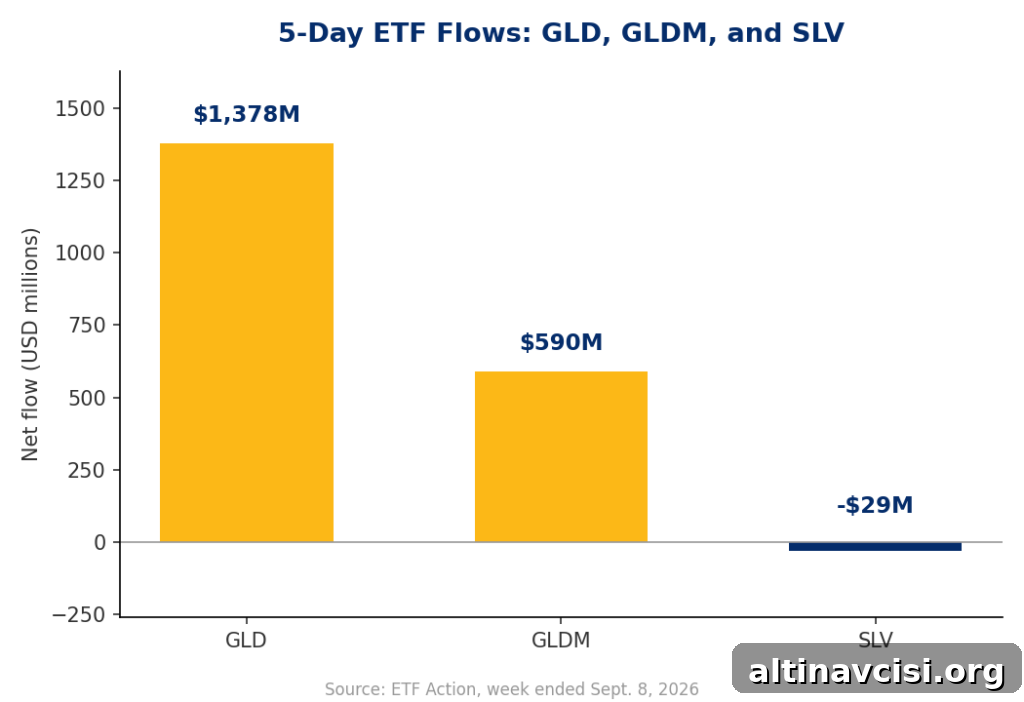
The two largest SPDR gold funds — SPDR Gold Shares (GLD) and SPDR Gold MiniShares (GLDM) — were the primary drivers of the inflows. GLD added about $1,378 million over five trading days and GLDM added roughly $590 million, combining for nearly $2 billion. That sum accounted for the vast majority of net inflows into the broader focused-precious-metals ETF group during that week.
By contrast, the iShares Silver Trust (SLV), the largest silver ETF, recorded a small outflow of about $29 million over the same five days. While the dollar amount is modest compared with GLD’s intake, the direction is notable: investors were net buyers of gold exposure through ETFs at the same time they were modest sellers of the largest silver ETF.
Why Does It Matter That Gold Rose in Flows While Its Price Fell?
This is where the story departs from a simple price-chasing explanation. The focused-precious-metals ETF category, which includes GLD, GLDM, SLV and other similar funds, actually saw a slight price decline for the week. In other words, the net inflows into gold ETFs were not the product of momentum chasing a rising market. Instead, investors were adding exposure while prices were flat to slightly lower.
That distinction matters. Buying into weakness tends to signal conviction: investors are adding or initiating positions because they believe in the underlying case for the asset, not simply because they are trying to hop on a rally. When flows align with falling prices, it suggests demand driven by conviction rather than pure momentum.
Is a Silver ETF Outflow Actually Bearish for Silver?
Not necessarily, especially at this size and over a single week. A $29 million redemption in SLV is small relative to the fund’s total assets and can represent routine portfolio adjustments or profit-taking after a recent run. One week of flows is a single data point — useful for color, but not definitive.
What the split does show is a divergence in how paper investors treated the two metals during the period: gold ETF buyers added exposure into a soft tape, while silver ETF holders trimmed into relative strength. That difference reflects behavior at the margin and highlights that gold and silver, despite often moving together, can attract distinct investor motivations at any given moment.
Does a Week of ETF Flows Predict Where Gold or Silver Go Next?
No. Short-term ETF flows are often tactical and highly responsive to headlines, portfolio rebalances, or one-off trades. In contrast, other sources of demand — such as central bank buying — operate on a much longer horizon and provide structural support. This week’s GLD-versus-SLV split is meaningful as a snapshot of investor behavior, but it is not a forecast that settles price direction on its own.
What Is the Difference Between Owning a Gold ETF and Owning Physical Gold?
ETF flow figures are commonly referenced as a proxy for demand for physical metal, but the two are not identical. Major gold ETFs such as GLD and GLDM hold physical bullion in vaults, and share creation/redemption mechanisms link flows to actual transactions in the metal. However, owning shares of an ETF is not the same as owning allocated, segregated bullion in your name. ETF holders own a security backed by metal, which is convenient for trading and portfolio exposure, while direct ownership of physical bars or coins means different custody, liquidity and delivery characteristics.
Because of that difference, the behavior of paper investors in ETFs is informative about market sentiment among a particular investor class, but it does not directly describe what private bullion owners or central banks are doing. The week’s inflows into gold ETFs indicate conviction among fund buyers comfortable with share-based exposure; they do not, on their own, settle the future path of prices for gold or silver.
Stay On Top of Gold & Silver Prices
Receive concise market alerts and essential updates delivered to your inbox.
SOURCES
1. ETF Action — weekly ETF flows summary (Sept. 8, 2026)
2. ETF Database citing Goldman Sachs — research on gold allocations (March 2026)
3. GoldSilver — live spot price data and charts
Disclaimer: This article is for informational purposes only and does not constitute investment advice. Past performance is not indicative of future results. Always consult a qualified financial advisor before making investment decisions.
You May Also Like:
- Gold/Silver Ratio September 2026: What a 12-Week Round Trip Is Telling Holders
- Gold Is Falling Today. Four Other Signals Say the Hard-Assets Trade Isn’t.
- Gold Is Falling for a Reason Most Investors Have Backwards
- Even Central Banks Don’t Trust Someone Else’s Vault Anymore
- Gold’s Dip Below $4,400 Didn’t Scare Wall Street. Here’s Why.
- China Just Broke Its Own Gold-Buying Record. Then Broke It Again.
- The BLS Revised April Up 64,000, Then Down 31,000. Gold Traded the First Print.
Popular Topics
Picked from the archive
-
01
 Topics
Gold Flat, Silver Down 2.3%: Gold-Silver Ratio Signals Tomorrow
-
02
Topics
How Gold Prices Are Determined: East-West Market Forces
-
03
Topics
Why Hong Kong? Inside GoldSilver’s Offshore Gold Storage Network
-
04
Topics
Federal Reserve Votes Wednesday: Track the Vote Tally
-
05
Topics
Canadian Gold Maple Leaf: Purity, Low Premiums, IRA-Ready
-
06
Topics
Gold Needed One Catalyst to Break $4,400 – It Just Got Five
-
07
Topics
Gold +3%, Silver +4.7%: 5 Drivers Behind Today’s Metals Rally
-
08
Topics
Silver Price Drops 7% After No-Deal at Trump-Xi Summit