
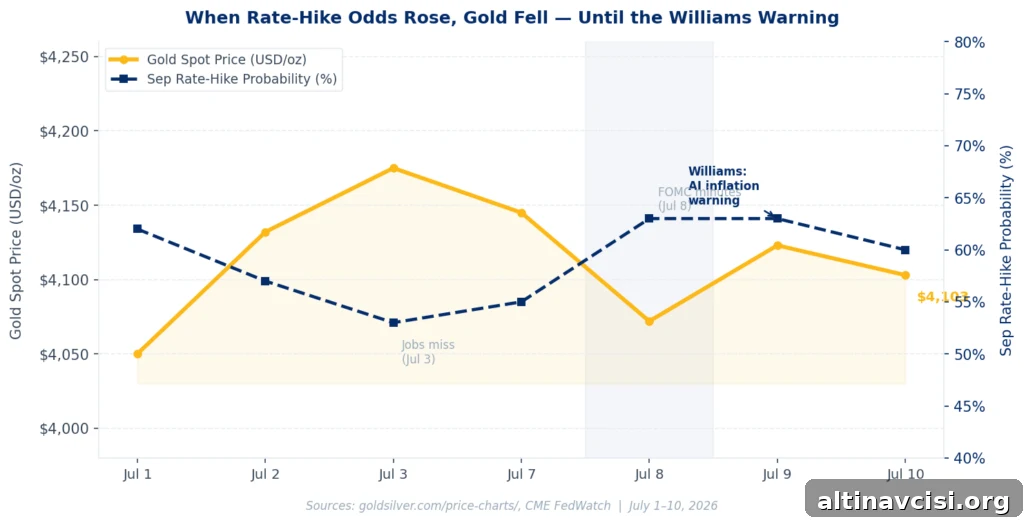
Gold is trading near $4,103 an ounce today, down roughly half a percent on the day and about 1.2% on the week. Much of the mainstream financial press is framing recent moves through a tech-sector lens: New York Federal Reserve President John Williams said on Thursday that demand driven by artificial intelligence is now his single biggest inflation concern. Wall Street interpreted that primarily as bad news for chipmakers such as Nvidia. For gold investors, however, Williams’s comments point to something broader: the Federal Reserve’s inflation challenge now contains a structural element that traditional explanations like tariffs and energy prices do not fully capture.
What Did the Fed’s Williams Actually Say About AI and Inflation?
Williams spoke at a Federal Reserve workshop on market liquidity in New York on July 9, 2026. He said that among the various drivers of U.S. inflation, demand generated by artificial intelligence is the issue he watches most closely. He warned that if AI-related demand produces a “sustained impulse to demand relative to supply,” the Fed would need to respond.
He also noted that core goods inflation had risen in part because of what the June FOMC minutes described as “AI-related pricing pressures.” Williams provided a concrete benchmark: if core PCE runs above 0.2% per month in the second half of 2026, he would treat that as evidence inflation is more persistent than his baseline expects. Core PCE is currently well above the Fed’s 2% goal, reinforcing the urgency behind his comments.

The Edge Every Investor Needs
Smarter precious metals investing starts here. The Nuggets Newsletter delivers market perspective, timely Fed updates, and practical insights for metals investors.
What Does AI Inflation Mean for Gold?
AI-driven inflation behaves differently from previous inflationary episodes. Tariff-driven price pressure tends to fade once tariffs stabilize or trade routes adjust. Energy-driven inflation often eases as supplies recover or demand shifts. Capital spending to build AI infrastructure, by contrast, does not have a clear automatic off-switch.
Large cloud providers and hyperscalers—Microsoft, Amazon, Google, Meta and others—committed hundreds of billions of dollars to AI infrastructure. That capital spending increases demand for electricity, cooling systems, data center construction and advanced semiconductors. Those inputs push up prices across an extended supply chain. The result is a structural source of inflation that rate hikes can blunt at the margins but are less likely to eliminate entirely.
Higher interest rates make borrowing more expensive for AI projects, but many of these companies are able to fund build-outs from operating cash flow and are driven by strategic priorities. In other words, a large portion of AI capex is relatively rate-insensitive. For gold this matters because the Fed could be compelled to keep policy tighter for longer—not necessarily because the broad economy is overheating, but because a concentrated sector repeatedly injects inflationary pressure the Fed cannot fully neutralize.
Why Is This a Gold Story, Not Just a Tech Story?
Gold’s movement is driven less by headline inflation than by real yields—the return on fixed-income assets after adjusting for inflation expectations. When real yields fall, non-yielding assets like gold become relatively more attractive compared with Treasury securities.
The AI inflation dynamic creates a plausible scenario for falling real yields. If the Fed keeps nominal rates steady while inflation expectations rise because of AI-driven demand, real yields compress. That compression increases the appeal of gold. Williams’s comments, combined with FOMC minutes showing a divided committee and multiple inflation pressures (tariffs, energy, and AI), strengthen the case that structural forces could extend the timeline for returning inflation to target. Each additional month of elevated inflation expectations makes inflation-resistant assets comparatively more valuable.
What Is the Deeper Story That Most Analysts Are Missing?
The immediate narrative many analysts are promoting is straightforward: the Fed is hawkish, higher rates pressure gold, so avoid precious metals until rates fall. That is a short-term, rate-focused view that overlooks a deeper structural constraint.
If the Fed responds to persistent AI-driven inflation with aggressive rate increases, the cost of servicing the national debt rises. U.S. federal debt is large, and interest expenses are already significant. Each substantial rate increase raises annual interest costs and can widen the fiscal deficit. That dynamic creates a tension: the Fed can slow AI-driven inflation through higher rates, but doing so may accelerate fiscal pressures and long-term monetary debasement. The policy trade-off is consequential for real yields and for demand for safe-haven assets such as gold.
This is not an exact repeat of past episodes, and history does not guarantee identical outcomes. But the structural setup resembles earlier periods when the central bank faced inflation forces that could not be fully addressed by rate policy without risking other parts of the financial system. In those circumstances, gold has historically performed well as a hedge against both inflation persistence and monetary strain.
Mark Your Calendar: July 14 Is the Next Test
Investors should watch the June CPI report due Monday, July 14, and upcoming testimony from Fed officials. A CPI print meaningfully above recent levels would increase the odds of further tightening later in the year. A weaker print would ease immediate rate pressure. How Fed leaders frame AI-driven inflation—whether as a transitory spike or a durable problem—will be a key signal for markets.
At current gold prices the market appears to have priced in some rate tightening but has assigned relatively little premium to an extended structural inflation risk tied to AI demand. That gap between market expectations and the structural challenge described by policymakers is something to monitor closely.
Stay On Top of Gold & Silver Prices
Get important market alerts sent straight to your inbox.
SOURCES
1. Fortune — Federal Reserve’s John Williams Says AI Is Now His Main Inflation Concern
2. Bloomberg — Fed’s Williams Says AI Is Now His Main Inflation Concern
3. FXStreet — Fed’s Williams: Inflation Is Still ‘Far Too High’
4. Bureau of Economic Analysis — Core PCE Price Index, May 2026
5. Federal Reserve — June 2026 FOMC Meeting Minutes, released July 8, 2026
6. CME Group — FedWatch Tool, accessed July 10, 2026
7. Congressional Budget Office — Budget and Economic Outlook 2026–2036
8. U.S. Treasury — Fiscal Data, Debt to the Penny
9. GoldSilver — Live Gold Price Charts
Disclaimer: This article is for informational purposes only and does not constitute financial or investment advice. Consult a qualified financial adviser before making investment decisions.
You May Also Like:
- Five Days From Now, Two Numbers Will Decide Gold’s Second Half
- Bank of America Cut Its Gold Forecast. The Reason Is More Bullish Than It Looks.
- The Fed Is Split 9 to 8. Gold and Silver Are Paying the Price — Until July 14.
- Gold Is Sitting on $4,000. The World Gold Council Has a Model for What Happens Next.
- Trump Called the Deal Dead. Oil Jumped 6%. Gold Fell. Here Is Why Both Moves Make Perfect Sense.
- China Just Bought Its Most Gold Since 2023. It Did It During the Quarter Gold Fell 16%.