
Key Takeaways
- Gold’s value rests on a rare combination of physical scarcity (about 218,000 tonnes above ground, growing roughly 1.7% per year), exceptional chemical stability, and a 5,000-year record as a cross‑civilizational store of value.
- Since 1971 the dollar’s purchasing power has declined dramatically while gold’s nominal price has risen: gold moved from $35/oz in 1971 to roughly $4,565/oz in 2026, reflecting the dollar’s long-term erosion.
- Central banks continue to add to reserves: net central bank purchases reached 244 tonnes in Q1 2026, and China’s central bank had increased official gold holdings for 18 consecutive months as of April 2026.
Why is gold valuable? At its core, gold answers a fundamental economic question: how do you preserve purchasing power across time?
From ancient city‑states to modern reserve managers, societies have repeatedly gravitated toward the same solution. That convergence is not merely cultural fashion but the result of physical and chemical properties that make gold uniquely suited to storing value. As of mid‑2026, gold trades near $4,565 per ounce and central banks collectively hold more than 36,000 tonnes in official reserves. Over long time horizons, gold has outperformed major fiat currencies — not because it magically appreciates, but because it endures while paper currencies lose purchasing power.
To understand this properly, we need to look beyond price charts and examine the underlying reasons.
What Does Chemistry Tell Us About Why Gold Is Money?
Chemistry narrows down the periodic table until gold remains as the most suitable material for money.
Columbia chemist Sanat Kumar illustrated this idea by examining elements systematically: gases and liquids cannot serve reliably as money; radioactive elements are hazardous; highly reactive metals oxidize or burn; many rare earths were historically impossible to process; and common metals like iron, copper, and lead corrode. After excluding elements that are gaseous, liquid, radioactive, highly reactive, too scarce, too common, or prone to corrosion, only four metals remain practical candidates: gold, silver, platinum, and palladium.
Of those four, gold and silver were the only ones available in sufficient quantities for widespread monetary use. Between them, gold best combines rarity, near‑indestructibility, density, and divisibility, which together make it the most reliable long‑term store of value. This preference is rooted in chemistry, not merely cultural choice.
How Scarce Is Gold?
All the gold ever mined would fit in a cube roughly 72 feet to a side — small enough to sit inside a single tennis court.
That above‑ground stock totals about 218,000 metric tonnes as of 2026. Annual mining adds roughly 3,600 tonnes, or around 1.7% of the existing stock, producing a stock‑to‑flow ratio near 60. In plain terms, at current production rates it would take six decades of mining to double the existing supply.
Other commodities do not share this profile. Oil and agricultural goods are consumed; silver is used extensively in industry and technology so its above‑ground accumulation is limited. Gold, by contrast, is rarely destroyed — most of the metal ever mined still exists in some form — which gives its scarcity a fundamentally different and more durable character.
Why Doesn’t Gold Deteriorate?
Gold resists oxidation, rust, and corrosion and is among the least chemically reactive elements.
It withstands most acids and corrosive agents; the only common laboratory mixture that dissolves it is aqua regia. Archaeological finds confirm its durability — gold artifacts recovered from Egyptian tombs thousands of years old remain intact. That near‑permanence is central to gold’s role as a store of value: it does not decay like organic or many metallic alternatives, nor does it depend on digital infrastructure to persist.
Doesn’t the Dollar Work Fine as Money?
The dollar functions effectively as a medium of exchange, but it has not preserved purchasing power since 1971.
When President Nixon ended dollar convertibility to gold in 1971, the dollar began losing sustained purchasing power. Over the following decades the currency’s value eroded — roughly an 88% decline in purchasing power from 1971 to the mid‑2020s. During the same period gold’s nominal price rose from $35/oz to about $4,565/oz. The key point: gold’s rising price mostly reflects the dollar’s falling value, not a mystical increase in gold’s inherent usefulness.
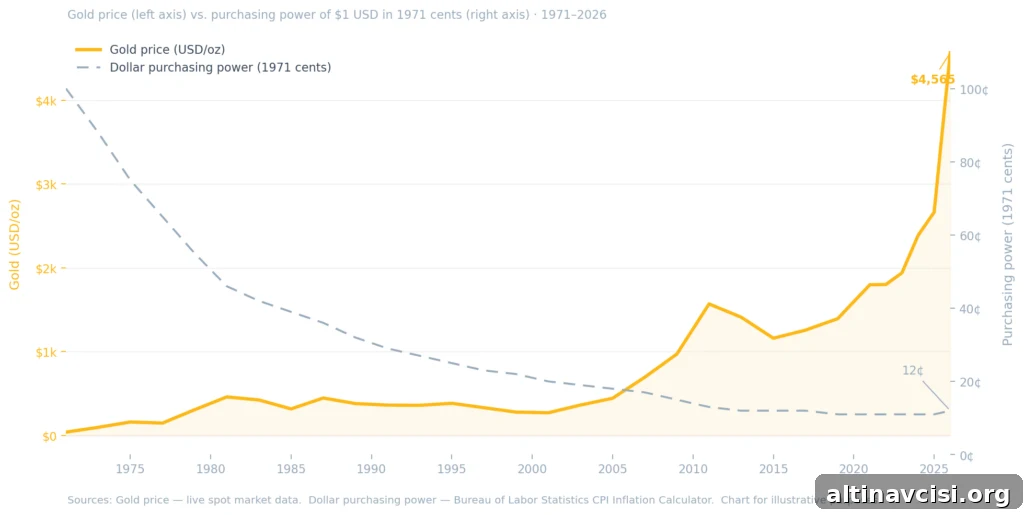
Thus gold’s value is not simply that its price increases; it is that gold preserves purchasing power while fiat currencies decline.
Why Are Central Banks Buying Gold at Historic Rates?
Central bank demand rose sharply in recent years: each of 2022–2024 saw annual purchases above 1,000 tonnes, more than double the previous decade’s average.
In Q1 2026 net central bank purchases were 244 tonnes. Several factors explain this trend, including geopolitical vulnerability of foreign‑held reserves. The 2022 freezing of a large portion of one country’s reserves highlighted that assets held in another jurisdiction can be restricted by political decisions. Gold stored in a sovereign vault, by contrast, cannot be frozen in the same manner, which makes it an attractive reserve asset for nations seeking greater autonomy and insurance against geopolitical risk.
Is the Case for Gold Getting Stronger Over Time?
The case for gold depends on long‑run fiscal and monetary trends rather than the occurrence of a single crisis.
Governments face ongoing fiscal pressures: interest costs on large national debts are substantial, money supplies remain elevated, and structural deficits persist in many economies. Those conditions erode purchasing power gradually over time. Because gold preserves purchasing power rather than promising growth, each year that fiscal and monetary policies continue to favor money creation increases the clarity of gold’s role as a hedge and reserve asset.
This observation describes how the system has behaved since 1971, not a speculative prediction.
Stay On Top of Gold & Silver Prices
Get important market alerts sent straight to your inbox.
People Also Ask
Is Gold Actually Worth Anything, or Is Its Value Just a Belief?
Gold’s worth is grounded in measurable properties: scarcity, chemical stability, durability, and divisibility. These characteristics explain why societies across time independently adopted gold as money, rather than it being solely a matter of belief or custom.
Why Does Gold Go Up When the Dollar Weakens?
Because gold is priced in dollars, a weaker dollar requires more dollars to buy the same ounce. In that sense, gold’s nominal rise often reflects a loss of purchasing power in the currency used to price it rather than an intrinsic change in gold itself.
Is Silver Just as Good a Store of Value as Gold?
Silver shares many monetary properties with gold but is more heavily consumed in industrial applications. That consumption limits silver’s ability to accumulate above ground and results in a lower stock‑to‑flow ratio compared with gold, making gold the stronger long‑term store of value for many investors.
Why Can’t Governments Just Create More Gold?
Gold is an element and cannot be produced at scale by policy decisions. New supply is limited by geology and mining capacity, not by printing presses, which is the fundamental asymmetry between gold and fiat currency.
How Much Gold Should an Individual Investor Hold?
There is no universal prescription. Gold is typically treated as a hedge or purchasing‑power anchor rather than a growth asset. Many financial advisors suggest allocations in the range of 5–15% of a diversified portfolio, but the right allocation depends on personal circumstances and exposure to fiat currency risk.
So, Why Is Gold Valuable?
Gold’s value derives from a single, well‑defined strength: it preserves purchasing power. It does not promise growth like equities or income like bonds; it offers durability and scarcity in a world where fiat currencies can be expanded by policy. The dollar has lost substantial purchasing power since 1971, while central banks increasingly diversify into gold. Those structural trends make gold relevant over long horizons, and they require only persistence of the current monetary regime, not a dramatic crisis.
If you find this reasoning compelling, consider how physical gold might fit into your broader wealth strategy.
SOURCES
- World Gold Council — Gold Demand Trends Q1 2026
- World Gold Council — Gold Supply Data, Full Year 2024
- World Gold Council — Above‑Ground Stock Data
- World Gold Council — China Gold Market Update, May 2026
- US Bureau of Labor Statistics — CPI Inflation data
- Congressional Budget Office — The Budget and Economic Outlook: 2026 to 2036
- US Department of the Treasury — REPO Task Force Joint Statement
- NPR — A Chemist Explains Why Gold Beat Out Others
- World Gold Council — Central Bank Gold Reserves Survey
- Peter Bernstein — The Power of Gold: The History of an Obsession
Disclaimer: This article is for informational and educational purposes only and does not constitute investment advice. Consult a qualified financial adviser before making investment decisions.
You may also like:
- 72% of Family Offices Hold No Gold. What They’re Missing.
- Gold Remonetization: Six Forces Restoring Gold’s Monetary Role
- Silver Industrial Demand: Solar, EVs, and the Supply Gap
- Bank of America’s $6,000 Gold Forecast Isn’t a Price Call. It’s a System Call.
- Silver IRA Complete Guide: Rules, Limits, and Custodians Explained
- Silver’s Tesla Moment: The Solid‑State Battery Thesis
- Physical Gold vs. Digital Gold: Which Is the Ultimate Safe Haven?
- BRICS Is Hoarding Gold. Here’s What It Means for Your Portfolio.