Fed Names AI Top Inflation Threat, Gold Reacts

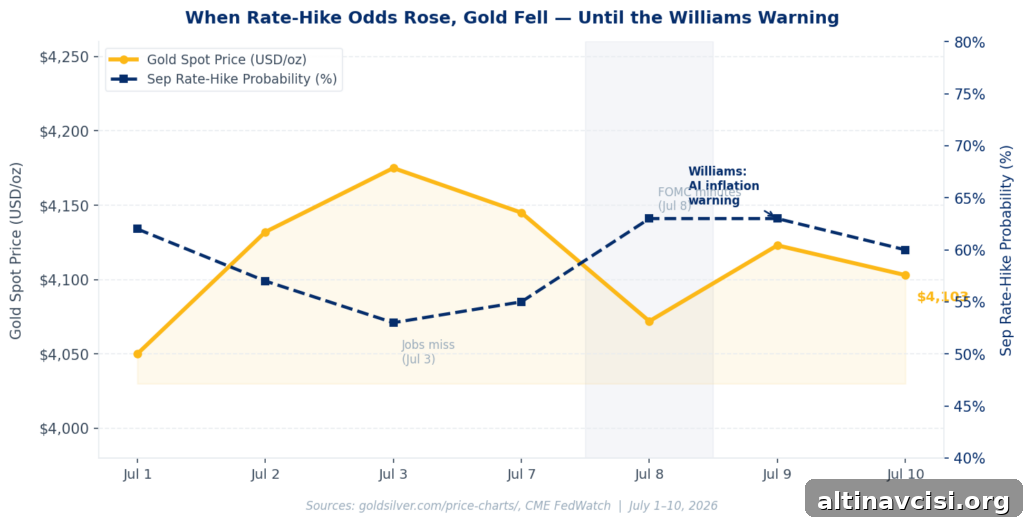
Gold is trading near $4,103 per ounce today, down roughly 0.5% on the day and about 1.2% for the week. Much of the mainstream coverage frames the story as a technology-sector issue: New York Federal Reserve President John Williams said AI-driven demand is now his primary inflation concern, and Wall Street quickly interpreted that as negative for semiconductor names like Nvidia. For gold investors, though, Williams’s comments confirmed something broader and more consequential: the Fed now faces a structural source of inflation that tariffs and energy shocks alone cannot explain away.
What Did the Fed’s Williams Actually Say About AI and Inflation?
On July 9, 2026, speaking at a Federal Reserve workshop on market liquidity in New York, Williams highlighted that artificial intelligence has become the single largest inflation risk on his radar. He warned that if AI-driven demand produces a “sustained impulse to demand relative to supply,” the Fed would be compelled to act. He also pointed to rising core goods inflation and referenced the June FOMC minutes, which explicitly mentioned “AI-related pricing pressures.”
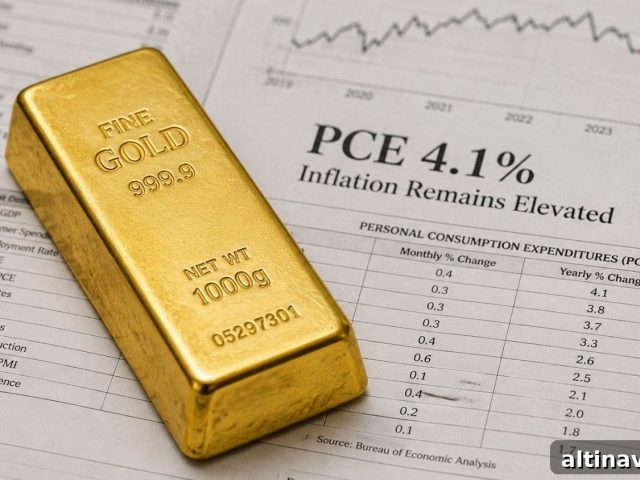
Williams set a clear metric: if core PCE inflation runs above 0.2% month-over-month in the second half of 2026, he will treat that as evidence inflation is more persistent than currently forecast. Core PCE is currently well above the Fed’s 2% target on a year-over-year basis, which underscores why his remarks drew attention from markets and policymakers alike.
What Does AI Inflation Mean for Gold?
AI-driven inflation represents a different, more persistent kind of price pressure. Tariff-driven inflation wanes when trade policies stabilize. Energy-driven inflation eases when supply constraints are relieved. Capital spending to support AI — on data centers, power, cooling, construction, and advanced semiconductors — does not have a simple off-switch. Large cloud providers and hyperscalers committed hundreds of billions to AI infrastructure in recent years, creating sustained demand across multiple industrial supply chains.
That sustained demand bids up prices across inputs, contributing to core goods inflation. Unlike consumer spending that reacts strongly to interest rate moves, much AI capex is strategic and is frequently financed from operating cash flow. Higher interest rates make borrowing more expensive, but they do not fully remove the incentive for major technology companies to continue investing. In short, the AI capex boom is notably less sensitive to rate policy than many other inflation drivers.
For gold specifically, this matters because gold’s price reacts more to real yields than to headline inflation alone. Real yields — the return investors earn after subtracting expected inflation from nominal interest rates — determine the opportunity cost of holding non-yielding assets like gold. If inflation expectations rise while the Fed holds nominal rates steady, real yields fall and gold becomes relatively more attractive.
Why Is This a Gold Story, Not Just a Tech Story?
The key link is through real yields and policy risk. If the Fed keeps nominal policy rates unchanged while inflation expectations rise because of AI-driven demand, real yields compress. Lower real yields support higher gold prices because gold does not pay interest and therefore competes more favorably when Treasury real returns decline.
Williams’s remarks were echoed in the June FOMC minutes, which showed a divided committee with several policymakers still voting for an additional rate hike in 2026. Combined with tariffs and energy price dynamics, AI adds a fourth structural reason the Fed may struggle to return inflation to target quickly. Each added structural pressure lengthens the expected timeline for disinflation, and the longer that timeline extends, the stronger the case becomes for holding assets that protect purchasing power over time.
What Is the Deeper Story That Most Analysts Are Missing?
Many market commentators emphasize the short-term ups and downs tied to Fed rate expectations: higher rates are bearish for gold; lower rates are bullish. That surface-level view misses the structural trade-off the Fed now faces. If the Fed responds to AI-driven price pressures with aggressive rate hikes, those hikes increase the government’s interest burden on a very large national debt. Rising interest costs can widen the fiscal deficit, which over the long run can add upward pressure on inflation — the very problem the Fed is trying to counter.
This creates a policy trap: the Fed can tamp down AI-driven inflation at the cost of greater fiscal stress, or it can prioritize fiscal stability and tolerate longer-lasting inflation. Either outcome can support gold: aggressive rate hikes lower real yields only if inflation expectations fall faster than nominal rates rise; fiscal strains can increase inflation expectations and support gold independent of nominal rate moves.
Investors have seen similar dynamics before. When central banks face supply-driven shocks they cannot fully control with interest-rate policy, the result can be prolonged inflationary pressure that supports tangible assets like gold. While history does not repeat exactly, it provides a useful framework for understanding how structural, sector-specific spending can evolve into a broader macroeconomic force.
Mark Your Calendar: July 14 Is the Next Test
The June CPI report and accompanying congressional testimony scheduled for July 14 will be an important near-term test of how durable AI-driven inflation appears to policymakers. A higher-than-expected CPI print would raise the odds of additional rate hikes later in the year and could shift market expectations about the Fed’s path. Conversely, a softer print would reduce immediate pressure on the Fed and be constructive for risk assets.
Markets currently price a range of outcomes, and gold trading near $4,103 suggests the market has priced in some but not all of the structural risks Williams highlighted. Investors should watch inflation readings and Fed commentary closely: when inflation expectations move, real yields follow, and that movement is the primary driver for gold.
SOURCES
1. Fortune — Federal Reserve’s John Williams Says AI Is Now His Main Inflation Concern
2. Bloomberg — Fed’s Williams Says AI Is Now His Main Inflation Concern
3. FXStreet — Fed’s Williams: Inflation Is Still ‘Far Too High’
4. Bureau of Economic Analysis — Core PCE Price Index, May 2026
5. Federal Reserve — June 2026 FOMC Meeting Minutes, released July 8, 2026
6. CME Group — FedWatch Tool (accessed July 2026)
7. Congressional Budget Office — Budget and Economic Outlook 2026–2036
8. U.S. Treasury — Fiscal Data, Debt to the Penny
9. GoldSilver — Live Gold Price Charts
Disclaimer: This article is for informational purposes only and does not constitute financial or investment advice. Consult a qualified financial adviser before making investment decisions.
You May Also Like:
- Five Days From Now, Two Numbers Will Decide Gold’s Second Half
- Bank of America Cut Its Gold Forecast. The Reason Is More Bullish Than It Looks.
- The Fed Is Split 9 to 8. Gold and Silver Are Paying the Price — Until July 14.
- Gold Is Sitting on $4,000. The World Gold Council Has a Model for What Happens Next.
- Trump Called the Deal Dead. Oil Jumped 6%. Gold Fell. Here Is Why Both Moves Make Perfect Sense.
- China Just Bought Its Most Gold Since 2023. It Did It During the Quarter Gold Fell 16%.
Popular Topics
Picked from the archive
-
01
 Topics
Why Gold Tumbled After the Hormuz Tanker Strike
-
02
Topics
GDP Report Delays and Weak Retail Sales Signal Economic Risk
-
03
Topics
Physical vs Digital Gold: Which Is the Safer Investment?
-
04
Topics
Gold Price Near $5,000 as Fed Battles Sticky Inflation
-
05
Topics
Wall Street’s $6,000 Gold Call Relies on Hidden Data
-
06
Topics
PCE Inflation Hits 4.1%: Why Gold Prices Rose
-
07
Topics
UBS Cuts Gold Price Target by $400: What They Kept Matters
-
08
Topics
Gold and Silver Hit Record Highs Amid Shutdown Deadlock