China’s AI Stocks Plunge 40%: Will Gold Prices Rise or Fall?

Gold: $4,056.80/oz (+0.99% today). Silver: $54.28/oz (+0.57%). Gold-silver ratio: 74.75. Prices as of 2:00 p.m. ET, October 27, 2026.
Key Takeaways
- China’s STAR50 index has collapsed almost 40% over six months after a rapid earlier rally. Contemporary reports estimate the market value lost in the sector at roughly $480 billion; that figure stems from a single wire source and should be treated as directional rather than definitive.
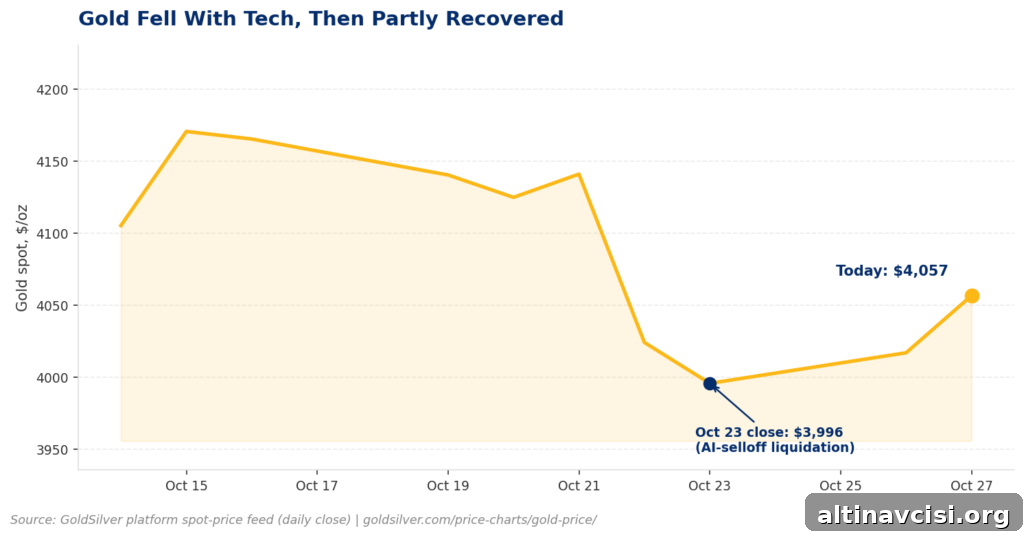
- When U.S. tech stocks plunged on October 22, gold did not act as a haven. Instead, bullion fell nearly 3% that day, driven by liquidity needs rather than a collapse in investor faith.
- Multiple market participants reported margin calls and liquidity-driven selling as the primary reason investors exited gold and other liquid assets to meet obligations elsewhere.
What Happened to China’s AI Stocks This Week?
China’s STAR50 index—often compared to the Nasdaq for Shanghai tech names—rallied sharply earlier in the year, then reversed course. Over the past six months the index has fallen nearly 40% after gains of up to 75% between April and June. Contemporary media reports put the market value decline at about $480 billion; because that estimate comes from a single wire source, it should be regarded as indicative rather than final. A more corroborated datapoint shows net outflows through the Hong Kong trading link of roughly 90 billion yuan (about $13.5 billion) in the third quarter, the largest quarterly outflow in a year.
Despite the pullback, valuations in the STAR50 remain elevated: the group still trades at over 40 times forward earnings, compared with about 30 times for the Nasdaq-100. Rapid shifts in sentiment and large flows out of concentrated AI-related positions explain much of the price action this week.

The Edge Every Investor Needs
Smarter precious-metals investing starts here. Subscribe for market insights, central-bank updates, trend analysis, and educational pieces on gold and silver.
Subscribe to newsletter alerts and market commentary to stay informed about price drivers and liquidity events.
Did Gold Rise When US Tech Stocks Fell Last Week?
No. On October 22 Meta reported a roughly 7% decline—the firm’s worst single-day drop since July—and the Nasdaq Composite fell 2.6% to 26,008.86, marking its largest one-day drop since June. Gold moved in tandem with that selling, losing nearly 3% on the same day. By the following morning bullion had reached an intraday low near $3,986.85, the first time it traded below $4,000 since July.
The spillover extended beyond equities: Japanese 10-year yields declined by as much as 10 basis points and global corporate-bond spreads widened to their largest gap since May 2025, by some measures. Silver did not hit its low until a few sessions later; it traded near $55 on October 22 and reached an 11-month low close to $53 around October 26–27.
Why Would Investors Sell Gold During a Stock Selloff?
Market professionals described the October move as a liquidity-driven liquidation. In a rapid market downturn, investors who face margin calls or need immediate cash will sell the most liquid assets they can. Gold, being one of the deepest and most liquid markets, becomes an obvious source of liquidity.
Analysts and metals strategists told news outlets that margin calls forced some investors to exit commodity positions, including gold and silver, to meet obligations elsewhere. That helps explain why conventional drivers that would normally support gold—central-bank buying, lower bond yields, and steady commodity dynamics—did not prevent the intraday break below $4,000.
Is Gold’s Safe-Haven Case Broken?
This episode does not overturn gold’s longer-term safe-haven or store-of-value narrative. Central banks continued to buy through the selloff, with sizable official-sector purchases reported in recent months. Short-term forced selling driven by margin calls and rapid deleveraging is a flows story rather than a fundamental verdict on gold’s role as a reserve asset.
Positioning in silver was already light before the selloff: futures data showed speculative net-long silver positions at a historically low percentile over recent weeks, limiting how far mechanical liquidation could push prices. For investors focused on multi-year allocations, the relevant considerations remain reserve diversification, inflation dynamics, and monetary-policy trends. A brief liquidity squeeze tests trading behavior, not necessarily long-term fundamentals.
Market participants will be watching whether this round of AI-related deleveraging remains concentrated in the most exposed tech names or continues to force sales across unrelated liquid assets. Upcoming events include the Federal Reserve’s rate decision and the September PCE inflation release, both of which could influence flows and positioning in precious metals.
SOURCES
1. Bloomberg — coverage on gold retreat amid margin-call selling
2. NewsBytes — reports on gold dipping below $4,000
3. Industry commentary on AI-related market moves and cross-asset spillovers
4. Company and regional press coverage of China’s STAR50 pullback
5. Market and data providers reporting on gold and silver price action and positioning
Disclaimer: This article is for informational purposes only and does not constitute investment advice. Past performance is not indicative of future results. Consult a qualified financial advisor before making investment decisions.
You May Also Like:
- Durable Goods Beat: What It Means for the Gold Price Today
- Gold Steadies Near $4,000 as Fed Week Begins
- Russia Is Selling Gold: Why That’s Not Necessarily Bearish
- Gold-Silver Ratio Today: Why Silver Is Falling Faster
- Gold Priced in Oil: What an Ounce Buys Now vs. a Year Ago
- How Gold’s 2026 Correction Impacted Portfolios
- Central Bank Gold Buying: Why Recent Demand Matters
- Investors Turn to Treasuries as AI Stocks Slide
Popular Topics
Picked from the archive
-
01
 Topics
BLS Revises April Jobs: +64,000 Then -31,000; Gold Reacts
-
02
Topics
Gold-Silver Ratio Hits 61.1: Silver Poised to Rally
-
03
Topics
U.S. Sanctions Target Iran’s Gold Sector, Prices Slide
-
04
Topics
Hong Kong Completes First Gold Settlement; Banks Also Run London
-
05
Topics
Why Gold and Silver Climbed Despite Multiple Bearish Catalysts
-
06
Topics
Gold Market Split: Short-Term Sellers vs Long-Term Buyers
-
07
Topics
3 Fed Officials Voted to Hike Rates: What It Means for Gold
-
08
Topics
Why Gold Is Still a Safe Haven, Says Switzerland’s Top Refiner