
Gold is down about 0.8% on the day, trading near $4,454 as of Tuesday afternoon. But the more significant development came from Frankfurt.
The European Central Bank released its annual report on global reserve assets yesterday. The headline: gold now represents 27% of global official central bank reserves, ahead of US Treasuries at 22% and the euro at 15%. This is the first time since 1996 that gold has exceeded Treasuries in the global reserve mix.
The asset many governments had long regarded as an outdated relic has, in a single step, overtaken the securities those same governments use to borrow.
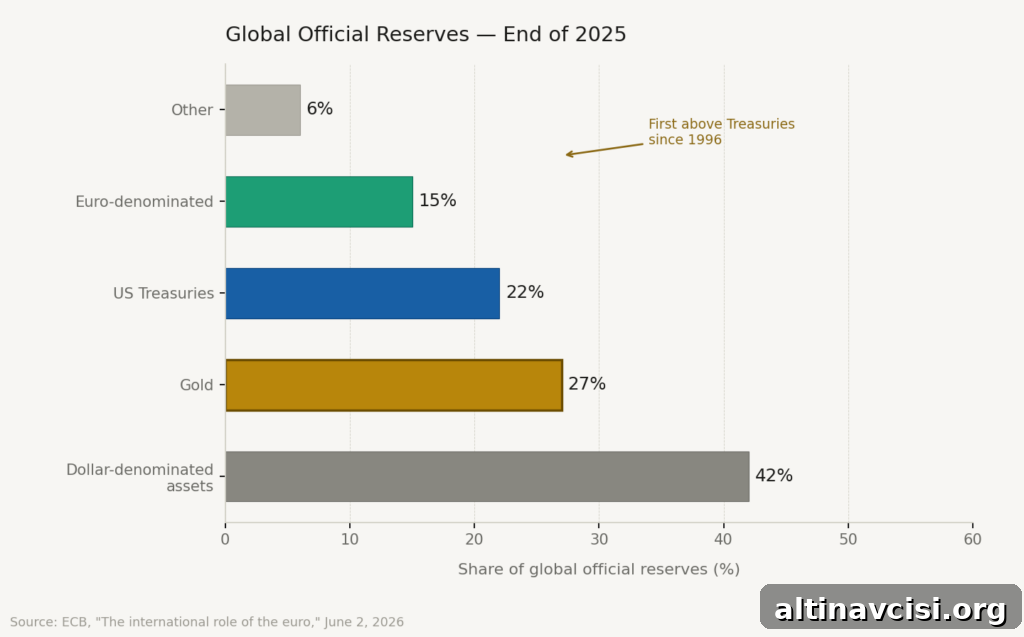
Why did gold’s share of global reserves jump seven points in a single year?
Two forces explain the shift, and both are important.
First, valuation. Gold rose roughly 60% in 2025 after a roughly 30% gain in 2024 (ECB, June 2026). When an asset appreciates substantially, its weight in a fixed portfolio increases automatically. The ECB notes that using 2023 prices, US Treasuries would still lead at about 26% while gold would be near 16% — highlighting that price moves alone account for much of the change.
Second, demand. Central banks bought around 850 tonnes of gold in 2025. That is below the 2022–2024 pace of over 1,000 tonnes per year, but still well above long-term norms. Since Russia’s invasion of Ukraine, China has added more than 350 tonnes, Poland about 320 tonnes, India 130 tonnes, and Turkey roughly 220 tonnes before loaning or selling about 130 tonnes in early 2026 (ECB, June 2026). Notably, stablecoin issuer Tether was the largest buyer overall in 2025, acquiring over 100 tonnes — just ahead of Poland as the top official buyer. That detail underscores which actors are seeking protection and why.
So this is both a valuation story and a buying story. The distinction matters because it speaks to the motivations behind the shift.
The Edge Every Investor Needs
Smarter precious metals investing starts here. The Nuggets Newsletter brings essential market insights, Fed updates, global trends, educational videos, and more.
Why didn’t central banks rebalance back into Treasuries when gold prices surged?
Calling this merely a “price effect” is technically correct but incomplete. Central banks actively manage and rebalance reserves. If gold’s weight had risen only because of price moves and no country wanted that exposure, many would have sold. Instead, official gold purchases have remained above long-term norms for four straight years. Governments that could have trimmed gold in favor of Treasuries chose not to — a clear policy decision that signals preference.
ECB President Christine Lagarde summed this up: “Geopolitical tensions continue to drive strong central bank demand for gold” (ECB, June 2026).
The logic is straightforward. After the US froze Russian dollar reserves following the 2022 invasion of Ukraine, many reserve managers asked: what happens to our dollar assets if we become subject to foreign policy actions by another state? Gold carries no counterparty risk. It cannot be frozen, sanctioned, or seized through correspondent banking, and it sits outside any single nation’s legal framework.
Central banks now hold more than 36,000 tonnes of gold — approaching the roughly 38,000 tonnes recorded during the Bretton Woods era when the dollar was convertible to gold (ECB, June 2026). The reserve system is being adjusted in a deliberate, gradual way.
What limitations of gold does the ECB highlight?
The ECB notes the practical drawbacks: gold generates no yield, its price is volatile, storage and security are costly, and supply cannot be ramped up quickly to meet sudden demand. These are valid constraints.
Yet from a sound-money standpoint these same characteristics are strengths: scarcity, independence from sovereign balance sheets, and resistance to monetary inflation or political seizure. Each limitation cited by the ECB also underpins why institutions may prefer holding gold as a hedge.
What the ECB cannot explicitly state is that the other reserve assets in the table are instruments of fiat monetary policy. By diversifying into gold, reserve managers are partly hedging against the vulnerabilities of fiat assets — including those they themselves oversee.
If the largest, most sophisticated balance sheets on earth are increasing gold allocations, individual savers may reasonably ask whether their own portfolios reflect similar diversification logic — not out of panic, but out of prudent risk management. That approach is about financial sovereignty, not doomsday scenarios.
What should gold investors watch in the week ahead?
Short-term price moves will respond to Friday’s US jobs report and the June 16–17 FOMC meeting — Kevin Warsh’s first as Fed Chair — which will shape summer rate expectations. But the reserve composition shift is a longer-term trend. Central banks make measured decisions over years; this trajectory reflects durable policy choices rather than single data releases.
Key Takeaways
- The ECB reports gold now comprises 27% of global official reserves, surpassing US Treasuries at 22% for the first time since 1996 (ECB, June 2026).
- Valuation matters: at 2023 gold prices, Treasuries would still lead. But central banks chose not to rebalance away from gold during the price rally — an active policy choice.
- Since the 2022 invasion of Ukraine, major buyers including China, Poland, India, and others have added gold to reduce exposure to assets that can be frozen or sanctioned.
Stay On Top of Gold & Silver Prices
Get important market alerts sent straight to your inbox.
SOURCES
1. ECB — The International Role of the Euro, June 2026
2. Xinhua — Gold Surpasses U.S. Treasuries, Euro in Global Official Reserves: ECB
3. The Northern Miner — Gold Overtakes US Treasuries in Global Reserve Shift: ECB
4. Canadian Mining Journal — Gold Overtakes US Treasuries in Global Reserve Shift: ECB
5. Mining.com — Gold Overtakes US Treasuries in Global Reserve Shift: ECB
6. South China Morning Post — China Among Top Gold Buyers as Bullion Overtakes US Treasuries: ECB
7. Yahoo Finance — Gold Overtakes US Treasuries as Top Central Bank Reserve Asset
8. World Gold Council — Gold Demand Trends: Central Banks, Full Year 2025
9. TradingEconomics — Gold Price
10. MPA Magazine — Key Dates That Will Define Kevin Warsh’s Opening Months as Fed Chair
Disclaimer: This article is for informational purposes only and does not constitute financial or investment advice. Always consult a qualified financial adviser before making investment decisions.
You May Also Like:
- Central Banks Just Crossed a Line Not Seen Since 1996
- Factory Costs Hit 82.1. That Number Is Now Working for Your Gold.
- Gold at $4,500: What Fort Knox, China, and Silver Are Telling You
- Silver Has Two Engines. Stagflation Is the One Condition That Fires Both at Once.
- The Buyer List for Gold Just Got Longer. These Countries Have Never Bought Before.
- PCE Hit 3.8%. GDP: 1.6%. Gold Went Up. Here’s the Mechanism.
- Gold Targets Are Falling. The $8,000 Forecast Isn’t.
- Gold Radar: 5 Stories the Price Chart Isn’t Telling You
- Silver Lost 3.3% While Gold Lost 1.6%. That Gap Is Not Random.
- Gold Down 1.2%, Silver Down 2.8% — The Floor Holds