
Key Takeaways
- Bank deposits are unsecured loans to a bank; allocated physical gold is not. These two forms of holding value carry fundamentally different risk profiles.
- In February 2022, Western governments froze roughly $300 billion of Russian central bank foreign currency reserves. That event underscored political risk associated with holding reserve currencies.
- World Gold Council data shows central bank gold purchases reached multi-decade highs in 2022–2024 as many non-Western banks reduced dollar exposure and increased holdings of physical gold.
- Gold roughly doubled from early 2024 lows while silver rose more than 130% over the same period. For live prices, consult price charts from market sources.
- GoldSilver’s InstaVault offers a single account for allocated institutional-grade vault storage and home-held physical metal, with no minimums and full delivery flexibility.
Does Physical Gold Have Counterparty Risk?
Investors commonly think about diversification across asset classes to reduce exposure to a single market shock. Equally important, but less discussed, is diversification of custody: where you keep assets and who controls them. That distinction matters more than many people realise when comparing bank deposits to physical precious metals.
The crucial question is not only what you own, but who is responsible for safeguarding it.
When it comes to bullion, the answer is clear: physical allocated gold does not carry the same counterparty risk as a bank deposit. Understanding this changes how you view and protect your savings.
What Is Counterparty Risk? Here’s a Story
Picture lending a neighbour $10,000 and receiving a note promising repayment. If that neighbour becomes unable to pay, the note has no value. That is counterparty risk: the other party fails to fulfil their obligation.
That same dynamic applies to bank deposits. When you deposit cash you are effectively lending it to the bank. The bank uses those funds and records a liability on its balance sheet. Your account balance is a claim on the institution, not a physical asset sitting untouched in a vault.
Deposit insurance—such as FDIC coverage in the U.S.—provides meaningful protection up to specified limits. However, it covers individual institutional failures, not necessarily systemic events that affect many institutions simultaneously. And insurance protects nominal dollars, not the purchasing power those dollars represent over time.
By contrast, physical gold tells a different story.
Does Physical Gold Have Counterparty Risk? The Definitive Answer
According to standard definitions used by international institutions, counterparty risk arises when one party can fail to deliver on a contract. Physical gold is not a contractual claim; it is tangible property. When gold is allocated to you in a vault, it is not recorded as someone else’s liability. No intermediary can unilaterally “create” or dilute your metal, and a bank failure does not make the metal vanish.
Banks may operate on limited hours and can impose transfer restrictions during stress events. Physical gold markets operate around the clock. Allocated metal cannot be frozen by an institution in the same way currency balances may be restricted.
This enduring quality helps explain why gold has functioned as a form of money across many failed monetary regimes: the systems change, the metal persists.
Why Central Banks Made the Same Calculation in 2022
The reality of political risk became stark in February 2022, when Western authorities froze about $300 billion in Russian foreign currency reserves held abroad. Assets denominated in and held within another jurisdiction can be subject to sudden political actions.
Non-Western central banks drew a lesson: holding reserves in foreign currencies or institutions introduces political exposure in addition to inflationary risk. Gold, by comparison, offers a reserve asset that cannot be frozen by a foreign government in the same way.
World Gold Council reporting shows central bank gold buying reached multi-decade highs across 2022–2024, driven by countries increasing physical holdings while decreasing dollar-denominated reserves. For many, these were structural changes to reserve strategies rather than short-term trades.
Individual investors face a similar choice at a smaller scale: do you accept dependence on a bank and a currency, or do you hold an asset outside those systems?
How to Think About Gold vs. Silver
Gold and silver serve different roles within a diversified precious metals allocation. Gold is typically the stability anchor, preserving purchasing power over long horizons and moving with less volatility. Silver has stronger industrial demand and historically can outperform during certain market dislocations when monetary demand rises.
Since early 2024, silver rose sharply—more than 130% from its lows—while gold approximately doubled. Investors often track the gold-silver ratio as one signal among many; it works best combined with analysis of real yields, central bank activity, and broader market dynamics rather than as a standalone trigger.
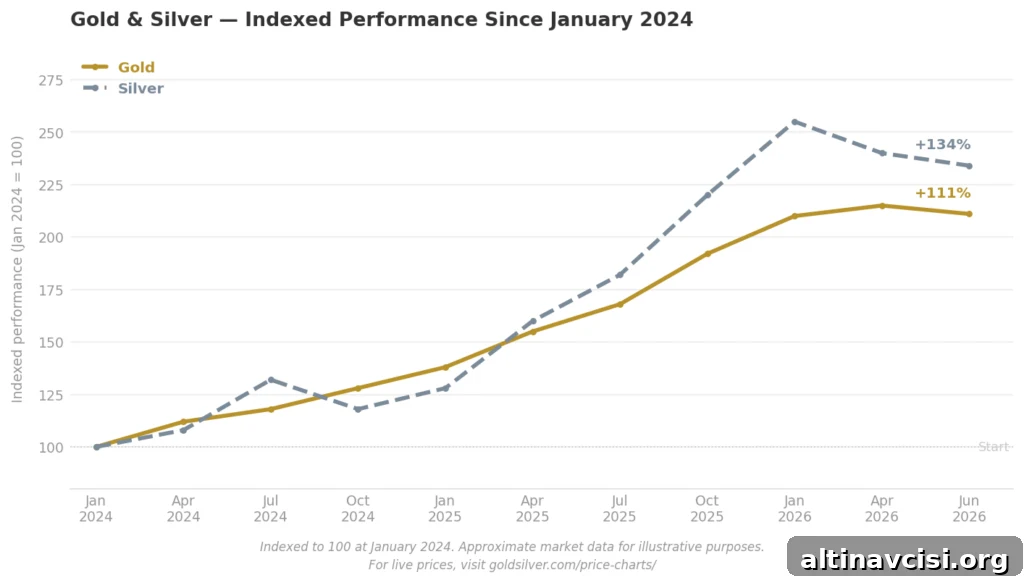
Price corrections can occur within any long-term bull market, but the structural drivers—monetary expansion, compressed real returns on savings, and central banks shifting from paper reserves to physical metal—remain central to the thesis for owning precious metals.
GoldSilver Vault Storage: Not a Deposit. Every Ounce Is There.
A key distinction between a bank deposit and professional vault storage is legal and operational: vault storage that is allocated means your metal is not lent out, pledged as collateral, or recorded as someone else’s liability. Each allocated ounce is physically present in a secure vault and assigned to your ownership.
Insurance for allocated vault storage commonly covers replacement at market value rather than a fixed dollar cap like deposit insurance. Vaults used by institutional programs are often operated by established providers, audited independently, and secured to high standards.
GoldSilver’s storage program uses established vault operators across several locations, with third-party audits and high-grade security standards. Storage fees are typically charged as a small percentage of value, with no minimums and the flexibility to request delivery at any time.
Getting Started Is Easier Than You Think
Institutional-grade storage is often thought to be accessible only for large accounts, but fractional ownership and allocated programs allow small investors to participate. Platforms that combine allocated vault storage with options for home delivery let investors choose the mix that suits their needs.
Services may support individual, joint, trust, corporate, and retirement accounts and offer in-kind transfers from existing qualified accounts. Offshore vault locations can provide additional jurisdictional choices for internationally minded investors.
A single account that displays both home-held and vaulted holdings simplifies management: you can see your entire position in one dashboard while holding some metal at home and some in secure vaults.
The Question Nobody Asks Until It’s Too Late
Many investors carefully decide how much precious metal to own but spend little time deciding how to store it. Home storage eliminates counterparty risk entirely because you hold the metal directly. The downside is that security and adequate insurance become your responsibility; typical homeowners’ policies provide minimal bullion coverage.
Professional vault storage offers institutional security, regular third-party audits, and full market-value replacement insurance. It introduces a measured degree of institutional reliance but removes many burdens associated with home storage.
A combined approach—some metal held at home and some in allocated vaults—balances independence with liquidity, insurance, and convenience. Many experienced investors use both methods together.
Where to Start
Begin by defining the role of each portion of your metal allocation. If the metal is intended as an immediate backstop you would reach for during a severe disruption, keep it at home where you alone can access it. If the goal is to build a position that is insured, auditable, and easily transacted, choose allocated vault storage that permits delivery on demand.
Neither approach is sufficient on its own for many investors; together they cover complementary risks. This is practical wealth preservation rather than an extreme scenario plan.
People Also Ask
Does physical gold have counterparty risk?
No. Allocated physical gold held in institutional storage carries essentially zero counterparty risk as it represents direct ownership of metal rather than a claim on an institution.
What is the difference between a bank deposit and physical gold?
A bank deposit is an unsecured loan to the bank and depends on the institution’s solvency and regulatory environment. Physical gold is tangible property you own outright and is not subject to the same institutional or policy risks.
Why are central banks buying gold instead of holding dollars?
Events that demonstrated the ability to freeze foreign-held reserves highlighted political risk in reserve currencies. As a result, many central banks increased allocations to physical gold, viewing it as a reserve asset free from the same jurisdictional constraints.
Is it safer to store gold at home or in a professional vault?
Both approaches protect against different risks. Home storage removes counterparty risk but requires you to manage security and insurance. Professional vaults provide institutional security and insurance but introduce a limited degree of reliance on the custodian. Many investors use a mix of both.
What does allocated gold storage mean?
Allocated storage assigns specific bars or coins to your ownership record, with one-to-one backing by physical metal in a vault. This contrasts with unallocated storage where your balance reflects a claim on a pooled inventory rather than distinct, assigned metal.
SOURCES
1. Bank for International Settlements — definitions and framework on counterparty credit risk.
2. World Gold Council — gold demand and central bank purchase data.
3. Historical and theoretical work on money and credit.
4. Underwriters Laboratories standards for vault security.
5. Insurance industry guidance on homeowners’ policy limits and bullion coverage.
6. Federal Deposit Insurance Corporation — overview of deposit insurance.
7. Industry guides on allocated versus pooled vault storage and combined home-and-vault approaches.
Disclaimer: This article is informational only and does not constitute financial or investment advice. Consult a qualified financial adviser before making investment decisions.
You may also like:
- Why Is Gold Still a Safe Haven? Switzerland’s Biggest Refiner Just Answered.
- Rate Hike Odds Just Hit 85%. Gold Is Up. Here’s Why.
- Gold Confiscation: Could the Government Take Your Gold Again?
- Gold Price History: From $35 to $4,500 in 100 Years
- The Debasement Trade Explained: Mechanism, History, and What It Means for Gold
- Gold or Silver First? A First-Time Buyer’s Framework
- Gold Reserves by Country: The 2026 Rankings
- Gold Portfolio Allocation: Why Wall Street Is Rewriting the 60/40
- What Does the SILVER Act Mean for Precious Metals Investors?
- What Backs the US Dollar? Not Gold. Not Silver.