Can Lab-Grown Gold Be Created and Would It Impact Market Value?
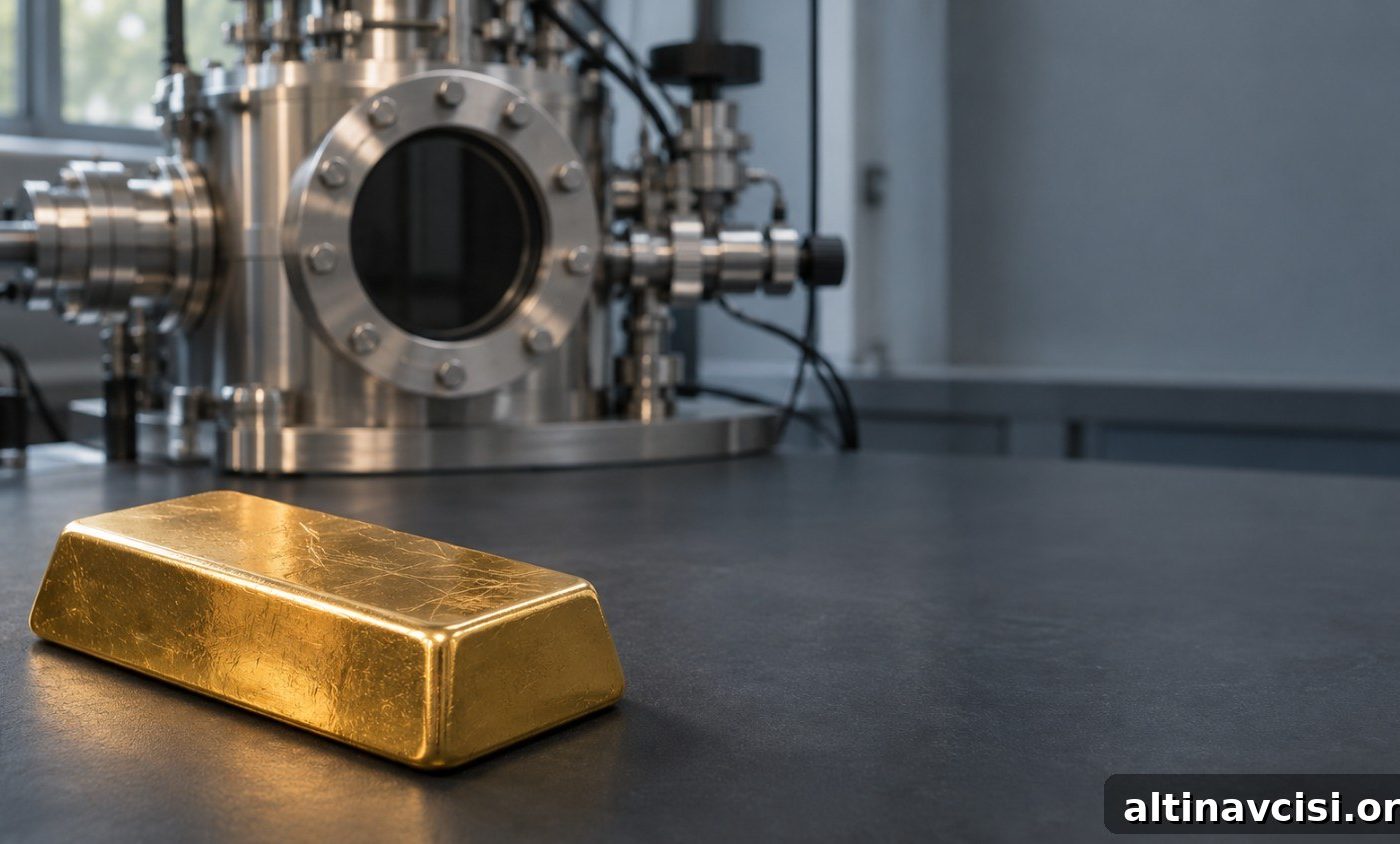

Yes — gold can be created by nuclear reactions. That scientific fact, however, does not mean there is an inexpensive, scalable way to produce marketable bullion. For anyone who holds gold partly because its supply is constrained, the key questions are practical: can a process reliably produce usable gold at competitive total cost, repeatedly and in quantities large enough to affect market supply?
If you own physical gold because of its scarcity, it’s reasonable to examine claims about manufactured gold. A laboratory demonstration or a model can show possibility without immediately changing market dynamics. Conversely, an attractive projection can remain years away from dependable commercial production.
The useful approach is to ask what a technology has actually demonstrated, which parts remain theoretical, and which claims have independent verification. Those distinctions matter when judging whether manufactured gold could alter long-term supply.
Can gold be made the same way as laboratory-grown diamonds?
It’s natural to compare gold production to lab-grown diamonds, but the processes are fundamentally different. Lab-grown diamonds form a carbon crystal; the material remains carbon, simply arranged as a diamond lattice. Those man-made diamonds match natural stones in chemical composition and many physical properties, because no new element is created.
By contrast, making gold from another element requires altering atomic nuclei. Nuclear transmutation — changing one element into another — involves nuclear reactions, not ordinary chemistry. That difference affects energy needs, equipment, safety, and cost.
So while the diamond analogy helps frame the question of whether technology can expand supply, it does not answer whether gold production can be made practical, economical, and scalable.
The Knowledge That Changes Everything
Two concise guides — free. Learn why gold matters and why fiat currencies face long-term pressures.
What did CERN actually demonstrate?
In May 2025, CERN published results from the ALICE experiment showing that collisions at the Large Hadron Collider can, in rare cases, transform lead nuclei into gold nuclei by ejecting protons and neutrons. These measurements quantified specific reaction channels that can produce gold isotopes under ultraperipheral collision conditions.
The amount involved was extremely small. Across several experiments during the 2015–2018 run, the estimated cumulative mass was on the order of 29 picograms (0.000000000029 grams). Those were not collected bars of metal; energetic particles struck accelerator components and fragmented. The result proves scientific possibility but does not provide a route to economical bullion production.
CERN’s work is important because it demonstrates that element conversion can occur under high-energy conditions. It does not, however, establish the equipment, scaling, or cost parameters required for a commercial gold-making operation.
Could fusion produce gold on a larger scale?
Some researchers have modeled gold production using neutron fluxes from fusion systems. For example, a 2025 preprint by a commercial research group modeled a scenario in which a gigawatt of thermal fusion power operating on enriched mercury-198 feedstock might produce on the order of two tonnes of gold per year in idealized conditions. That calculation assumes continuous operation, specific feedstock isotopes, and highly efficient recovery and separation.
A subsequent revision examined how selling isotopes could affect overall fusion economics. Those studies consider different products and reactor designs, so outcomes for high-value medical isotopes cannot be applied to gold without careful adjustments. Their gold-production numbers remain conditional models, dependent on plant performance, cost assumptions, and market prices.
Because the authors have commercial affiliations, readers should weigh those projections alongside independent analysis and recognize that lab or model results are not equivalent to verified commercial output.
What would turn a production claim into a credible source of bullion?
The decisive test is evidence across the entire production chain. A credible claim connects the nuclear reaction to recovered, assay-verified metal, repeated output, and transparent economics. Headlines that say merely “gold produced” can obscure which steps were demonstrated.
Key questions to ask:
- What exactly was measured? Was the result a detection of reaction byproducts, an estimate of produced mass, or an actually recovered and assayed sample?
- Can the process be repeated consistently outside an idealized laboratory run? Sustained production matters far more than a one-off event.
- Is the product marketable? Some production pathways yield radioactive isotopes that require cooling periods and handling that affect economics and timing.
- What are the full costs? Construction, financing, feedstock procurement, operation, recovery, waste and regulatory compliance all figure into whether an operation can compete with mined gold.
An independently verified demonstration of recoverable, non-hazardous bullion and transparent operating accounts would be stronger evidence of commercial potential than optimistic projections alone.
How much manufactured gold would matter to the market?
Scale matters when assessing market impact. To provide context, an early estimate of global mine production for 2025 was roughly 3,672 tonnes. By that reference, a modeled two tonnes per year from one gigawatt of thermal fusion power would equal roughly 0.05% of annual mine production. That comparison contrasts a hypothetical facility’s modeled rate with historical mining output; it is not a forecast of future supply.
Even if a single facility had only a tiny share, the broader question is whether the technology could be replicated economically at scale. Critical considerations are the speed of capacity expansion, required capital, operating costs, and whether producers could sell increasing output without collapsing prices. Demand-side factors — jewellery, technology, investment, and central-bank buying — would shape how any new supply is absorbed.
In short, larger and dependable manufactured output at lower cost could exert downward pressure on prices, other things equal. The current evidence does not, however, establish the production, adoption, or demand assumptions needed for a reliable price forecast.
What does this mean for someone holding physical gold?
A long-term case for owning gold should be robust to scrutiny of supply assumptions. The present evidence supports a careful distinction: nuclear production of gold is scientifically real, but competitive, sustained production of market-ready bullion is a commercial claim that requires further evidence.
If you hold physical gold, useful questions to monitor include: how much metal was actually recovered, who verified its purity, whether production can be repeated reliably, and what the total cost of a complete production chain would be. These practical criteria remain relevant regardless of company narratives or advances in reactor design.
Meanwhile, responsible physical ownership still involves verifying metal authenticity, understanding price drivers, and choosing secure custody. Maintain verification and storage practices that suit your needs and risk tolerance.
Stay On Top of Gold & Silver Prices
Receive timely market alerts directly to your inbox.
Live price widget unavailable in this version.
People also ask
No. Producing the element gold is different from creating imitations. Whether a product is genuine, pure, stable and suitable for sale depends on its isotopic composition, purity and independent assay — not on how it was made.
Not necessarily. Natural gold-197 is stable, while other isotopes are radioactive. The radioactivity of any manufactured material depends on which isotopes are produced and their proportions; these factors must be measured and disclosed.
No. Market impact depends on how much usable metal is produced, production costs, the pace of adoption, and demand. Scientific feasibility alone does not determine market outcomes.
SOURCES
1. CERN — ALICE Detects the Conversion of Lead into Gold at the LHC
2. GIA — Difference Between Natural and Laboratory-Grown Diamonds
3. Physical Review C — Proton Emission in Ultraperipheral Pb–Pb Collisions at √sNN = 5.02 TeV
4. arXiv — Scalable Chrysopoeia via (n, 2n) Reactions Driven by Deuterium-Tritium Fusion Neutrons
5. arXiv — Isotope Production in Fusion Systems
6. World Gold Council — Gold Demand Trends: Q4 and Full Year 2025, Supply
7. World Gold Council — Gold Demand Trends: Q4 and Full Year 2025
8. World Gold Council — Gold Demand Trends: Q3 2026, Supply
9. NUBASE2020 / The NUBASE2020 Evaluation of Nuclear Physics Properties
Disclaimer: This article is for informational purposes only and does not constitute investment advice. Past performance is not indicative of future results. Consult a qualified financial advisor before making investment decisions.
You May Also Like:
- Gold and Silver Outlook 2027: Forecasts and Risks
- Gold Vault Storage: Inside a Brink’s Vault
- What Backs the US Dollar Today?
- Silver Price Outlook October 2026: Fed Hold Is Locked
- Gold Price Outlook October 2026: Pullback & Fed Decision
- Long-Term Gold Ownership: The Case for Holding Gold
- How Higher Silver Prices Can Create a Cash-Flow Squeeze for Recyclers
Popular Topics
Picked from the archive
-
01
 Topics
Why Investors Choose the Vienna Philharmonic Gold Coin
-
02
Topics
Stablecoin Issuer Outspent Central Banks on Gold Last Year
-
03
Topics
Why Gold Prices Are Falling Amid the Oil War
-
04
Topics
How to Buy Gold in 2026: Step-by-Step Guide for Beginners
-
05
Topics
Silver Appears Weak, Silver-to-Gold Ratio Signals Accumulation
-
06
Topics
Why Gold Prices Are Falling: What Most Investors Get Wrong
-
07
Topics
Should You Still Hold Gold in Your Portfolio?
-
08
Topics
Gold Bars vs Jewelry: Why Investors Choose Bullion