Currency Swing Reverses Short Dip in Gold Prices

This morning, a single Federal Reserve governor’s choice of words moved the gold price by nearly $40 per ounce. By midday, most of that move had unwound.
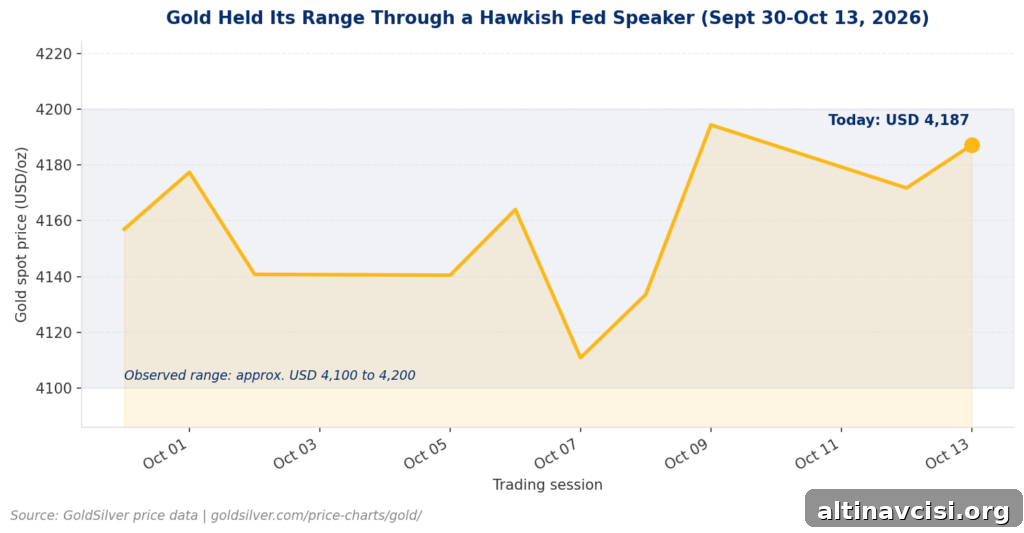
Gold is trading near $4,187 an ounce early Tuesday, roughly 0.4% above this morning’s open of $4,171.67 after briefly dipping toward $4,150 overnight. Silver sits near $60.07, down about 0.4% on the day, reflecting a continued divergence driven by real yields and industrial demand. The gold-to-silver ratio stands at 69.7.
Key takeaways:
- Cleveland Fed President Beth Hammack’s hawkish comments briefly pushed gold down toward $4,150 before the metal recovered toward $4,200 within hours.
- The underlying driver is the 10-year TIPS (real) yield, which sits near 2.9% — among its highest levels since the 2008 financial crisis.
- September’s Consumer Price Index (CPI) is due Wednesday at 8:30 a.m. ET. For holders of physical gold, short-term volatility around that release is rarely a reason to change a long-term position.
Why Did Gold Dip, Then Recover, on Hawkish Fed Comments?
Hammack’s remarks were notably hawkish and registered well above her usual tone on speech-tracking measures, reinforcing expectations that the Fed — which raised rates in September for the first time since 2023 — could raise rates again before year-end. That hawkish surprise briefly strengthened the dollar and pushed gold lower toward $4,150. When the dollar retraced some of those gains a few hours later, gold climbed back toward $4,200. In short: one Fed official’s words moved sentiment, and a currency swing erased most of that move within the same trading day.
What Is a Real Yield, and Why Isn’t It Sinking Gold Faster?
A real yield is the return on a nominal Treasury after adjusting for inflation expectations — essentially the nominal yield minus expected inflation. The 10-year TIPS market provides a direct read on that figure. Right now the 10-year real yield sits near 2.9%, a level not seen since the 2008 financial crisis.
Classical finance suggests higher real yields raise the opportunity cost of holding non-yielding assets like gold, which should pressure prices. Yet gold has largely ignored that expected pressure in recent weeks, trading in a steady range roughly between $4,100 and $4,200 rather than collapsing. This pattern — a decoupling between rising real yields and stable gold prices — has appeared before during this rate-hike cycle, and today’s Fed-driven move is another example rather than a new trend.
Put simply, while higher real yields create headwinds for gold, other forces (demand from buyers, safe-haven flows, and supply dynamics) have kept the metal resilient through elevated real rates.
Why Doesn’t This Week’s Fed Noise Matter to Someone Who Owns Physical Metal?
Most social and trading chatter right now is tactical and short-term. Bullish sentiment on gold tickers sits very high, and a large share of commentary focuses on whether Wednesday’s CPI will push gold through a nearby resistance band. That debate matters to traders who must be right about a specific intraday or next-day move.
By contrast, someone holding physical gold or silver typically cares more about the structural picture than day-to-day headlines. The current real-yield environment — where bond markets are offering historically strong real returns — tells a longer-term story. If gold can hold its range while real yields are near multi-decade highs, that resilience is a meaningful data point. The identity of the Fed speaker or the headline of the week will change, but the broader question — can gold compete with attractive yields from cash and bonds? — remains the same and needs only periodic reassessment, not constant monitoring.
What Should You Actually Watch This Week?
Key scheduled events this week include September’s CPI on Wednesday at 8:30 a.m. ET, the Producer Price Index on Thursday, and remarks from Fed Chair Kevin Warsh at IMF and World Bank gatherings on Friday. These releases and speeches will influence intraday and short-term market flows. Still, none of them will instantly rewrite the real-yield picture that has already allowed gold to maintain its range through a hawkish Fed comment and a dollar reversal in the same 24-hour period.
If you hold physical metal, consider focusing on the structural drivers — real yields, central-bank policy trends, and global demand — rather than reacting to every headline. For traders, the calendar provides clear catalysts for potential volatility and trading opportunities around the CPI and subsequent data.
Sources
1. Trading and market coverage of gold and the dollar
2. Reporting on Fed Governor Hammack’s remarks and policy stance
3. Real-yield and Treasury market data
4. Calendar items and economic-release schedules
Disclaimer: This article is for informational purposes only and does not constitute investment advice. Past performance does not guarantee future results. Consult a qualified financial advisor before making investment decisions.
You May Also Like:
- Short-Term Pressure Pushes Gold Down
- Squeezed at the Pump, Steady in the Vault
- Fed Governor Blames AI Chips for Inflation, Silver Falls
- Oil Jumps on Weather and Geopolitical Squeeze — Why Gold Didn’t Follow
- China’s Large Gold Purchases and the Price Reaction
- Why Silver Is Declining Faster Than Gold
- Five Wall Street Perspectives on Gold’s Recent Pullback
- Gold Rebounded After a Morning Sell-Off
- Market Structure Moves Quietly Rebuilding Gold’s Base
Popular Topics
Picked from the archive
-
01
 Topics
Why Investors Choose the Vienna Philharmonic Gold Coin
-
02
Topics
Stablecoin Issuer Outspent Central Banks on Gold Last Year
-
03
Topics
Why Gold Prices Are Falling Amid the Oil War
-
04
Topics
How to Buy Gold in 2026: Step-by-Step Guide for Beginners
-
05
Topics
Silver Appears Weak, Silver-to-Gold Ratio Signals Accumulation
-
06
Topics
Why Gold Prices Are Falling: What Most Investors Get Wrong
-
07
Topics
Should You Still Hold Gold in Your Portfolio?
-
08
Topics
Gold Bars vs Jewelry: Why Investors Choose Bullion