Why Central Banks Are Stockpiling Gold in 2026
Last verified October 2026.
De-dollarization describes a steady movement by many central banks to reduce the US dollar’s dominance in their foreign-exchange reserves. In practice this usually means raising allocations to gold and diversifying into other currencies. In 2026 that shift stopped being mostly theoretical: new IMF reserve statistics and the World Gold Council’s survey data show a clear, documented trend.
Central banks reported purchasing a record 289 tonnes of gold in Q2 2026, the largest quarterly total on record according to the World Gold Council (WGC). At the same time, IMF COFER data show the dollar’s share of allocated global reserves falling to 56.7%. The WGC’s 2026 survey also found a record share of reserve managers planning to add more gold over the next year.
Key Takeaways:
- Central banks bought a record 289 tonnes of gold in Q2 2026 (World Gold Council), continuing a multi-year run that has averaged well above historical norms.
- The US dollar’s share of allocated global reserves dropped to about 56.7% in Q2 2026 (IMF COFER), down from a peak above 72% in 2001.
- In the WGC’s 2026 survey, 45% of reserve managers said they plan to increase gold holdings within the next 12 months; 89% expect global official gold holdings to rise further.
- The 2022 freezing of roughly $300 billion in Russian reserves crystallized a political risk that reserve managers now model explicitly.
- Most central banks are targeting a 15–20% allocation to gold, so this is a targeted diversification program rather than an open-ended accumulation.
Why Does This Matter Right Now?
What changed in 2026 is not a single price move but the buyer. These purchases are coming from sovereign balance sheets implementing multi-year reserve strategies, not from retail traders chasing short-term momentum. That distinction matters because central-bank buying is deliberate, strategic and slow-moving, and it tends to continue regardless of short-term price swings.
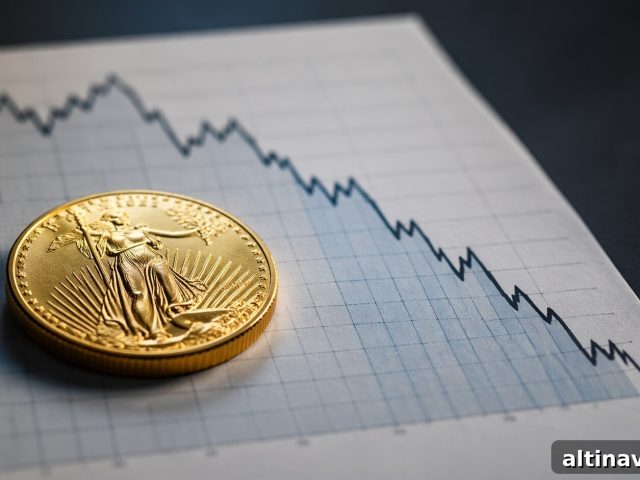
By early October 2026, gold traded in the mid-$4,100s (after a September peak), and silver sat in the low $60s. Those price pullbacks might look like fading demand on a chart, but official-sector buying continued through the correction. The real story is the divergence between price volatility and persistent, policy-driven accumulation by central banks.
The Knowledge That Changes Everything

Two essential guides — free. Learn why gold remains a central tool for preserving wealth and why fiat systems regularly face pressure.
Why Are Central Banks Buying Gold Right Now?
The dominant driver is reserve diversification in the face of geopolitical risk, not a short-term bet on bullion’s price. Since 2022 central banks have bought at a pace not seen since the era of fixed exchange rates, running well above the historical annual average.
The WGC’s 2026 Central Bank Gold Reserves Survey—completed by a record 76 respondents—found that 93% of reserve managers hold some gold (up from 81% several years earlier) and 84% expect gold to represent a larger share of reserves in five years. In March 2026, 68% of central banks said they planned to increase gold holdings that year, up from 62% the prior year.
Individual country examples underline the scale: Poland added 82 tonnes in 2026 toward a stated 700-tonne goal; Turkey added 45 tonnes in January; China reported a 20-tonne addition in July—its 21st consecutive month of reported buying—bringing disclosed holdings to roughly 2,366 tonnes. These are deliberate, balance-sheet moves, not short-term trading positions.
Is the Dollar Really Losing Its Reserve Currency Status?
Not in the dramatic sense that phrase often implies. The dollar still dominates global trade invoicing and settlement by a wide margin. The data instead shows a long-term decline in concentration: IMF COFER puts the dollar’s share of allocated reserves at 56.7% in Q2 2026, down from a peak above 72% in 2001. That decline reflects diversification across currencies and a growing share for gold, not an immediate replacement of the dollar.
It’s useful to be precise: losing share is not the same as losing status. A more diversified reserve mix simply reduces single-currency concentration risk while the dollar remains the primary international currency for many functions.
What Does the 2022 Russian Reserve Freeze Have to Do With Gold?
The 2022 freezing of roughly $300 billion in Russian central-bank assets made a latent risk concrete: assets held in another country can be politically restricted. For many reserve committees this transformed an abstract tail risk into a modeled, quantifiable scenario. Gold held domestically does not rely on another government’s permission; it is a physical asset under domestic legal control. That difference has strengthened the appeal of on-balance-sheet gold for many central banks.
How Much Gold Are Central Banks Actually Buying, and Is It Slowing Down?
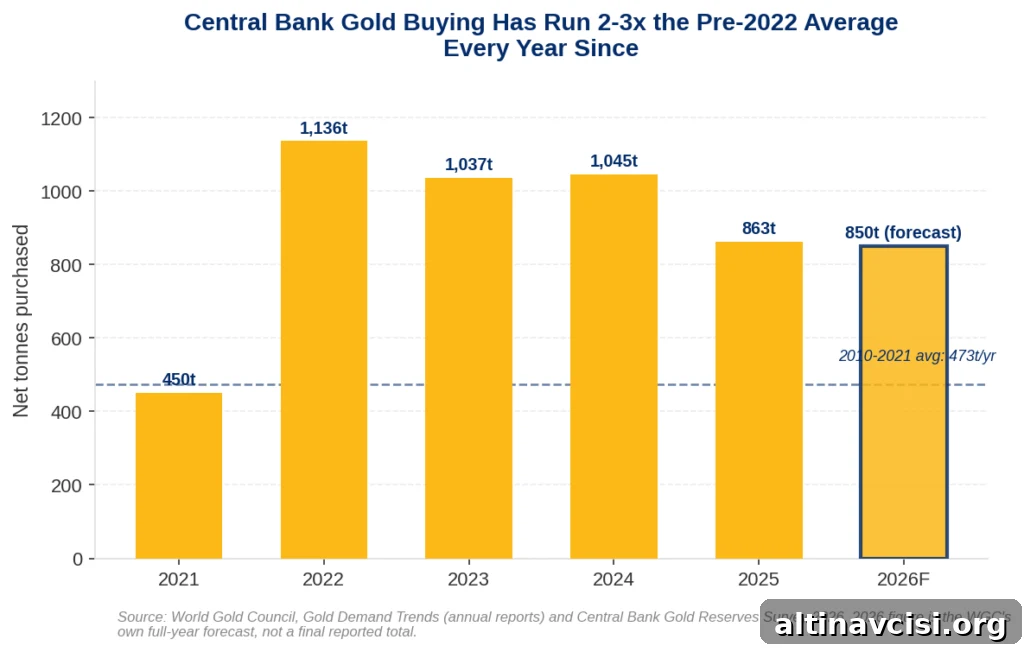
Q2 2026’s 289 tonnes is the most recent full-quarter figure and a record for a single quarter. Looking at annual patterns, the contrast is stark: between 2010 and 2021 central banks averaged about 473 tonnes per year; since 2022 annual purchases have run two to three times that historical average. The WGC’s 2026 forecast is somewhat more conservative than the four-year run near 1,000 tonnes, but it still indicates elevated official demand.
Survey data suggest reserve managers are treating recent price pullbacks as secondary to their long-term mandates. Official buying is policy-driven and tends to follow a multi-year timetable, not a 90-day price chart.
Second Corner: Is Central Bank Buying the Whole Story?
Official buying is a major structural factor supporting gold, but it is not unlimited. Most central banks cite conventional target ranges—commonly 15–20% of total reserves—for their gold allocations. Many holders are still below that level, which explains continued purchases, but the presence of a target implies a destination. Official demand will slow as individual countries approach their chosen ceilings, independent of price action.
What Does This Mean for an Individual Investor?
The logic behind central-bank diversification is the same logic an individual can apply: avoid concentrated exposure to a single currency, institution, or asset. Central banks buy gold not to time a rally but to hold an asset with no counterparty risk as part of a long-term reserve strategy. For private investors that supports the case for including a modest allocation to physical precious metals or other non-sovereign assets as insurance against geopolitical or market disruptions.
Stay On Top of Gold & Silver Prices
Get concise market alerts delivered to your inbox.
People Also Asked
What percentage of global reserves is gold?
Gold’s share of total global reserves has roughly doubled over the past 25 years, moving from around 10% to close to 20% by IMF-based estimates. That increase occurred while the dollar’s share declined over the same period.
Is de-dollarization the same as the dollar collapsing?
No. De-dollarization is a gradual rebalancing of reserve portfolios away from extreme concentration, not an immediate collapse of the dollar. The dollar still dominates international payments and trade settlement; the change is one of diversification, not replacement.
Should individual investors care about what central banks are doing with their reserves?
Yes, at least for strategic guidance. Central banks manage risk over long horizons; their move toward greater diversification provides a useful signal about portfolio construction and the potential role of non-sovereign assets like physical gold in protecting wealth.
How much gold did central banks buy in 2026?
Central banks reported a record 289 tonnes in Q2 2026. The WGC’s full-year forecast for 2026 is around 850 tonnes, and the recent multi-year pace has averaged roughly 1,000 tonnes annually since 2022—well above the pre-2022 average of about 473 tonnes per year.
Which central banks are buying the most gold?
Notable 2026 activity included Poland (adding 82 tonnes toward a 700-tonne target), Turkey (adding 45 tonnes in January), and China (reporting consecutive months of buying with disclosed holdings near 2,366 tonnes). Observers also believe some countries buy more than they publicly report.
Why don’t central banks just hold more US Treasuries instead of buying gold?
Treasuries yield interest while gold does not, so the choice involves a trade-off. Treasuries are a claim on the US financial system and can be affected by political decisions; the 2022 reserve freeze showed that risk. Gold held domestically avoids that counterparty exposure, which is why some reserve managers accept the yield sacrifice for improved political and operational security.
SOURCES
1. World Gold Council – Central Banks Set to Step Up Gold Buying Over the Next Year – June 16, 2026
2. World Gold Council – Gold Demand Trends, Full Year 2023: Central Banks – January 31, 2024
3. Mining.com – Central Banks’ Gold Buying Momentum Carries Into 2026 – March 2026
4. Mining.com – 2022 Was Record Year for Central Bank Gold Buying, WGC Confirms – Early 2023
5. OilPrice.com – Central Banks Continue Gold Buying Spree – Early 2023
6. Modern Diplomacy – Central Banks Are Buying Gold Like De-Dollarization Is Already Happening – September 14, 2026
7. Discovery Alert – Central Bank Gold Purchases: 2026 Market Analysis – March 2026
8. Canadian Mining Report – Central Banks Are Still Buying Gold: Here’s Why – March 2026
9. Canadian Mining Report – Central Banks Keep Buying Gold as Government Debt Mounts – August 2026
10. bne IntelliNews – Dollar’s Grip on Global Reserves Slips to Lowest Level This Century – July 13, 2026
11. Central Banking – Dollar’s Share of Foreign Reserves Fell Slightly in Q2 – IMF – September 30, 2026
12. FXStreet – 2024 Started as 2023 Ended With Central Banks Buying More Gold – March 7, 2024
13. Incomeshares – Central Bank Gold Reserves: How Much Do They Hold? – March 3, 2025
14. GOLDINVEST.de – Gold Remains in Demand: WGC Sees New Central Banks on the Buyer Side in 2026 – May 2026
Disclaimer: This article is for informational purposes only and does not constitute investment advice. Past performance is not indicative of future results. Always consult a qualified financial advisor before making investment decisions.
You May Also Like:
- Proof Gold Coins: Same Gold, So Why the Bigger Price?
- Silver Fell Harder Than Gold in September. The Solar Thrifting Story Isn’t Why.
- K-Shaped Economy: Why Asset Owners Win and Wage Earners Don’t
- Gold in Medicine: Dental, Surgical, and Pharmaceutical Uses Explained
- What Is Gold Backwardation? The Rare Signal That Struck 3 Times in 2025
- A Bank Just Said the Fed Isn’t Done Hiking. Here’s the Math on What That Does to Gold.
- Gold Fell 23% This Year. One Number Explains Why.
- What Is the Debt-to-GDP Ratio, and What the US Number Tells You About Gold
Popular Topics
Picked from the archive
-
01
 Topics
Why Investors Choose the Vienna Philharmonic Gold Coin
-
02
Topics
Stablecoin Issuer Outspent Central Banks on Gold Last Year
-
03
Topics
Why Gold Prices Are Falling Amid the Oil War
-
04
Topics
How to Buy Gold in 2026: Step-by-Step Guide for Beginners
-
05
Topics
Silver Appears Weak, Silver-to-Gold Ratio Signals Accumulation
-
06
Topics
Why Gold Prices Are Falling: What Most Investors Get Wrong
-
07
Topics
Should You Still Hold Gold in Your Portfolio?
-
08
Topics
Gold Bars vs Jewelry: Why Investors Choose Bullion