PMI Beat Moves Gold Price Two Ways: Markets Priced Only One

The U.S. economy just produced its strongest monthly reading in more than five years — yet gold and silver both fell on the day. The same S&P Global flash PMI report that pushed markets toward a growth-driven reaction also contained clear signs of rising price pressure, a nuance the market has not fully priced into precious metals.
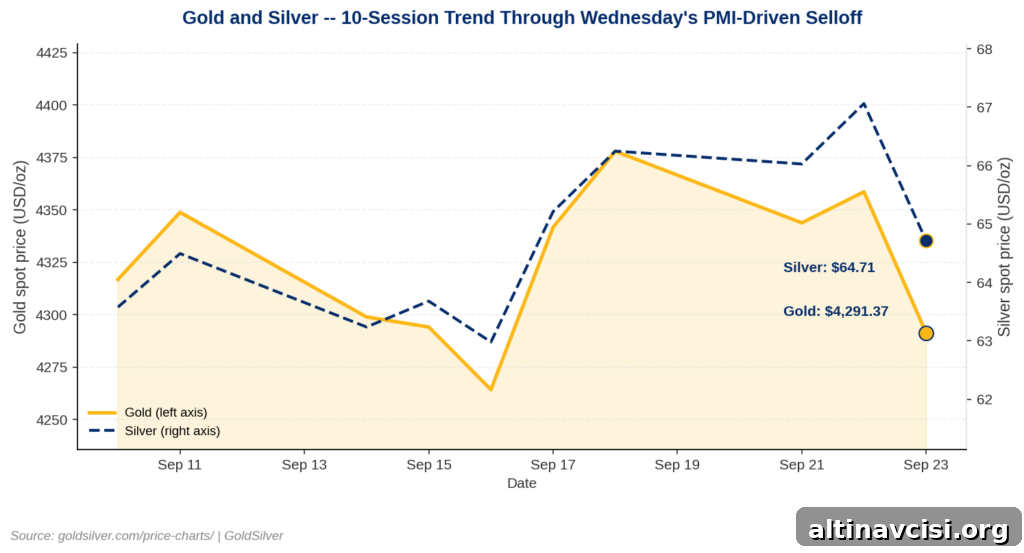
Gold is trading near $4,291.37, down about 1.5% on the session. Silver traded near $64.71, off about 3.5%. These levels reflect live spot readings on the afternoon of Wednesday, September 23, 2026.
Key takeaways
- Gold and silver declined after S&P Global’s flash Composite PMI unexpectedly jumped to 58.4 in September, the fastest pace of U.S. business expansion in 62 months and well above the consensus forecast.
- The same PMI release shows input costs rising at their fastest rate in four years and order backlogs worsening to levels not seen in nearly two decades outside the pandemic — evidence of demand-driven inflation that could support precious metals over time.
- Platinum and palladium posted even larger declines than gold and silver, suggesting a broad market move tied to the dollar and interest-rate expectations rather than metal-specific demand shifts.
What did today’s PMI report actually show?
S&P Global’s flash U.S. Composite PMI rose to 58.4 in September, up from 56.0 in August and comfortably above the consensus of 55.2. Services led the expansion, and manufacturing output accelerated sharply — manufacturing climbed to 57.0 from 53.9, its strongest reading since May 2022. S&P Global called this the fastest pace of U.S. business growth in over five years.
Markets reacted quickly. Gold dropped to session lows within minutes of the 9:45 a.m. ET release. The logic is straightforward: a materially stronger PMI increases the odds of another Federal Reserve rate hike. The CME FedWatch Tool had already priced roughly a 54% chance of an October hike before the report; a stronger data point reinforces that path. Higher short-term rates raise the opportunity cost of holding non-yielding gold, and that dynamic often pressures bullion in the near term.
Why might the selloff be missing half the story?
The same PMI release that signaled robust growth also flagged rising input costs and growing backlogs of work. Input costs accelerated at their fastest rate in four years, and backlogs increased at the sharpest pace since May 2022. Those backlog readings are the strongest outside the pandemic era in the survey’s nearly two-decade history. S&P Global’s lead economist warned that the report’s internal price pressures are “a worry for the inflation outlook.”
Rising input costs and lengthening supply constraints point to demand-driven inflation. That kind of inflationary pressure is typically supportive for gold, which investors use as a hedge against currency debasement and persistent inflation. In short, the same document that sparked selling because it implies higher rates also contains signals that should, over time, support precious metals. The market has mainly traded the growth beat so far; the inflation half of the story has not yet been reflected fully in metal prices.
Does the wider metals complex confirm this is a macro move?
Yes. Platinum dropped roughly 4.4% and palladium about 3.1% alongside gold and silver. Those metals do not share the same industrial drivers as silver (solar, electronics, AI hardware) nor gold’s role with central-bank buyers. Their primary industrial use is in catalytic converters for vehicles, a separate demand pool. The synchronized declines across metals with different demand profiles point to a common macro driver — movements in the dollar and in rate expectations — rather than issues limited to any single metal.
What does this mean for someone holding physical gold or silver?
Short-term price moves can reflect shifts in rate expectations even when fundamentals still support precious metals as an inflation hedge. Today’s price decline looks like a technical reaction to a growth surprise and the resulting higher probability of Fed tightening. But the report’s own data on input costs and backlogs argues that inflationary pressures are still present.
If the Fed hikes into an expansion characterized by tight supply rather than genuine disinflation, nominal yields could rise while real inflation remains persistent. That scenario erodes the purchasing power of currency over time and reinforces the role of gold and silver as stores of value. Falling prices on a single day do not negate that structural case.
What should investors watch next?
- 10-year Treasury breakeven inflation rate — it stood near 2.33% as of September 22. A rising breakeven would signal the market starting to price the inflation half of the PMI report.
- Near-term data releases: weekly jobless claims, the Fed’s H.4.1 balance sheet update, and the University of Michigan’s final September inflation-expectations reading.
- Geopolitical and macro events such as major summits or trade discussions that can affect the dollar and commodity demand; these events can amplify moves already set off by economic data.
Sources
S&P Global Market Intelligence — Flash US Composite PMI Press Release, September 23, 2026; CME Group — FedWatch Tool; Federal Reserve Bank of St. Louis — 10-Year Breakeven Inflation Rate (T10YIE).
Disclaimer: This article is for informational purposes only and does not constitute investment advice. Past performance does not guarantee future results. Consult a qualified financial advisor before making investment decisions.
You may also be interested in
- Analysis of how dollar strength and rate expectations can drive coordinated moves across precious metals.
- Perspectives on how major geopolitical events and summit meetings affect silver’s industrial outlook and price action.
- Discussion of why gold-mining equities sometimes lag bullion during short-term market rotations.
Popular Topics
Picked from the archive
-
01
 Topics
Will Policy Reversal Move Gold? Conflict Pressure Index Insight
-
02
Topics
Silver Drops 6% After Jobs Beat; Six-Year Deficit Remains
-
03
Topics
3 Fed Officials Voted to Hike Rates: What It Means for Gold
-
04
Topics
Gold vs Silver: Why Gold Stabilizes Markets, Silver Amplifies
-
05
Topics
How Silver Powers AI Models and Infrastructure
-
06
Topics
Gold vs Savings Account: Which Investment Beats Inflation Now?
-
07
Topics
Federal Reserve Votes Wednesday: Track the Vote Tally
-
08
Topics
Peak Gold: Why Gold Mine Output Can’t Meet Demand