Peak Gold: Why Gold Mine Output Can’t Meet Demand
Key Takeaways
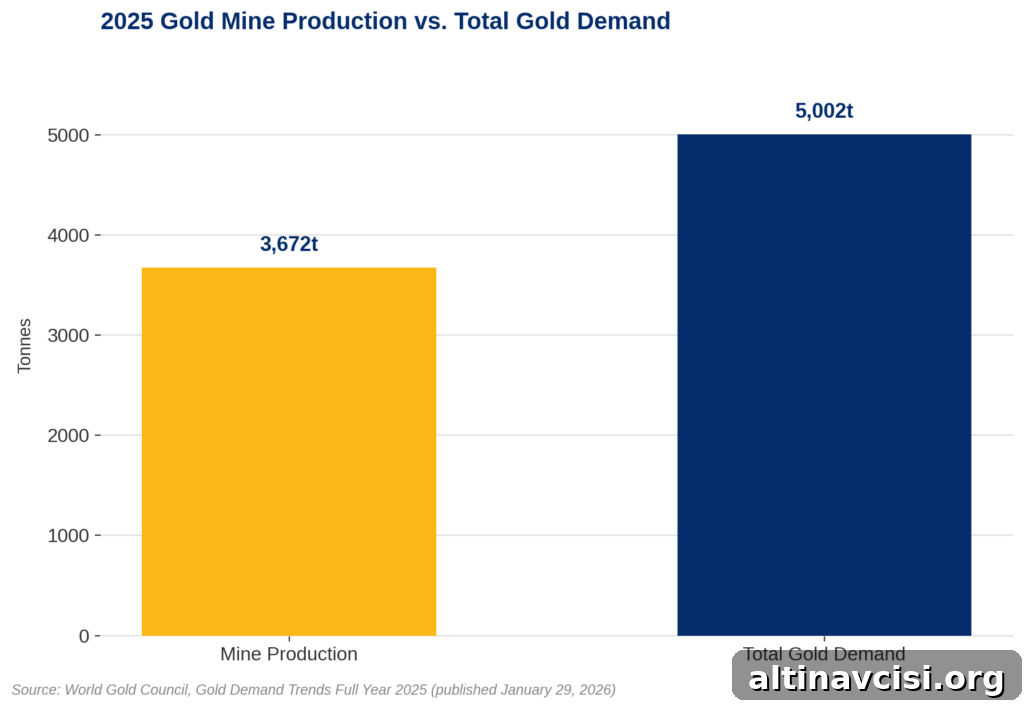
- Global gold demand exceeded 5,000 tonnes in 2025 for the first time, while total market supply reached 5,002 tonnes. Mine production provided only 3,672 tonnes [World Gold Council].
- Mine output has averaged growth below 1% per year for a decade, even as the gold price jumped significantly in 2025. Mining cannot simply be ramped up overnight.
- No new major gold discovery was confirmed in 2023 or 2024, and large producers like Newmont reported lower reserves mainly due to portfolio reshaping rather than new finds.
- Industry-wide all-in sustaining costs rose to roughly $1,605 per ounce in 2025. A fresh discovery made today typically takes roughly 16 years to reach production.
- Recycled gold and above-ground stocks now fill the gap between demand and mining supply. That structural shortfall is an important consideration for physical metal ownership versus paper claims.
“Peak gold” describes a turning point in which global mine production stops expanding and can no longer keep pace with demand. For investors in gold and silver, that shift changes market dynamics: instead of an elastic supply responding quickly to higher prices, a constrained physical supply means price and the willingness of existing holders to sell become the dominant balancing forces.
In 2025 total gold demand surpassed 5,000 tonnes for the first time since records began. Mine production did set a record at 3,672 tonnes, but the increase was only about 1% year-over-year, continuing a long-term trend of near-zero growth. The shortfall between what the market wanted and what miners produced was met mostly by recycled gold and existing above-ground stocks held in jewelry, bars, coins and central bank vaults.
Why Is Gold Demand Outpacing Mine Supply Right Now?
By mid-2026, gold traded near $4,130 an ounce, up roughly 24% year-over-year. Demand continued to climb: investment demand surged, ETF inflows were large, bar and coin purchases reached multi-year highs, and central banks remained net buyers. Yet mine production barely moved. That mismatch—hundreds of tonnes of additional demand in a single year versus mine output that grows only marginally—is the core of the peak-gold argument.
When demand accelerates quickly but mine production is structurally constrained, price must absorb the imbalance. Production cannot be scaled quickly because the underlying geology and long development timelines limit how fast new ounces can be delivered to market.
What Does “Peak Gold” Actually Mean?
Peak gold does not imply the world is running out of gold. Instead, it indicates that mining output has stopped growing meaningfully. Unlike many commodities where higher prices quickly unlock new supply, gold’s supply response is slow because the industry is digging lower-grade ores, and large, easy discoveries are increasingly rare.
Over time ore grades have declined sharply. Whereas early twentieth-century deposits often ran several grams per tonne, many modern open-pit operations recover only 1–2 grams per tonne. Lower grades mean more rock must be moved and processed for each ounce produced, raising costs and reducing the speed at which miners can expand output no matter how high the price climbs.
Why Haven’t Miners Found More Gold?
Industry discovery data show a prolonged drought in major finds. The number of significant discoveries has been limited, and the share of exploration budgets devoted to grassroots, high-risk discovery is at historic lows. Producers increasingly invest in expanding and extending known deposits or buying reserves from other companies rather than funding risky searches for entirely new deposits. That strategy boosts near-term certainty but does little to increase the overall reserve base.
Since 2020 only a few discoveries of substantive scale have been confirmed, and some resumptions in reserve figures reflect reclassification of known deposits or price-driven economic re-evaluations rather than fresh geological finds.
The Newmont Case Study
Newmont’s 2025 reserve update illustrates the dynamics. Reported reserves fell from 134.1 million ounces to 118.2 million ounces. Much of that decline resulted from divestments and portfolio changes rather than geology. Mining depletion removed several million ounces, while exploration-driven additions replaced only a fraction of what was mined. In short, exploration is not replacing mined ounces at anywhere near a one-to-one rate.
The Knowledge That Changes Everything

Two concise guides to help you understand why gold matters and the long-term risks of fiat currencies.
How Long Does It Take to Bring a New Gold Mine Into Production?
Even when a major discovery is made, bringing it to first production is a long process. From discovery through permitting, feasibility studies, financing and construction, the typical timeline is roughly 16 years. That lag means today’s shortfall in exploration and discovery will influence supply for a generation, regardless of current price levels.
Because of long lead times, miners often prefer acquisitions to expensive, risky exploration. In 2025 the industry completed a number of M&A deals that transferred hundreds of millions of ounces of resources and reserves—an indication that companies are buying growth rather than drilling for it.
What Happens to Gold Supply If Grades and Discoveries Keep Falling?
Known global gold reserves are estimated in the tens of thousands of tonnes. At recent production rates, those identified reserves represent a couple of decades of mining. But reserves are a moving measure: higher prices and new technology can convert more rock into economically mineable reserves over time. Still, conversion requires capital, permits and years of work.
A more immediate impact is on cost. Industry all-in sustaining costs increased in 2025, driven by lower grades, higher sustaining capital and rising royalties. When the marginal cost to produce approaches or exceeds price moves, incentives and economics change, but the physical limits and long development cycles remain.
The Part of This Story Most Coverage Skips
Media coverage often treats demand and supply as separate narratives—central bank buying, ETF flows and jewelry demand are discussed independently of mine production. But the critical point is their interaction. In 2025 total market supply reached 5,002 tonnes while mine production supplied roughly 73% of that. The rest came from recycled metal. Recycling rose only modestly despite higher prices, suggesting many holders preferred to keep physical gold rather than sell into the rally. That dynamic shifts marginal supply away from miners toward existing owners.
What Peak Gold Means for Gold and Silver Investors
For investors, the peak-gold concept highlights the difference between owning physical metal and owning paper claims. Many financial products represent claims on pooled metal rather than specific, allocated bars. When physical supply is constrained and holders are reluctant to sell, the distinction becomes more important. Physical ownership provides direct access to the metal itself; claims, futures or unallocated positions depend on the integrity and liquidity of the backing pool.
Ultimately, declining discovery rates, falling ore grades and long project lead times mean supply will likely respond slowly to price. That structural reality should be factored into portfolio decisions, allocation size and storage choices for investors considering gold and silver.
Stay On Top of Gold & Silver Prices
Receive concise market alerts and analysis by email. (Subscription form removed for privacy.)
People Also Ask
What is peak gold?
Peak gold is when global mine production levels off and can no longer expand to match rising demand. It’s driven by geological constraints—falling ore grades and fewer major discoveries—not by the physical absence of gold in the Earth.
Is gold actually running out?
No. Identified reserves and the large stock of above-ground gold (jewelry, bars, coins, central bank holdings) mean total available gold remains substantial. The constraint is how quickly and economically new supply can be extracted.
How is peak gold different from peak oil?
Both describe production plateaus, but gold responds far more slowly to price signals. New oil projects can sometimes reach production in months; a new gold mine typically takes many years—on average about 16 years—from discovery to first production.
Why don’t higher gold prices lead to more mine supply?
Higher prices increase financial incentives, but they don’t change geology. Lower ore grades mean miners must process more material for each ounce. Costs and long development timelines limit how quickly new supply can appear.
What fills the gap between gold demand and mine supply?
Recycled gold and above-ground stock in bars, coins and jewelry fill most of the gap. In 2025 about 27% of supply came from recycling and existing holdings rather than new mining output.
Does peak gold mean I should buy physical gold instead of paper gold?
That depends on your objectives and risk tolerance. When physical supply is constrained, the benefits of holding allocated, identifiable metal—versus claims on pooled metal—become more pronounced. Understand the differences before making allocation decisions.
Will gold mine production ever grow again?
Possibly, but not quickly. Exploration spending has increased recently, which could lead to discoveries, but any new large-scale mines discovered today would likely not contribute materially to global supply until many years from now. In the near term, growth is more likely to come through mergers and acquisitions than by immediate new production.
SOURCES
World Gold Council — Gold Demand Trends: Full Year 2025; supply and demand data
S&P Global Market Intelligence — discovery and exploration analysis
Newmont Corporation — 2025 mineral reserves report
USGS — historical ore grade and reserve context
GoldSilver — live price charts and market context
Disclaimer: This article is informational only and not financial or investment advice. Consult a qualified financial adviser before making investment decisions.
You May Also Like:
- How Is Gold Taxed When You Sell It? The 28% Collectibles Rule Explained
- Most Gold Storage Isn’t Allocated. How to Check Yours.
- Garner Calls a $3,600 Floor. Is Gold Going Lower?
- Why Is Gold So Expensive? The 5 Mechanisms Behind the Price
- Gold vs. Savings Account: Which One Is Actually Beating Inflation Right Now?
- Seigniorage: The Hidden Tax on Every Dollar You Hold
- Gold Has a 0% Risk Weight and an 85% Funding Penalty. Banks Are Finally Asking Why.
Popular Topics
Picked from the archive
-
01
 Topics
Silver Price Hits $50 as Morgan Stanley Allocates 20% to Gold
-
02
Topics
Gold vs Silver: Liquidity Explained for Investors
-
03
Topics
Kansas City Fed President Urges Steady Rates Amid High Inflation
-
04
Topics
Trump $2,000 Stimulus Checks, Auto Loan Crisis and Silver Rally
-
05
Topics
France Completes Gold Repatriation, Germany Set to Follow
-
06
Topics
Deutsche Bank Identifies Gold Price Floor: Surprise Buyers
-
07
Topics
Should Investors Swap Silver for Gold Now?
-
08
Topics
Gold vs Bitcoin: Which Is the Smarter Investment Today?