Gold Prices Fall as Fed Turns Hawkish, Iran Rally Fades
Although the Federal Open Market Committee did not meet this week, gold fell after remarks from two Federal Reserve presidents pushed markets to reprice how many rate increases may still be required.
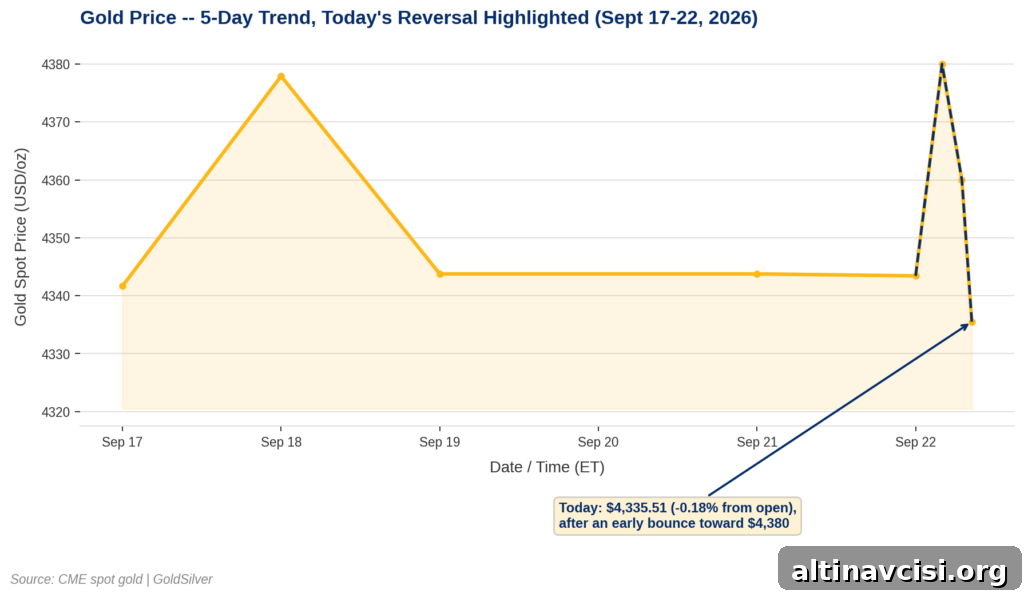
As of September 22, gold is trading near $4,335 an ounce, down about 0.2% from the morning open. Silver slipped more sharply to about $65.68, off roughly 0.7%. Both metals gave back an early recovery: gold briefly reached about $4,380 during Asian hours before hawkish Fed commentary from U.S. officials pushed prices lower once domestic trading desks opened.
Key takeaways:
- Gold and silver eased as hawkish comments from Fed officials reinforced the tighter policy outlook outlined at the September 16 meeting, even though no FOMC vote occurred this week.
- The main transmission is through real yields: Fed commentary shifts expectations for future real interest rates, and historically a 25-basis-point move in real yields tends to move gold by roughly $40–$60 an ounce.
- Hopes for progress on Iran diplomacy tied to the UN General Assembly are supporting gold somewhat, but they are not the primary reason the metals fell today.
Why did gold fall today?
Two regional Fed presidents spoke on Monday and their comments pushed traders to reassess how much further policy will tighten. St. Louis Fed President Alberto Musalem warned that additional rate hikes may be necessary to ensure inflation settles back toward 2% over the medium term. Chicago Fed President Austan Goolsbee likewise cautioned that persistent supply shocks could keep inflation elevated and that bringing inflation back to target may require higher rates and the growth slowdown that accompanies them.
Neither official cast a vote this week. Markets, however, treated their remarks as fresh information about the likely path of policy ahead of upcoming Fed meetings — and that repricing pushed real-yield expectations higher, which lowers gold’s relative appeal.
Why does Fed speech move gold without a meeting?
Gold does not pay interest, so its opportunity cost depends on real interest rates — nominal rates minus expected inflation. When real yields rise, holding cash or Treasury securities looks more attractive compared with non‑yielding gold. When real yields fall, gold becomes relatively more appealing. Historically, a 25-basis-point shift in real yields tends to move gold by roughly $40 to $60 per ounce.
Markets had already priced in the Fed’s September 16 decision to raise rates to a 3.75%–4.00% range. What remained uncertain was how many additional hikes would follow and how quickly they would come. The speeches from Musalem and Goolsbee moved those expectations. CME FedWatch probabilities shifted after their comments: traders now assign about a 53% chance to another quarter-point hike at the October 27–28 meeting, and the cumulative odds of at least one more hike by year-end are close to 90%. Changes in those odds affect gold today because they change the expected path of real yields well before votes actually occur.
What are the Fed’s own numbers saying?
The Fed’s internal projections reflected a hawkish tilt: most participants expect at least one more quarter-point hike before year-end. In the post-September projection, 16 of 18 FOMC participants indicated they expect another rate increase, and the median year‑end projection for 2026 rose to about 4.1% from 3.8% in June.
The 10-year real yield, as measured by TIPS, was around 2.63% at Monday’s close — materially higher than the levels seen before the tightening cycle resumed. That concrete rise in real yields underpins the market’s “hawkish Fed” interpretation and helps explain downward pressure on gold in the near term.
None of these developments undermines the structural case for holding physical precious metals. The Fed is raising rates into an environment with persistent supply-driven inflation and a large federal debt burden, a combination that makes prolonged, aggressive tightening politically and economically difficult. That structural backdrop remains intact even as short-term volatility reflects shifting policy expectations.
Is silver following gold today, or breaking away?
Today silver underperformed gold: silver fell about 0.7% while gold eased roughly 0.2%. That moved the gold‑to‑silver ratio up to approximately 66.0 from Monday’s close of 65.79. A rising ratio indicates silver is cheaper relative to gold; a falling ratio signals the opposite. One session’s movement does not establish a long-term trend, but the ratio is a useful indicator to watch over the coming days before drawing conclusions.
What’s the real story here?
On the surface the story is straightforward: hawkish Fed commentary prompted a near-term pullback in gold. The deeper point is that markets are now trading on the distribution of possible future Fed paths rather than on the single last vote. Speeches and public appearances by Fed officials matter because they shift expectations about future policy decisions. The September hike itself produced only a modest one-week gain for gold because markets had largely anticipated the move; subsequent public remarks are doing the marginal work of repricing expectations.
Expect similar volatility in the run-up to the Fed’s October meeting. Each Fed speaker can confirm or complicate the market’s view of the likelihood of another rate increase, and that ongoing stream of commentary will continue to move real-yield expectations and, therefore, precious-metal prices.
What should investors watch next?
Two more Fed officials are scheduled to speak later today — New York Fed President John Williams and Richmond Fed President Thomas Barkin — any of whom could nudge October hike odds again. The Fed’s next scheduled meeting on October 27–28 is a policy meeting without a fresh Summary of Economic Projections; the next SEP release is set for December 8–9. On geopolitics, follow remarks at the UN General Assembly: President Trump’s speech and Iranian President Masoud Pezeshkian’s address the following day could influence oil markets and risk sentiment, which in turn can affect safe-haven demand for gold. At present, no bilateral meeting between the two leaders has been confirmed.
The edge every investor needsSmarter precious-metals investing begins with timely market insight. Subscribe for concise alerts, Fed updates, and analysis you can use.
Stay on top of gold & silver prices
Get important market alerts sent to your inbox.
Current prices (snapshot): Gold ≈ $4,335 | Silver ≈ $65.68
SOURCES
1. FXStreet — Gold declines to near $4,350 on rising odds of Fed rate hike
2. Benzinga — Goolsbee warns on inflation, October hike odds stay above 50%
3. CNBC — Fed rate decision September 2026: Rates rise to 3.75%-4%
4. briefs.co — Gold rises as oil slide eases inflation fears
5. FXStreet — Gold steadies on Iran diplomacy hopes, Fed outlook caps upside
6. PrimeRates — Federal Reserve meeting schedule 2026 & prime-rate dates
7. WatchGold — 10‑Year TIPS yield and US real interest rate chart
Disclaimer: This article is for informational purposes only and does not constitute investment advice. Past performance is not indicative of future results. Consult a qualified financial advisor before making investment decisions.
You may also like:
- Bernstein just cut its gold forecast — by breaking gold’s oldest rule to defend it
- The Fed just hiked. Wall Street keeps getting more bullish on gold anyway.
- Gold dips, silver holds as Iran diplomacy hopes sink oil before a bigger week
- Silver round-tripped a 6.8% shock in nine days. Real yields did it, not inflation.
- Iran hit a tanker in Hormuz and Trump threatened Iran. Oil isn’t reacting.
- Rates just went up twice. Five reasons gold didn’t care.
- The Bank of Japan just hiked to a 31-year high. Gold barely noticed.
Popular Topics
Picked from the archive
-
01
 Topics
Major Banks Now Converge on 2026 Gold Price Near $4,500
-
02
Topics
Gold Prices Ahead of April 29 FOMC: What Traders Should Watch
-
03
Topics
Should You Buy Gold Now During a Dip? Timing and Risks
-
04
Topics
Gold Allocation Calculator: How Much Gold Should You Hold?
-
05
Topics
Silver vs Gold 2026-2031: 5-Year Investment Outlook
-
06
Topics
How a Copper Mine Skipping Silver Explains the Deficit
-
07
Topics
Why Central Banks’ Purchase of 39 Tonnes of Gold Matters
-
08
Topics
Why Silver Jumped 6% Before Trump Xi Summit