Cantillon Effect: Who Gets Rich First When New Money Is Created

Key Takeaways:
- The Cantillon effect explains that new money does not reach everyone at once. Those who receive it first can spend and invest before prices adjust; those who receive it last—typically wage earners and savers—face higher prices paid with devalued money.
- Richard Cantillon articulated this mechanism around 1730 in his Essay on the Nature of Trade in General, drawing on his own experience trading shares in John Law’s Mississippi Company a decade earlier.
- Post-2008 quantitative easing provides a clear, dated example: the Federal Reserve’s balance sheet rose from under $1 trillion before the crisis to roughly $8.95 trillion by April 2022. Over the same period, financial assets and real estate appreciated much faster than wages.
- The Fed’s Distributional Financial Accounts show the result in dollar terms: as of Q3 2025 the top 0.1% of households held $24.9 trillion in net worth, compared with $4.2 trillion held by the entire bottom half of American households in that quarter.
- How new money enters the economy matters. Bond purchases tend to inflate financial assets first; direct fiscal transfers inflate consumer spending and prices first, which can temporarily narrow wealth gaps before inflation erodes real purchasing power.
- Physical gold and silver sit outside the banking system’s transmission channel: central bank balance sheet expansion cannot create additional ounces of precious metal.
Gold trades near $4,296 an ounce and silver near $63 an ounce today. Those prices are the outcome of many forces; the Cantillon effect helps explain why asset prices and the distribution of wealth move the way they do.
What Is the Cantillon Effect?
New money does not spread evenly through an economy. It appears first to whoever is closest to the source—typically banks, large financial institutions, and the government—and those recipients can act on it immediately at existing prices. As that money moves outward through loans, investment and spending, prices adjust. By the time wage earners, pensioners and savers receive the new money, the purchasing power it represents may already be lower.
Richard Cantillon, an Irish‑French banker, developed this insight around 1730 and published it posthumously in 1755. Cantillon’s view was shaped by direct involvement in John Law’s Mississippi experiment in early‑18th‑century France: he bought shares early, traded them as prices rose dramatically, converted gains into coin, and left before the collapse. That experience illustrated who benefits first when a government expands the money supply and who bears the losses when it collapses.
From that episode Cantillon drew a broader conclusion: monetary expansion unfolds in sequence, not uniformly, and the order of recipients determines who gains and who loses in real terms.
The Knowledge That Changes Everything

Two essential guides — yours free. Learn why gold matters and why fiat systems have repeatedly failed.
How Does New Money Actually Move Through the Economy?
Textbooks often describe inflation as if adding money is like raising the level of water in a bathtub: everything rises evenly. The Cantillon effect shows a different reality. New money enters at specific points and takes time to spread, much like a drop of dye released at one end of a tub. The water closest to the drop changes color long before the rest.
In today’s financial system the drop usually falls into the banking and financial sector. A central bank expands its balance sheet by purchasing Treasuries or mortgage-backed securities from large financial firms. Those firms—and the wealthy households that own most financial assets—receive the newly created money first and can deploy it into stocks, property and other assets at prevailing prices. Wages and pensions, however, adjust more slowly; paychecks often reflect earlier price levels while asset prices have already moved.
What Did Post-2008 Quantitative Easing Actually Show?
The decade and a half after the 2008 crisis offered a clear real‑world test of the Cantillon mechanism. The Federal Reserve’s balance sheet, under $1 trillion before the crisis, expanded through multiple rounds of quantitative easing to about $4.5 trillion by 2014 and reached roughly $8.95 trillion by April 2022 during the pandemic response. After subsequent runoff it stood at about $6.74 trillion at the time of the latest reporting.
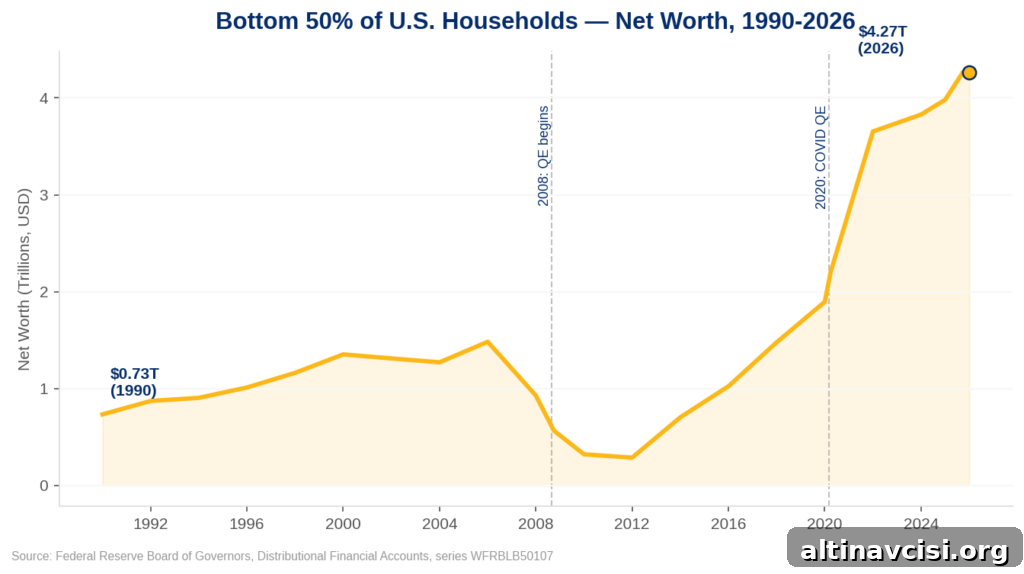
Most of that expansion entered the economy via purchases of Treasuries and mortgage securities from banks and dealer firms—the same institutions and households that already held the majority of financial assets. The Federal Reserve’s Distributional Financial Accounts quantify the distributional outcome: both the bottom half and the very top of the wealth distribution increased in nominal terms, but the top 0.1% grew far faster. That divergence aligns with the Cantillon insight: early recipients of new money tend to capture asset gains before prices broadly adjust.
Does It Matter How the Money Gets In?
Yes. The point of entry determines which prices and which people are affected first. Bond purchases—standard QE—inject liquidity into financial markets and tend to push up asset prices before consumer prices. Direct fiscal transfers, such as the stimulus checks of 2020–2021, put money directly into household accounts and boost consumer spending, which can raise the price of everyday goods faster than asset prices.
Those differences show up in the data. After the first rounds of QE, the combined net worth of the bottom half of U.S. households fell for several years even as the Fed’s balance sheet expanded. The bottom half’s balance did not recover strongly until the pandemic-era fiscal transfers arrived. That contrast supports the idea that the injection point matters for distributional outcomes.
This is not a moral judgment that one policy is inherently “good” and another “bad.” Rather, it is a structural observation: whoever receives newly created money first gains a timing advantage. The mechanism works similarly regardless of the political or policy context.
What Does the Cantillon Effect Mean for Gold and Silver?
Physical gold and silver are not created by central bank actions. No expansion of a central bank’s balance sheet, no bond-buying program, and no change in reserve accounts can increase the number of ounces above what mines and recycling supply. That constraint separates precious metals from assets whose prices can be inflated by the Cantillon sequence.
Holding physical metal does not negate monetary policy’s distributional impacts, but it does place an investor outside the queue that gives timing advantages to early recipients of newly created money. Because supply of gold and silver is constrained by geology and production, physical ownership behaves differently than a claim on financial assets that can be created by policy choices.
Stay On Top of Gold & Silver Prices
Get important market alerts sent straight to your inbox.
People Also Ask
What is the Cantillon effect in simple terms?
It means new money reaches some people before others. Early recipients—usually banks and financial institutions—can spend and invest before prices rise. Late recipients—often wage earners and savers—face higher prices paid with money that has already lost purchasing power.
Does quantitative easing cause inequality?
The evidence from 2008–2022 is consistent with that interpretation. The Fed’s asset purchases entered primarily through financial markets, boosting asset prices faster than wages. The Fed’s Distributional Financial Accounts show a widening wealth gap between the top 0.1% and the bottom half of households over that period.
Who first described the Cantillon effect?
Richard Cantillon, an 18th‑century Irish‑French banker, articulated the idea in his Essay on the Nature of Trade in General, written around 1730 and published after his death in 1755. He based his conclusions on personal experience trading in the Mississippi Company episode.
How does gold protect against the Cantillon effect?
Gold and silver cannot be created by policy decisions; their supply is limited by mining and physical availability. Holding physical metal places an owner outside the sequence that gives timing advantages to early recipients of newly created money.
SOURCES
1. Econlib — Essai sur la Nature du Commerce en Général (Cantillon)
2. Oxford Academic — Richard Cantillon: Entrepreneur and Economist (Antoin E. Murphy)
3. Federal Reserve — H.4.1 Release: Factors Affecting Reserve Balances
4. Federal Reserve Board — Distributional Financial Accounts
5. Mises Institute — John Law and the Mississippi Bubble, 300 Years Later
6. Liberty Street Economics — The Mississippi Bubble of 1720
7. Britannica — Mississippi Bubble
8. GoldSilver — Live Gold and Silver Spot Prices
Disclaimer: This article is for informational purposes only and does not constitute investment advice. Past performance is not indicative of future results. Consult a qualified financial advisor before making investment decisions.
You May Also Like:
- Silver Price Outlook September 2026: The Hike Is Priced In. The Positioning Isn’t.
- Gold Is About to Face Its First Rate Hike of the Cycle. Here’s Why It Isn’t Scared.
- How Much Gold Should You Own at 25, 45, or 65?
- Gold Price Outlook September 2026: What the Fed’s September 15–16 Meeting Means for Your Metals
- Do You Have to Report Gold Stored in a Foreign Vault? FBAR and FATCA Rules Explained
- Tokenized Gold: What It Actually Is, and Where the “Just Like Owning Gold” Pitch Breaks Down
- IRA‑Eligible Gold: The Coins and Bars That Actually Qualify
- The No‑Home‑Storage‑IRA Myth: Why the IRS Requires a Depository
Popular Topics
Picked from the archive
-
01
 Topics
Major Banks Now Converge on 2026 Gold Price Near $4,500
-
02
Topics
Gold Prices Ahead of April 29 FOMC: What Traders Should Watch
-
03
Topics
Should You Buy Gold Now During a Dip? Timing and Risks
-
04
Topics
Gold Allocation Calculator: How Much Gold Should You Hold?
-
05
Topics
Silver vs Gold 2026-2031: 5-Year Investment Outlook
-
06
Topics
How a Copper Mine Skipping Silver Explains the Deficit
-
07
Topics
Why Central Banks’ Purchase of 39 Tonnes of Gold Matters
-
08
Topics
Why Silver Jumped 6% Before Trump Xi Summit