Fed Vote Wednesday: Key Gold Decision Arrives Friday

Gold is trading near $4,284 and silver near $63.18 as of Tuesday. Prices are largely unchanged as investors await the Federal Reserve’s decision scheduled for Wednesday, while the Bank of Japan meets on Friday. For the first time in this tightening cycle, two of the world’s most influential central banks are expected to raise interest rates within the same eight-day span, a development that has important implications for currency markets, precious metals and global liquidity.
Why Is the Bank of Japan Rate Hike Decision Different This Time?
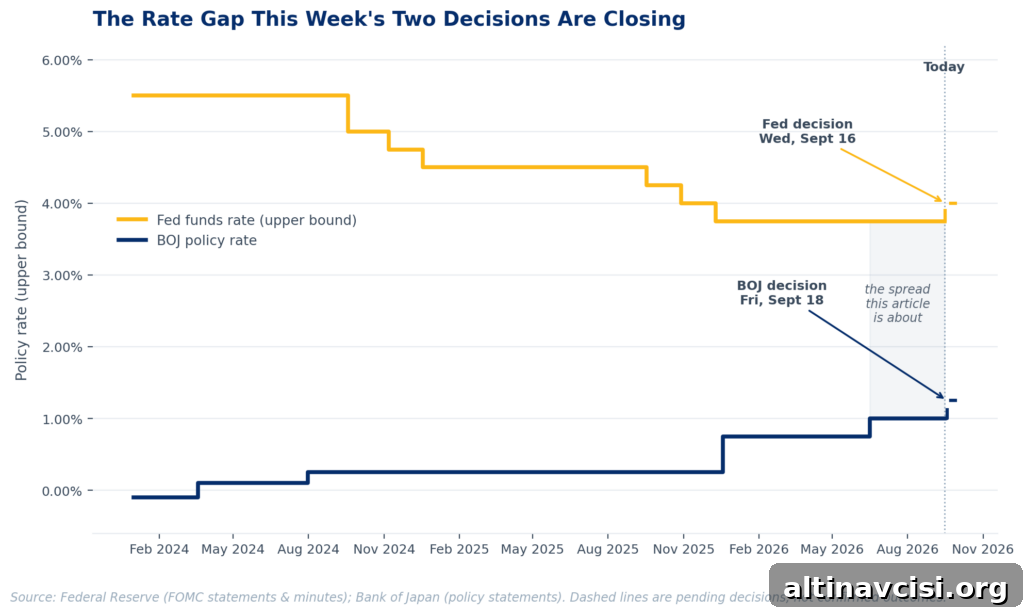
The Bank of Japan (BOJ) is widely expected to announce a rate increase on Friday, September 18, marking another step away from the negative-rate era. Economists generally project a 25 basis-point rise from 1.00% (set in June) to 1.25%. Professional consensus on the hike is strong: a recent Bloomberg survey of 52 BOJ watchers found virtually unanimous expectations for a move. Market-implied measures, however, tell a more nuanced story. TONA-futures pricing implied probabilities near the low 60% range in some models, while overnight-index-swap estimates ran as high as the high 90s. Those differences reflect two distinct questions: “Will the BOJ act?” (the economists’ view) and “How has the market already priced it?” (the traders’ view).
What truly matters this week is timing. Earlier rate increases in this tightening cycle occurred on isolated dates—March 2024, July 2024, December 2025 and June 2026—each acting as a standalone policy event. This week is different because the BOJ decision is now falling in the same calendar week as the Fed’s vote. That overlap increases cross-market sensitivity: a surprise from one central bank can amplify reactions to the other, and vice versa.
Within the Federal Reserve, policy views are already more dispersed than usual. At the Fed’s June meeting, nine of eighteen officials signaled the possibility of at least one more hike this year. The Fed chair also withheld a personal dot on the dot plot for the first time since that practice began in 2012, highlighting internal uncertainty. With both central banks potentially tightening in the same week, markets must digest two independent decisions instead of a single monetary signal.

The Edge Every Investor Needs
Smarter precious metals investing starts here. The Nuggets Newsletter delivers market insights, central bank updates, global trends and educational analysis tailored for investors in gold and silver.
What Happens When Two Central Banks Tighten in the Same Week?
A key channel for cross-border impact is the yen carry trade. For years investors have borrowed low-cost yen to fund higher-yielding positions in U.S. dollars and other currencies: U.S. Treasuries, technology and AI-related equities, and leveraged growth strategies. That trade depends on a persistent interest-rate gap large enough to cover the cost of yen funding. Each BOJ rate increase narrows that spread by raising Japanese rates. A Fed hike the same week does not widen or close the gap from the other side, but it signals that more than one major economy is moving away from ultra-cheap borrowing conditions.
The acute risk from overlapping tightening is not necessarily a slow, orderly adjustment. It is the potential for a hawkish surprise—by either the BOJ or the Fed—that forces leveraged positions to unwind quickly. A recent example occurred in late July and early August 2024, when a BOJ hike paired with weak U.S. jobs data and prompted a rapid global unwind of yen-funded trades. Gold was among the first assets sold during that liquidity squeeze because it is highly liquid and widely held; the sell-off reversed once central banks signaled a pause and market stress eased.
What Does This Mean for Gold and Silver Before Friday?
In the short term, a disorderly surprise from the BOJ or the Fed could trigger reflexive selling in liquid assets, including gold and silver. Those moves are often liquidity-driven rather than long-term revaluations of precious metals. Historically, such price shocks tend to be temporary and can reverse quickly once central banks clarify their paths or market liquidity stabilizes.
Gold’s traditional sensitivity to the dollar may be less clear this week because the shock is arriving through the yen—a component of trade-weighted dollar measures—rather than a broad dollar appreciation alone. That nuance can produce atypical price behavior where gold reacts more to funding stress and cross-currency flows than to a simple dollar move.
Over the medium term, however, the implications for gold and silver are more supportive. Every major central bank that raises the real cost of borrowing makes the era of near-zero global liquidity harder to sustain. When multiple central banks tighten within a short window, it signals a structural shift away from free money that has underpinned massive leveraged positioning. That backdrop strengthens the case for holding assets whose supply cannot be expanded by policy decisions.
Precious metals have a constrained supply profile: global mine output generally grows at a low single-digit pace annually, often cited around 1.5–2% for gold and similar for silver. Unlike fiat currencies, their supply cannot be increased by a committee vote. With two major economies raising their policy rates within days of each other, investors are reminded that reserve currencies and interest-rate regimes are not fixed measures. This dynamic reinforces the long-term rationale for owning gold and silver as protection against currency debasement and systemic liquidity shocks.
Stay On Top of Gold & Silver Prices
Get important market alerts sent straight to your inbox.
SOURCES
1. Bloomberg — BOJ watcher survey and commentary on September rate expectations.
2. Market-implied pricing tools and TONA futures estimates for BOJ rate probability.
3. Coverage of past yen carry trade unwinds and the August 2024 liquidity event.
4. Federal Reserve meeting summaries and dot-plot commentary from June 2026.
5. Historical BOJ rate moves and context around the exit from negative rates.
6. Benchmark pricing for spot gold and silver from major market sources.
Disclaimer: This article is for informational purposes only and does not constitute investment advice. Past performance is not indicative of future results. Consult a qualified financial advisor before making investment decisions.
You May Also Like:
- The Fed Vote Is Already Priced In. These Five Things Aren’t.
- The 10-Year Yield Just Hit an 18-Year High. Gold Isn’t Falling For It.
- Gold Fell 1.62% Today. Gold Miners Didn’t. Here’s the Math.
- Gold Fell to $4,271 Today. Five Bigger Stories Are Moving Underneath It.
- Gold Just Ignored a War. Here’s What It’s Actually Watching.
- Five Things Are Moving Gold and Silver Today. They All Point to the Same Argument.
Popular Topics
Picked from the archive
-
01
 Topics
How the Fed Picks Gold Market Winners
-
02
Topics
Silver Price Outlook Sep 2026: Hike Priced In, Positioning Lags
-
03
Topics
Gold Price Outlook June 2026: CPI Impact and Fed Signals
-
04
Topics
Why One Central Bank Sold Gold and Why Most Haven’t
-
05
Topics
Record Gold ETF Outflow Sparks Debate as China Disagrees
-
06
Topics
Why Gold Surges When the Strait of Hormuz Opens and Then Falls
-
07
Topics
Seigniorage: How Inflation Acts as a Hidden Tax on Your Dollars
-
08
Topics
Gold Price Falls Before US Market Opens