How Much Gold to Own by Age: 25, 45, and 65

Key Takeaways
- The right allocation to gold is not a fixed figure. It should shift with your time horizon, income requirements, and tolerance for volatility so you avoid selling at the worst times.
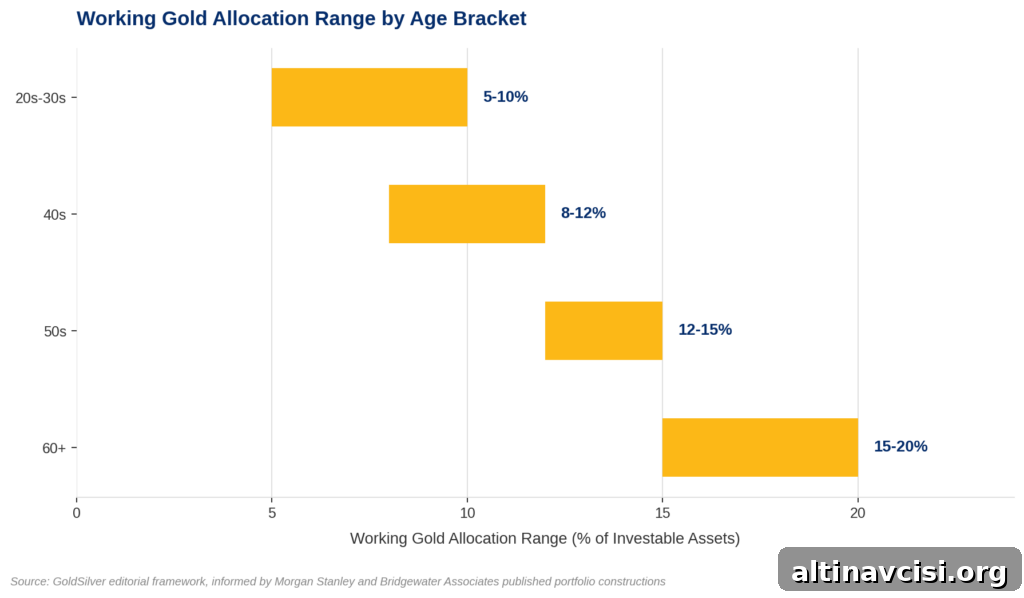
- A useful working guideline is 5–10% of investable assets in your 20s and 30s, rising toward 15–20% by your late 50s and 60s. Your personal number depends on the factors described below, not the percentage alone.
- Some institutions, such as Morgan Stanley, have advocated for a larger gold sleeve (around 20%) because they believe bonds may no longer reliably offset equity losses.
- Bridgewater’s All Weather portfolio holds roughly 7.5% gold and 7.5% broad commodities as a fixed allocation; its aim is protection across economic regimes rather than a retirement glide path.
- Regular rebalancing — not a single lump-sum purchase — keeps an age-based gold allocation aligned with its intended role as markets and balances change.
Ask several advisers how much gold you should own at a given age and you will get different answers. That divergence exists because many recommendations start with a percentage rather than the mechanism behind it. A 22-year-old and a 62-year-old face different trade-offs. Their allocations should reflect how much time they have to recover from market losses, whether they need portfolio income, and how much price movement they can tolerate without being forced to sell.
Why Should Your Gold Allocation Change as You Age?
The principle is straightforward once you name it: every dollar in your portfolio is either working to grow, protecting value, or waiting to be spent. Young investors can afford to emphasize growth because they have decades for compounding to smooth over downturns. That reduces the need for assets that primarily store value rather than compound, such as gold. As you get closer to spending your savings, protection becomes more important relative to growth.
Gold performs the protection role. It is a monetary asset with very little industrial consumption, so most demand comes from reserve and store-of-value motives rather than manufacturing. That quality helps gold move differently than equities and bonds and is why its appropriate share in a portfolio should change as your need for non-correlated protection increases.
Three variables do most of the heavy lifting when deciding how much gold to hold: time horizon, income need, and volatility tolerance.
Time horizon: How many years before you need to draw on your portfolio? A 25-year-old who faces a 30% equity drawdown still has decades of contributions and compounding ahead to recover. A 63-year-old two years from retirement has much less runway, so preserving what has already been accumulated becomes a higher priority.
Income need: Gold yields no dividend or interest. If you are withdrawing from your portfolio to cover living costs, a large gold allocation can crowd out the income-producing assets you need. For savers decades from retirement, that trade-off matters far less.
Volatility tolerance: How will you actually react when your portfolio falls in value? A younger investor can usually ride out corrections; someone taking withdrawals during a downturn may be forced to sell at low prices. A properly sized gold position reduces the odds of having to sell into weakness.
This is not an argument for a single “right” percentage. It is an argument for a framework that shifts with your personal numbers across these three factors. The age brackets below put that framework into practical ranges.
The Knowledge That Changes Everything

Two essential guides — free. Learn why gold matters and why fiat currencies can erode purchasing power over time.
How Much Gold Should You Own in Your 20s and 30s?
For most people in this age range, a practical target is about 5–10% of investable assets. Aim for the lower end if you truly have decades to retirement and your equities and other growth assets will carry most of the return burden.
At this stage, the motivation for holding gold is not short-term preservation but protection against long-term currency debasement. Since 1913 the U.S. dollar’s purchasing power has fallen dramatically, which highlights gold’s role as a long-duration store of value. A modest, regular allocation established early can act as a compounding hedge against that multi-decade trend.
Dollar-cost averaging into a small gold position suits this decade better than trying to time a single perfect entry. The priority is to build the habit and the position size rather than to chase exact prices.
How Much Gold Should You Own in Your 40s?
Your 40s are often peak earning years and the point at which the dollar value at risk in a downturn becomes more meaningful. A 30% drop on a larger portfolio takes longer to recover, especially with fewer years left until retirement.
A reasonable range for this decade is about 8–12%. The mix shifts modestly from pure accumulation toward a blend of growth and protection. This is also a good time to reassess whether your defensive holdings—like long-duration bonds—are still serving as the cushion you assume. If they are not, tilting some of that defensive sleeve into gold can be a sensible partial solution.
How Much Gold Should You Own in Your 50s?
In your 50s the shift from growth to protection typically accelerates because the time available to recover from a large loss shrinks. A drawdown a few years before retirement behaves very differently than one occurring a decade earlier.
For most people still working and contributing, 12–15% is a practical working range. Move toward the higher end as retirement nears and your income needs solidify. At the same time, pay attention to how central banks and official institutions treat gold: their sustained buying behavior is a useful signal about gold’s perceived role in reserves and long-term portfolios.
How Much Gold Should You Own After 60?
When retirement is imminent or underway, two priorities dominate: protecting purchasing power and reducing reliance on the correlation between stocks and bonds. With little runway left to recover from a poor sequence of returns, preservation and diversification matter more than chasing extra expected return.
A common range for investors prioritizing capital preservation is 15–20%. The exact allocation depends significantly on how much guaranteed income you already have from pensions or annuities. Those guaranteed streams reduce the need for portfolio-generated income, allowing a higher allocation to non-yielding assets like gold if desired. By contrast, someone relying solely on portfolio withdrawals will usually prefer a lower gold weighting in favor of income-producing holdings. Institutional constructions such as Bridgewater’s All Weather, which includes hard assets as a stable sleeve across regimes, can offer useful perspective as a floor, not necessarily a ceiling, for this age bracket.
What Do Institutional Portfolios Get Right About Age and Gold?
Institutional examples help highlight the deciding mechanism rather than give fixed rules. Two notable models illustrate different rationales.
Morgan Stanley proposed a 60/20/20 split that keeps equities at 60% and divides the rest between shorter-duration fixed income and gold. The idea is not to eliminate bonds but to acknowledge that bonds may no longer provide the same consistent offset to equities in some stress scenarios, and that gold has offered a different type of ballast.
Bridgewater’s All Weather approach takes a different tack: it holds a fixed allocation to hard assets and commodities to protect across economic regimes, independent of any single investor’s retirement date. The lesson for individuals is descriptive rather than prescriptive: institutions size gold according to the role they need it to play, and individuals should do the same based on their horizon, income needs, and tolerance for volatility.
How Should You Rebalance Your Gold Allocation as You Age?
An age-based target only works if you rebalance toward it. Gold’s price can move enough that your allocation drifts significantly—what started as 10% can become 15% after a strong rally without you adding any metal.
Check your allocation on a regular schedule—annually is a practical cadence for many investors—or whenever gold’s price alone pushes your weight several percentage points away from target. Rebalance back toward the target rather than letting drift determine your exposure. As you pass from decade to decade, adjust the target gradually to reflect steadily changing time horizon, income needs, and volatility tolerance.
Stay On Top of Gold & Silver Prices
Get important market alerts sent straight to your inbox.
People Also Ask
Most 30-year-olds will find 5–10% of investable assets reasonable. Favor the lower end when retirement is decades away and growth assets will drive most of the portfolio’s long-term returns.
The mechanism is similar, but silver has a much larger industrial demand component. That makes silver more sensitive to economic growth expectations, so it typically belongs in a smaller, separate allocation rather than a one-to-one replacement for gold.
Retirees often hold a higher share—commonly 15–20%—because they have less time to recover from market losses and greater need for an asset that behaves differently from stocks and bonds.
A 20% allocation is on the high end and suits investors specifically concerned about a weakened bond hedge. Many individual investors adopt lower weights unless that concern applies to them.
Yes. Gold within a self-directed IRA is part of your total exposure and should be included when calculating your overall allocation.
Review your allocation annually, or whenever price moves push your actual weight several percentage points away from your target. Either approach is practical for most investors.
SOURCES
1. Morgan Stanley — Michael Wilson, Chief Investment Officer, 60/20/20 portfolio proposal (September 2025)
2. Bridgewater Associates — All Weather portfolio, widely cited public construction
3. World Gold Council — Gold Demand Trends, Full Year 2025 and Q1/Q2 2026
4. Federal Reserve / Bureau of Labor Statistics — historical CPI and dollar purchasing power data since 1913
5. Silver Institute — annual industrial demand share estimates
6. CME Group / LBMA — benchmark price references
Disclaimer: This article is for informational purposes only and does not constitute investment advice. Past performance is not indicative of future results. Always consult a qualified financial advisor before making investment decisions.
You May Also Like:
- Gold Price Outlook September 2026: What the Fed’s September 15-16 Meeting Means for Your Metals
- Do You Have to Report Gold Stored in a Foreign Vault? FBAR and FATCA Rules Explained
- Tokenized Gold: What It Actually Is, and Where the “Just Like Owning Gold” Pitch Breaks Down
- IRA-Eligible Gold: The Coins and Bars That Actually Qualify
- The No-Home-Storage-IRA Myth: Why the IRS Requires a Depository
- What Is a Gold IRA? The Purity Rule the IRS Never Wrote
- What Is ZIRP (Zero Interest Rate Policy) and How It Changed Gold Forever
- How Much Is a Gold Bar Worth? Every Size, From 1 Gram to 400 Ounces
Popular Topics
Picked from the archive
-
01
 Topics
Major Banks Now Converge on 2026 Gold Price Near $4,500
-
02
Topics
Gold Prices Ahead of April 29 FOMC: What Traders Should Watch
-
03
Topics
Should You Buy Gold Now During a Dip? Timing and Risks
-
04
Topics
Gold Allocation Calculator: How Much Gold Should You Hold?
-
05
Topics
Silver vs Gold 2026-2031: 5-Year Investment Outlook
-
06
Topics
How a Copper Mine Skipping Silver Explains the Deficit
-
07
Topics
Why Central Banks’ Purchase of 39 Tonnes of Gold Matters
-
08
Topics
Why Silver Jumped 6% Before Trump Xi Summit