Silver Plunges Faster Than Gold Today as Supply Deficit Remains
Silver is poised to record its sixth consecutive annual supply deficit, yet today that structural shortage did nothing to support prices.
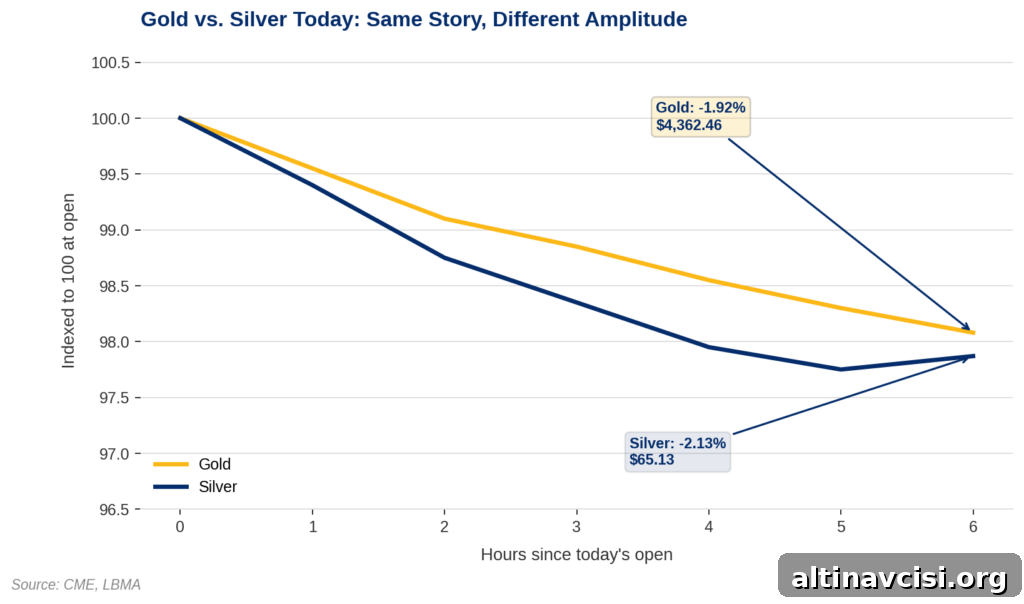
Gold is trading near $4,362, down about 1.92% from this morning’s open. Silver is weaker, around $65.13, off roughly 2.13%. The widening gap between the two metals is the notable takeaway: the gold–silver ratio moved from 66.84 at the open to 66.98 by the close of the session. In other words, it now takes nearly 67 ounces of silver to buy one ounce of gold, up from about 66.8 just a few hours earlier.
Why Are Gold and Silver Both Falling Today?
Neither metal’s move today reflects a change in their specific supply-demand fundamentals. Instead, both are reacting to the same macro lever: a higher probability of a Federal Reserve rate hike at the September 15–16 meeting. Market-implied odds of a September hike climbed sharply this week to roughly 60%–66%, up from about 36%–40% a week earlier. Different platforms report slightly different percentages, but they all show the same jump after the recent policy commentary.
At the same time, the 10‑year Treasury yield has pushed up to about 4.78%–4.80%, its highest level since January 2025. Rising real yields and a firmer dollar are classic headwinds for assets that don’t pay interest, and both gold and silver fit into that category. That single macro force — higher expected rates and real yields — is the main driver pushing both metals lower today.
Why Is Silver Falling Faster Than Gold?
Silver is reacting more aggressively than gold because it trades in a smaller, thinner market with a larger share of daily volume tied to industrial use and speculative positioning rather than long-term investment holdings. That structural difference gives silver a higher beta to movements in real yields and risk sentiment.
When the macro backdrop turns favorable for precious metals, silver often outperforms gold, sometimes by a wide margin. When the backdrop turns unfavorable — as it did today with rising rate-hike odds — silver typically falls harder. The same rate-driven story that dents gold tends to amplify silver’s move because of silver’s greater sensitivity to changes in expectations and liquidity.
Did Silver’s Supply and Demand Picture Change Today?
No. The underlying supply-demand picture for silver did not change between yesterday’s close and today’s trading session, and that stability is important to emphasize.
The Silver Institute, in its World Silver Survey 2026 produced with Metals Focus, projects a 46.3 million ounce deficit for the year — the sixth consecutive annual shortfall and wider than the 40.3 million ounce deficit estimated for 2025. Total demand is estimated at 1,112.6 million ounces against total supply of 1,066.4 million ounces. Those figures are about structural dynamics in mining, recycling and industrial demand; they don’t reprice based on a single central bank speech.
A clear example of persistent structural demand is electric vehicles. A December 2025 Silver Institute and Oxford Economics report estimated that a battery electric vehicle uses roughly 25–50 grams of silver — about 67%–79% more silver than a comparable gasoline-powered vehicle. That durable industrial demand profile isn’t altered by intra-week volatility in rate expectations.
What Does Today’s Ratio Move Actually Tell You?
Interpreting today’s jump in the gold–silver ratio as evidence that silver’s long-term case is weakening would be a mistake. The ratio move is primarily information about the Fed and short-term rate expectations, not a revision of silver’s structural supply-demand outlook.
Investors looking at a dip face two separate questions: (1) Is silver’s supply-demand structure intact? (2) Is right now a favorable entry point given rate-driven price weakness? The first answer remains unchanged: the market is running a multi-year deficit. The second answer is uncertain and depends on upcoming macro data and Fed signaling. Conflating the two issues — using a short-term rate-driven drop as proof the deficit no longer matters, or ignoring rate risk because of the deficit — increases the chance of a poorly timed decision.
What Should Investors Watch Next?
The next key data point is Friday’s August jobs report. That release can shift the market’s view on September rate odds before the FOMC meets. A softer jobs print would likely reduce the probability of a September hike and could reverse some of today’s losses in both metals; a stronger print would reinforce the hawkish pricing. Ultimately, the September 15–16 FOMC meeting will resolve the question markets are now trying to price.
For a clearer signal about whether silver’s structural case is reasserting itself, watch the gold–silver ratio around the Fed decision rather than focusing on any single day’s move. The ratio over that period will offer a cleaner read once the rate outlook has settled.
Stay On Top of Gold & Silver Prices
Receive timely market alerts and concise analysis delivered to your inbox.
SOURCES
1. CME Group, FedWatch Tool
2. Polymarket market data on Fed rate expectations
3. Federal Reserve communications
4. Silver Institute and Metals Focus, World Silver Survey 2026
5. Silver Institute and Oxford Economics, “Silver, The Next Generation Metal” (December 2025)
6. LBMA data
Disclaimer: This article is for informational purposes only and does not constitute investment advice. Past performance is not indicative of future results. Always consult a qualified financial advisor before making investment decisions.
You May Also Like:
- Wall Street Keeps Buying Gold. Washington Keeps Sending Mixed Signals.
- Iran’s Gold Sector Named in U.S. Sanctions. Gold Is Selling Off Anyway.
- Hike Odds Doubled This Week. Real Yields Didn’t.
- COMEX Registered Gold Fell Below 15 Million Ounces — It’s Still Refilling.
- Gold Isn’t Falling on a Hawkish Fed. Here’s Why.
- Gold and Silver Sink as Warsh Cites AI Boom to Justify More Fed Tightening.
- Five Things Moved Gold and Silver This Week. Only One Was Kevin Warsh.
Popular Topics
Picked from the archive
-
01
 Topics
Why Oil Is Surging While Gold Still Lags
-
02
Topics
Record Gold ETF Outflow Sparks Debate as China Disagrees
-
03
Topics
How Three Government Changes Shifted Inflation’s Official Number
-
04
Topics
5 Signs Gold’s Rally Is Gaining Momentum
-
05
Topics
Could the U.S. Government Seize Your Gold Again?
-
06
Topics
Is Gold Still a Safe Haven in War? Investor Insights
-
07
Topics
Gold Repricing Underway: 5 Major Institutions Confirm
-
08
Topics
Gold Price Outlook: Tariff Refunds, Weak Dollar, AI Bust