Wall Street Buys Gold While Washington Sends Mixed Signals

Gold slipped to $4,374 on Tuesday morning, down about 1.65%, while silver dropped to $65.14, off roughly 2.12%. Those moves came as traders priced in a likely Federal Reserve rate increase this month. But looking beyond today’s intraday tape reveals a different narrative: five independent signals from Wall Street and Washington suggest institutions are quietly accumulating precious metals even as headline data appear to argue otherwise. Below we connect the dots between a fickle long-bond market, surging ETF inflows, a widening silver deficit, options-market positioning, and this morning’s ISM and JOLTS releases.
Is Bessent’s Bond-Buyback Plan Already Losing Its Grip?
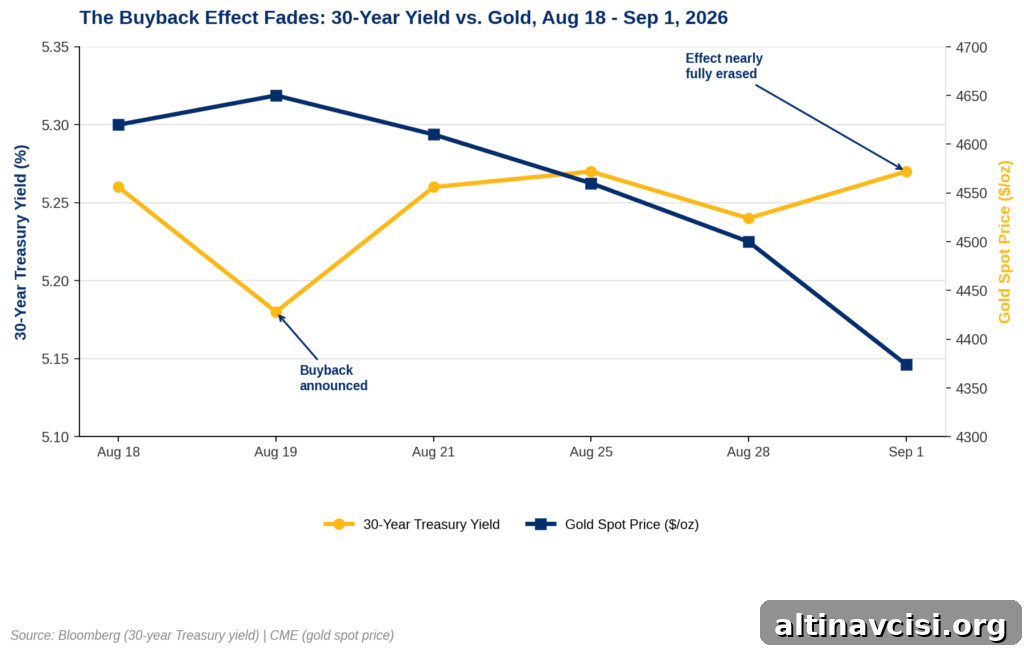
The 30-year Treasury yield climbed back to 5.27% on Tuesday, nearly erasing the modest decline that followed Treasury Secretary Scott Bessent’s mid‑August decision to double the long-bond buyback program. When the announcement landed, yields briefly dipped from 5.26% to about 5.18%, but that move has largely reversed even before the expanded buyback begins on September 9. The distinction between headline timing and underlying mechanics matters: buybacks temporarily reduce the supply of long bonds available in the market, which can push yields lower for a time. They do not, however, change the broader fiscal arithmetic that creates new debt and persistent issuance. A market that undoes most of a policy-driven yield decline in under three weeks is signaling skepticism about the long-term effectiveness of the intervention—markets are pricing the fiscal picture, not the PR around it.

The Edge Every Investor NeedsSmarter precious‑metals investing starts with timely context. The Nuggets Newsletter delivers market insight, Fed updates, trend analysis, and practical education.
Why Did Gold Funds Just Log Their Biggest Weekly Inflow in 10 Months?
Bank of America’s recent fund‑flow data provide a clear picture: gold-backed ETFs added about $6.4 billion in a single week in August, the largest weekly inflow in roughly ten months and the biggest since October 2025. BofA strategist Michael Hartnett highlights gold’s role as a hedge against dollar weakness and potential currency debasement. Importantly, the buying was not limited to a single large trade—the four‑week moving average of flows is rising too, indicating broader, sustained accumulation. Institutional allocations often precede shifts in retail sentiment; when flow data begins to trend before headlines catch up, it is frequently the more reliable signal about where big money believes value lies.
Can the Silver Deficit Widen Even as Solar Demand Falls 19%?
Yes—because supply is tightening faster than certain end uses are shrinking. The Silver Institute projects a 2026 global silver deficit of roughly 46.3 million ounces, wider than the estimated 40.3 million ounce shortfall in 2025, despite reports that solar‑panel manufacturers are cutting silver content by close to 19% this year. Major producers are shifting some designs toward copper‑based contacts to reduce silver intensity per panel, but much of global silver supply is a byproduct of mining for other metals. That means miners cannot quickly increase output in response to rising silver prices. Policy developments have reinforced the supply squeeze: silver was added to the U.S. critical minerals list in late 2025, and an ongoing tariff review remains unresolved, illustrating how constrained this market appears to policymakers as well as traders. The interaction of constrained supply and durable industrial demand underpins a structural case for silver beyond short‑term cyclical shifts.
Is Goldman’s Own Options Desk Betting Against a Selloff?
Goldman Sachs’ derivatives desk reports an unusual skew in options markets: strong demand for gold call options and scarce demand for puts designed to protect against downside. Brian Garrett, a derivatives strategist, characterizes the positioning as one‑sided—investors are eager to buy upside exposure but less inclined to pay for downside insurance. Goldman’s economists still expect the Fed to hold rates, yet the options desk favors staying long gold and recommends option structures that capture upside while managing the high cost of call skew. When a bank’s trading desk and its economists diverge in tone but traders still position for upside, that’s a telling market signal: risk traders see more potential for gains in gold than losses from here.
What Do This Morning’s ISM and JOLTS Numbers Really Show?
The Institute for Supply Management reported that its Manufacturing PMI slipped to 54.6% in August from 55.6% in July, with the New Orders Index falling to 53.7%. At the same time, the Bureau of Labor Statistics’ JOLTS report showed job openings at 7.271 million in July, a touch below the 7.3 million consensus and down from June’s 7.359 million. Those figures point to cooling in both manufacturing and the labor market—moderation, not collapse. Yet CME FedWatch data imply roughly two‑thirds odds of a September rate hike, up sharply from about 40% a week earlier. That divergence—softening real‑economy data alongside rising market expectations for tighter policy—creates a gap the Fed will face at its September 15–16 meeting. How the Fed reconciles cooling indicators with elevated hike odds will matter materially for bonds, the dollar, and precious metals.
Why Does This Matter for What You Own?
No single data point here is decisive by itself. Together, however, these signals sketch a system under strain. Policy tools like Treasury buybacks can temporarily affect market plumbing, but their impact can fade quickly. Institutional flows into gold are picking up at the fastest pace in nearly a year. Options desks and professional traders are positioned for asymmetric upside in gold. And supply constraints in silver are structural, not simply cyclical. For investors, that combination reinforces the case for exposure to physical precious metals as a hedge against policy mispricing, fiscal pressures, and supply tightness. Key dates to watch are September 9, when the expanded buybacks start, and September 15–16, when the Fed must square cooler economic data with market expectations for tighter policy.
SOURCES
1. Bloomberg — 30‑year Treasury yield reporting, September 1, 2026 (Bloomberg reporting)
2. Bank of America (Michael Hartnett) — gold ETF fund‑flow research note, August 31, 2026 (BofA research)
3. The Silver Institute — 2026 World Silver Survey deficit projection (46.3 Moz), reported September 1, 2026
4. Goldman Sachs (Brian Garrett) — derivatives positioning commentary, August 31, 2026 (Goldman Sachs derivatives commentary)
5. Institute for Supply Management — Manufacturing PMI report, August 2026, released September 1, 2026
6. U.S. Bureau of Labor Statistics — Job Openings and Labor Turnover Survey (JOLTS), July 2026, released September 1, 2026
7. CME FedWatch Tool — market‑implied probability for a September 2026 rate hike (CME Group data)
Disclaimer: This article is for informational purposes only and does not constitute investment advice. Past performance is not indicative of future results. Consult a qualified financial advisor before making investment decisions.
You May Also Like:
- Iran’s Gold Sector Named in U.S. Sanctions. Gold Is Selling Off Anyway.
- Hike Odds Doubled This Week. Real Yields Didn’t.
- COMEX Registered Gold Fell Below 15 Million Ounces. It’s Still Refilling.
- Gold Isn’t Falling on a Hawkish Fed. Here’s Why.
- Gold and Silver Sink as Warsh Cites AI Boom to Justify More Fed Tightening
- Five Things Moved Gold and Silver This Week. Only One Was Kevin Warsh.
- The Treasury’s Next Move Isn’t a Rate Cut. It’s a $967 Billion Checking Account.
Popular Topics
Picked from the archive
-
01
 Topics
Gold Radar: 5 Hidden Signals Your Price Chart Misses
-
02
Topics
Gold Plunged 9% When Kevin Warsh Spoke: He Speaks Tomorrow
-
03
Topics
Gold Allocation Calculator: How Much Gold Should You Hold?
-
04
Topics
172,000 Jobs Double Forecast: Thursday’s Report May Shift Gold
-
05
Topics
Why HSBC Says Gold Will Hit $4,750 by Year-End
-
06
Topics
Silver Drops 6% After Jobs Beat; Six-Year Deficit Remains
-
07
Topics
Gold +3%, Silver +4.7%: 5 Drivers Behind Today’s Metals Rally
-
08
Topics
Gold Price Rebounds Amid Iran Tensions, Fed Moves, Dollar Surge