Which Countries Hold the Most Gold Reserves?

Updated October 2026
The United States holds the largest official gold reserves at 8,133.5 tonnes, followed by Germany, Italy, France and Russia. The more important story in 2026 is who is actively buying: Poland, China and Uzbekistan are the most aggressive accumulators, while many long-time holders have not added materially for decades.
Key Takeaways
- The United States leads all countries with 8,133.5 tonnes of official gold reserves, but it has not materially increased holdings for decades. [World Gold Council, 2026] The most active buyers in 2026 include Poland (632t, targeting 700t), China (officially 2,313t but likely higher) and Uzbekistan (416t, about 87% of its reserves). [World Gold Council Gold Demand Trends Q1 2026]
- Central banks purchased a net 289 tonnes in Q2 2026 — a record for any second quarter — after the World Gold Council revised Q1 2026 down to 57 tonnes. [World Gold Council Gold Demand Trends Q2 2026] The 2022 freezing of roughly $300 billion in Russian reserves held abroad triggered a structural shift in reserve management that continues to drive demand. [Brookings Institution, 2025]
- The US and Germany allocate about 69% of their reserves to gold, while China is around 9% and Japan about 5%. [World Gold Council; IMF IFS, Q1 2026] That gap is one of the largest identifiable structural sources of demand for gold today.
When measuring official gold reserves by country, the United States tops the list with 8,133.5 tonnes stored primarily at Fort Knox and the Federal Reserve Bank of New York. [World Gold Council] That stockpile, however, has been effectively unchanged since the early 2000s.
The more revealing question in 2026 is not who holds the most gold, but which countries are buying and why they are doing so.
Central banks bought a net 289 tonnes in Q2 2026, a second-quarter record that followed a revised Q1 figure of just 57 tonnes. [World Gold Council Gold Demand Trends Q2 2026] These purchases reflect deliberate strategic accumulation by sovereign institutions and speak to long-term shifts in reserve policy rather than short-term trading.
Which Countries Hold the Most Gold?
Below are the top 10 official gold holders as of Q1 2026, using World Gold Council and IMF International Financial Statistics data: [World Gold Council; IMF IFS, Dec 2025 edition]
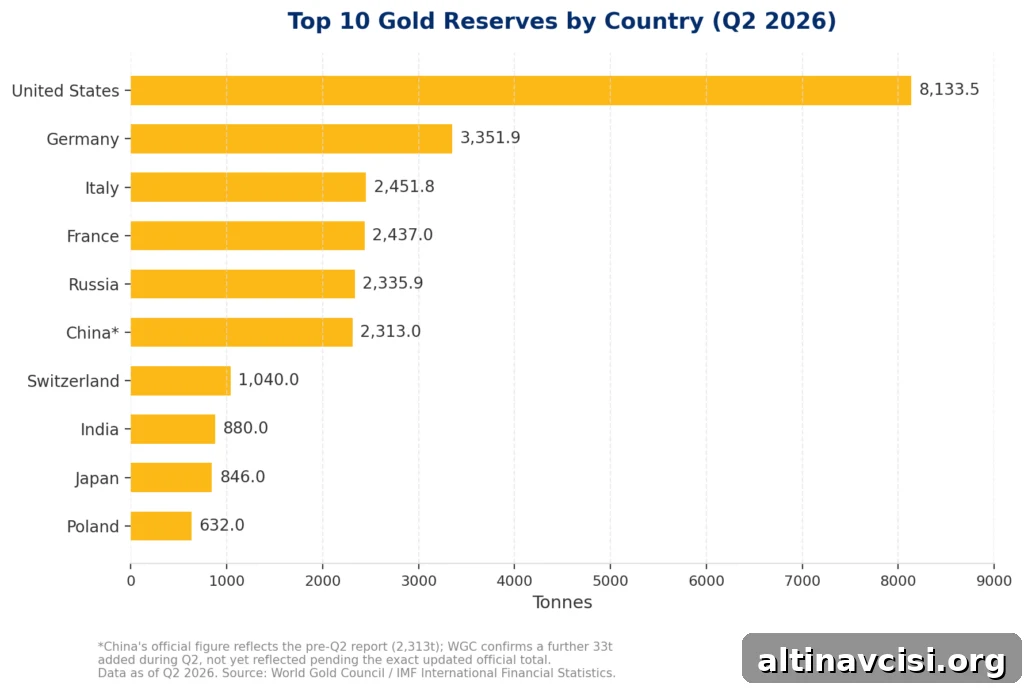
The top 10 central banks hold roughly 70% of official gold reserves worldwide. [World Gold Council] The United States and Europe together account for more than 60% of those holdings, a concentration that reflects the historical monetary role of gold in the global reserve system.
Two figures stand out: the US and Germany each hold about 69% of their reserves in gold, a legacy of the Bretton Woods era. By contrast, China holds about 9% and Japan about 5%. [World Gold Council; IMF IFS] That divergence is the most consequential structural dynamic shaping gold demand today.
The Knowledge That Changes Everything

Two essential guides — free resources explaining why gold matters and the long-term risks of fiat currency systems.
Why Are Central Banks Buying Gold at Record Pace?
The wave of official buying began in 2022 and has continued since. Central banks purchased a net 1,082 tonnes in 2022 — the highest annual total in more than five decades — and added another 1,037 tonnes in 2023. [World Gold Council] That sustained demand set the backdrop for Q2 2026’s 289-tonne quarter.
The immediate trigger was the freezing of roughly $300 billion of Russian central bank reserves in early 2022 after Russia’s invasion of Ukraine. [Brookings Institution, 2025] That event demonstrated that foreign-custodied dollar-denominated reserves can be vulnerable to geopolitical and political actions by other states.
Gold held in a sovereign vault, by contrast, cannot be froze n by a foreign government. Its physical, jurisdiction-independent nature moved from a theoretical hedge to an operational imperative for many reserve managers. That logic underpins much of the recent accumulation by a diverse set of countries.
Who Is Buying the Most Gold in 2026?
Poland was the leading buyer in Q2 2026, adding 51 tonnes to bring total holdings to 632 tonnes after adding 82 tonnes in the first half of the year. The National Bank of Poland adopted a formal 700-tonne target in January 2026, up from roughly 103 tonnes in 2018. The stated rationale emphasizes national security and the desire to hold assets inside the country.
Uzbekistan added 25 tonnes in Q1 2026, bringing its holding to about 416 tonnes — roughly 87% of its foreign reserves, one of the highest gold-to-reserves ratios globally. [World Gold Council Gold Demand Trends Q1 2026]
China’s central bank added modest amounts in recent months, extending a multi-month buying streak. Official holdings are 2,313 tonnes, about 9% of reserves, though several market observers believe actual Chinese holdings may be materially higher due to accumulation routed through state entities and domestic exchanges.
India has been a steady buyer as well, using gold to manage currency volatility and reduce dollar concentration in its reserves. [World Gold Council]
Why Aren’t Western Countries Buying?
Simply put: many Western countries already hold large legacy stockpiles that were accumulated over decades, particularly during and after the Bretton Woods period. Those positions are long-standing and carry enormous unrealized value on balance sheets.
As an example, the US records its 8,133.5 tonnes at a statutory price established decades ago. At contemporary market prices, that same stockpile is worth roughly one trillion dollars — representing one of the largest unrealized gains on any government balance sheet.
The asymmetry is clear: the countries that built the current monetary system largely retain the largest gold holdings, while countries questioning aspects of that system tend to accumulate more actively.
How Much Gold Does China Actually Hold?
Officially, China reports 2,313 tonnes of gold — sixth in global rankings and about 9% of total reserves. [World Gold Council; IMF IFS, Q1 2026] China has previously announced large, previously unreported increases in reserves (notably in 2015), demonstrating that disclosure has at times lagged actual accumulation.
Several indicators suggest China’s true holdings could be higher than the official number: record throughput on the Shanghai Gold Exchange, substantial domestic mine production, and policy initiatives encouraging gold accumulation across state channels. If real holdings were materially higher—some analysts estimate up to double or triple the official figure—then gold would make up a much larger share of China’s reserves and could support alternative settlement frameworks.
What Does the Buying Pattern Actually Signal?
Reserve rankings show who has the most gold; buying behavior reveals who no longer trusts the current system’s safeguards. Rapid accumulation by countries such as Poland and Uzbekistan reflects strategic hedging and a desire to hold assets that cannot be frozen by foreign authorities.
These purchases are not short-term trades. Sovereign reserve managers operate with multi-decade horizons and act on information and priorities that differ from retail investors. Three consecutive years of more than 1,000 tonnes of net purchases is not transient momentum — it indicates a structural reallocation of official-sector portfolios toward gold. [World Gold Council]
For individual investors the lesson is not to simply copy central bank allocations, but to understand the reasons behind those moves and consider how that insight fits within a long-term allocation strategy.
Stay On Top of Gold & Silver Prices
Get important market alerts sent straight to your inbox.
Sign up for timely market summaries and price alerts from trusted sources.
People Also Ask
Has the US gold reserve ever been independently audited?
Not comprehensively. The last full independent audit of US gold reserves dates back to the Eisenhower administration. Since then, audits have been conducted internally by the US Treasury and the US Mint, and the Federal Reserve Bank of New York verifies gold stored on behalf of foreign governments. No public, comprehensive third-party audit of all 8,133.5 tonnes has been completed, though no credible evidence of missing metal has surfaced.
Which country holds the highest percentage of its reserves in gold?
Among major central banks, Uzbekistan leads with gold comprising roughly 87% of its foreign reserves. [World Gold Council Gold Demand Trends Q1 2026] The US and Germany each sit near 69%. China is about 9%, Japan about 5%, and Switzerland roughly 7%. Higher percentages indicate a stronger structural commitment to gold over dollar-denominated assets.
Does the IMF hold gold reserves?
Yes. The IMF holds approximately 2,814.1 tonnes of gold (around 90.5 million troy ounces). These holdings belong to the institution itself and would rank the IMF third globally if treated as a single entity. The IMF conducted a notable sales program in 2009–2010 totaling 403.3 tonnes. [IMF facts and past press releases]
Why is China’s gold-to-reserves ratio so low?
China’s total foreign exchange reserves exceed $3 trillion, largely in dollar-denominated assets. Against that large base, official gold holdings represent a small percentage. Two plausible explanations coexist: strategic under-reporting to avoid signaling a rapid dollar exit, and deliberate retention of large dollar assets to support trade flexibility. Regardless of the exact ratio, the direction of sustained purchases is clear. [World Gold Council; IMF IFS]
What happens to gold if central banks stop buying?
Since 2022, central banks have absorbed a significant share of global mine output — on the order of one-third annually. [World Gold Council] If official-sector purchases fell back to the near-zero or net-selling behavior of the 1990s and 2000s, that would remove an important demand floor. However, the geopolitical and structural drivers underpinning recent buying — weaponization of foreign reserves, de-dollarization pressures and geopolitical fragmentation — remain in place, so most institutional analysts see no immediate case for a sustained pullback.
What Does This Mean for Investors in Physical Gold and Silver?
Central bank accumulation has established a structural demand floor that did not exist a decade ago. Annual official-sector purchases above 1,000 tonnes mean that a substantial portion of global mine production is absorbed by institutions that are unlikely to sell for short-term reasons. [World Gold Council]
The practical frame is simple: the most experienced reserve managers are increasing their allocations to gold, while the countries furthest from those allocation ratios are buying fastest. This signals a long-term reorientation in reserve policy rather than a transient market cycle.
Reserve managers operate on multi-decade time horizons and build positions deliberately. Individual investors who adopt a long-term perspective can use that insight to inform their own allocation decisions.
SOURCES
1. World Gold Council — Gold Demand Trends Q1 2026: Central Banks; Gold Reserves by Country; Central Bank Gold Reserves Survey 2025; Global Mine Production by Country.
2. IMF — International Financial Statistics, December 2025 Edition.
3. IMF — Gold in the IMF factsheet; IMF press releases regarding the 2009–2010 gold sales program.
4. Brookings Institution — Analysis of frozen Russian sovereign assets and their status.
5. National Bank of Poland — 700-Tonne Gold Reserve Target, January 20, 2026.
6. People’s Bank of China / public reporting — historical announcements on reserves and disclosure practices.
7. US Treasury — Data on US reserve assets and related disclosures.
Disclaimer: This article is for informational and educational purposes only and does not constitute investment advice. Consult a qualified financial adviser before making investment decisions.
You may also like:
- Gold Portfolio Allocation: Why Wall Street Is Rewriting the 60/40
- What Does the SILVER Act Mean for Precious Metals Investors?
- What Backs the US Dollar? Not Gold. Not Silver.
- Why Is Gold Valuable? The 5,000-Year Answer Most Investors Get Wrong
- 72% of Family Offices Hold No Gold. What They’re Missing.
- Gold Remonetization: Six Forces Restoring Gold’s Monetary Role
- Silver Industrial Demand: Solar, EVs, and the Supply Gap
- Bank of America’s $6,000 Gold Forecast Isn’t a Price Call. It’s a System Call.
Popular Topics
Picked from the archive
-
01
 Topics
Market Movers Aug 25: Gold Pullback, Jackson Hole, Intel Warning
-
02
Topics
Silver Price Jumps 7% as Bulls Gain Momentum
-
03
Topics
Gold Price Falls Today: Why $4,500 Holds as Support
-
04
Topics
Barrick CEO: Gold Miners Unfazed by U.S. Tariffs on Bullion Bars
-
05
Topics
After January Jobs Surprise, Silver Dips as Gold Holds Firm
-
06
Topics
Gold Surges to Record High as $5,000 Target Nears
-
07
Topics
Why China’s Silver Imports Soared to a Record in 2026
-
08
Topics
Dollar Steadies After Jobs Data Shock Sends 90% Odds of Fed Cut