Warsh Inflation Measure: What It Means for Gold Prices
Gold and silver market update — April 30, 2026
Key Takeaways
- Incoming Fed Chair Kevin Warsh prefers the Dallas Fed’s “trimmed mean” PCE, which reads 2.3% versus the official core PCE at 3.0%. That difference could change the Fed’s policy calculus.
- If Warsh uses the trimmed mean as his guide, it lowers the bar for rate cuts. Earlier or more-likely cuts would compress real yields — a major structural tailwind for the gold price.
- April 29’s FOMC vote was the most divided since October 1992 (8–4). Warsh inherits a committee split between doves and hawks on May 15, which raises uncertainty about the policy path and supports demand for gold.
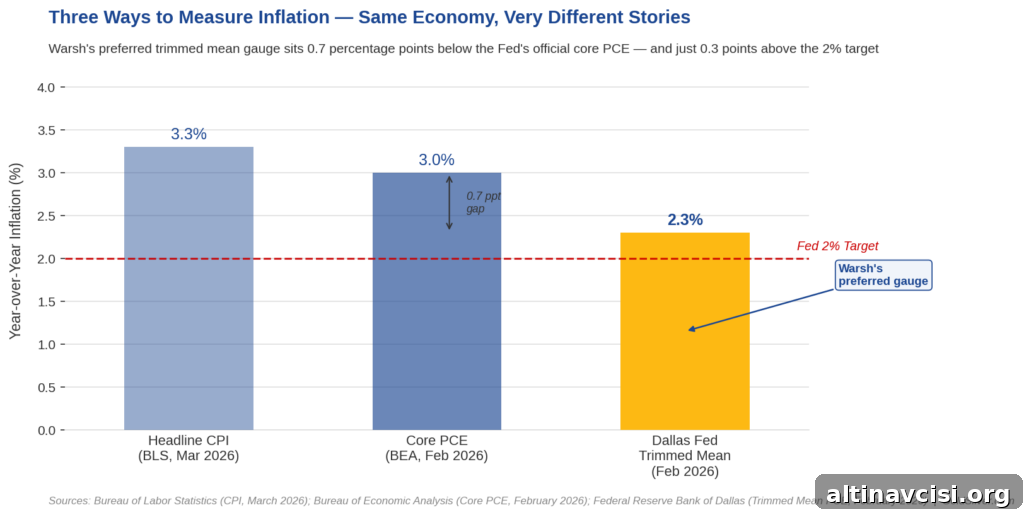
At his Senate Banking Committee hearing on April 21, Kevin Warsh said he does not fully trust the Fed’s current inflation metric. The nominee to replace Jerome Powell on May 15 favors a trimmed-mean approach to measuring inflation — the version published by the Federal Reserve Bank of Dallas — which currently shows 2.3% inflation on a 12-month basis.
The Fed’s official core Personal Consumption Expenditures (PCE) gauge stands at 3.0%. That 0.7 percentage-point gap is meaningful: it can determine whether the Fed feels justified holding rates steady or starting to cut. For investors in gold and silver, Warsh’s preferred inflation yardstick is the most important policy comment to come out of Washington this month.
Gold responded quickly. In early U.S. trading the morning after Warsh’s remarks, gold rose to around $4,600 per ounce, recovering more than 2% from the prior day’s one‑month lows as markets repriced expected monetary policy under a new Fed chair.
What Is the Trimmed Mean PCE, and Why Does Warsh Prefer It?
The standard PCE index averages price changes across hundreds of categories, including extreme swings. The trimmed mean removes the largest movers at both ends of the distribution and averages the middle portion. The result is a measure that filters out volatile, one-off price moves.
Think of the trimmed mean like dropping the highest and lowest scores in a judged competition to see how the majority performed. In February 2026, the Dallas Fed’s trimmed mean excluded extreme movements — for example, a spike in moving and storage services and a sharp drop in telephone equipment prices — producing a 12‑month inflation rate of 2.3%, compared with core PCE at 3.0%.
Warsh argues that temporary shocks — oil spikes, tariff-driven jumps, supply disruptions — should not determine monetary policy. If he governs by a trimmed-mean framework, inflation would be viewed as much closer to the Fed’s 2% target, making rate cuts more plausible on the data even while the official core PCE remains elevated.
How Does a Change in Inflation Measurement Move the Gold Price?
The key channel is real yields: nominal interest rates minus inflation expectations. Gold tends to rise when real yields fall and to struggle when real yields climb. This inverse relationship has been consistent across different market cycles.
With the FOMC’s policy rate at 3.50%–3.75%, the implied real yield versus core PCE at 3.0% is slightly positive. If the Fed instead uses a trimmed-mean inflation reading of 2.3%, the same nominal rate implies a lower real policy tightness, giving the Fed room to justify cuts sooner. Each rate cut, or even the credible signal that cuts are coming, compresses real yields further — making gold relatively more attractive because it pays no interest and benefits when real returns on cash and bonds fall.
Central banks and institutional buyers are already notable participants in the gold market: the World Gold Council reported strong net central bank purchases in Q1 2026. A policy regime that signals earlier accommodation could accelerate those buyers rather than slow them.
Does Today’s GDP and PCE Data Change the Picture?
The Bureau of Economic Analysis released the advance Q1 2026 GDP estimate and March PCE data at 8:30 a.m. ET. Expectations had varied: Wall Street looked for roughly 1.8% annualized growth while the Atlanta Fed’s GDPNow model had recently tracked closer to 1.2%.
Slower growth together with sticky inflation raises concern about stagflation — an environment where gold has historically outperformed many other assets. Under the official core PCE view, the combination of slow growth and elevated inflation would make rate cuts politically and economically harder to justify. Under Warsh’s trimmed-mean lens, inflation looks nearer the 2% target, and the same growth data could push the Fed toward easing sooner.
Those differing readings already show up inside the FOMC. The April 29 vote to hold rates was split 8–4, the most divided decision since October 1992. Several officials pushed for immediate cuts while others opposed dovish language. Warsh will join a committee where disagreement over the right path for rates is acute — a dynamic that heightens policy uncertainty and supports safe-haven demand for gold.
Isn’t the Trimmed Mean Also Flawed?
Yes. Critics note two important limitations. First, the trimmed mean can at times overstate inflation relative to core PCE depending on which items are trimmed. Second, when a shock is broad-based — for example, widespread energy-driven price pressure — trimming may not fully remove its impact and the trimmed mean could still show higher inflation than expected.
Those are valid technical objections and they present real risk to the near-term case for rate cuts. But for gold investors the more consequential point is what Warsh’s preference signals about the Fed’s stance and credibility. A chair who publicly questions his institution’s measurement tools is signaling a willingness to change the framework that guides policy. That kind of institutional uncertainty often boosts demand for gold, which buyers have treated as protection against monetary policy risk for millennia.
So Where Does This Leave the Gold Price?
Warsh may not cut rates immediately — geopolitical risks and elevated oil prices could delay any move. Still, his April 21 remarks change the policy ceiling: by redefining what “near target” means, the incoming chair has made the prospect of cuts more credible sooner than the official gauge alone would imply. Real yields can fall simply from that signal, even before a single cut is delivered.
Gold trading near $4,600, up more than 2% on the morning the comments landed, reflects a market repricing of the next 12 months of U.S. monetary policy under a new chair who has publicly criticized previous policy tools. For gold and silver investors, the principal takeaway is that measurement changes at the Fed can matter as much as raw data — and when policy credibility is in question, precious metals often benefit.
Stay On Top of Gold & Silver Prices
Receive timely market alerts and analysis delivered to your inbox.
Get concise updates on gold prices, Federal Reserve moves, inflation gauges, and market risks that matter to precious metals investors.
SOURCES
1. Federal Reserve Bank of Dallas — Trimmed Mean PCE Inflation Rate, February 2026
2. CNBC — Coverage of Kevin Warsh’s Senate confirmation hearing and comments
3. Rev — Transcript of Kevin Warsh’s Senate Banking Committee confirmation hearing, April 21, 2026
4. Federal Reserve — FOMC Statement, April 29, 2026
5. Bureau of Economic Analysis — GDP and PCE release schedule and data
6. Federal Reserve Bank of Atlanta — GDPNow model estimates, Q1 2026
7. World Gold Council — Q1 2026 central bank gold purchases and demand trends
8. Bank of America research and commentary on trimmed-mean PCE limitations
9. Trading Economics — Gold spot price snapshots, April 30, 2026
By the GoldSilver Editorial Team — helping investors understand sound money since 2005. This article is for informational purposes only and does not constitute financial, investment, or tax advice. Always consult a qualified financial advisor before making investment decisions.
You May Also Like:
- Gold Is Down 19%. This $3.8B Bet Says It Doesn’t Matter
- Gold, Oil, and the Fed: Why the Old Rules Don’t Apply
- Why Turkey Sold Its Gold Reserves — And What It Proves About Sound Money
- Why Gold Spikes Every Time Hormuz Opens — And Why It Never Holds
- Oil Hits $100 and OPEC Is Fracturing. Gold Knows Why
- How China Restricts Silver Supply Without Touching Silver
- Powell Press Conference: What It Means for Gold
- Iran Blinked — And One Word From Powell Decides What Happens Next
Popular Topics
Picked from the archive
-
01
 Topics
How Fed Pause and Rising PPI Affect Gold Prices
-
02
Topics
Gold Rebounds from Two-Week Low Ahead of Trump-Zelenskiy Summit
-
03
Topics
Shutdown Ends, Gold Price Climbs to Three-Week High
-
04
Topics
Silver Fair Value: Historical Trends and Market Data
-
05
Topics
How CPI Inflation Data Drives Gold Prices
-
06
Topics
Gold Price Could Reach USD 5,000 by 2026: Institutional Forecast
-
07
Topics
Trump’s 50% Metal Tariffs Hit Extinguishers and Auto Parts
-
08
Topics
Trump Names Tariff Architect Stephen Miran Interim Fed Governor