Why Turkey Sold Its Gold and What It Means for Sound Money
Last verified November 2026.
Key Takeaways
- When the Turkish lira came under severe pressure after a regional war shock, the central bank sold and swapped more than 127 tonnes of gold — the largest reserve drawdown on record for Turkey.
- This action reflected a currency crisis, not a failure of gold. The move was a distress signal from the lira and an example of sound-money dynamics at a sovereign level.
- Most operations were gold-for-currency swap futures, meaning the gold was contractually scheduled to return to Turkey’s reserves when those swaps matured.
- Global central banks remained net buyers of gold in 2026: buying surged in Q2 to a record 289 tonnes, led by China and Poland, after a volatile start to the year.
- As pressure on the lira eased, Turkey began rebuilding its gold reserves, consistent with historical patterns following past crises.
Turkey did not sell gold because gold had failed. It sold gold because the Turkish lira suffered a severe collapse. When the US–Israel war with Iran triggered an energy shock on February 28, 2026, the lira plunged to fresh lows and the Central Bank of the Republic of Turkey (CBRT) exhausted much of its foreign-exchange defenses—about $26 billion—before turning to its gold holdings. In the weeks that followed, the CBRT sold and swapped over 127 tonnes to secure liquidity and defend the currency.
Why Do Countries Sell Gold Reserves?
Coverage that labels central-bank gold sales as simple “supply pressure” is technically correct but incomplete. The crucial question is why a country needs to sell in the first place. In Turkey’s case, a decade of monetary mismanagement left the lira severely weakened: since 2016 it lost more than 90% of its value against the US dollar, inflation spiked, and the currency had little cushion when an external shock hit.
Gold is often the last liquid reserve a central bank can deploy. When a government trades gold for foreign currency, it reveals the state of its paper money—gold is being used as emergency collateral to stabilize balance-of-payments stresses or cover immediate liquidity needs. That dynamic is not evidence that gold has failed; it is evidence that the domestic currency has.
This pattern appears in many currency crises. Venezuela, Argentina, and Lebanon have all reduced official gold holdings during severe currency and fiscal stress. Those sales were symptoms of fiat currency breakdowns, not a reflection on gold’s long-term utility as a reserve asset.

The Edge Every Investor Needs
Smarter precious metals investing starts here. The Nuggets Newsletter delivers market insights, Fed updates, global trends, and educational content straight to your inbox.
Subscribe to receive timely alerts about gold and silver markets.
Is Turkey’s Gold Selling a One-Off or a Broader Trend?
Turkey’s episode is an outlier and the subsequent recovery confirms that. After a ceasefire eased immediate pressure on the lira, the CBRT began rebuilding reserves. By mid-April 2026, reported gold holdings rose to about 730 tonnes from a low near 693 tonnes at the end of March. The CBRT clarified that many operations were swaps, not permanent disposals: gold was used as collateral to access liquidity with contractual commitments to return the metal on swap maturity.
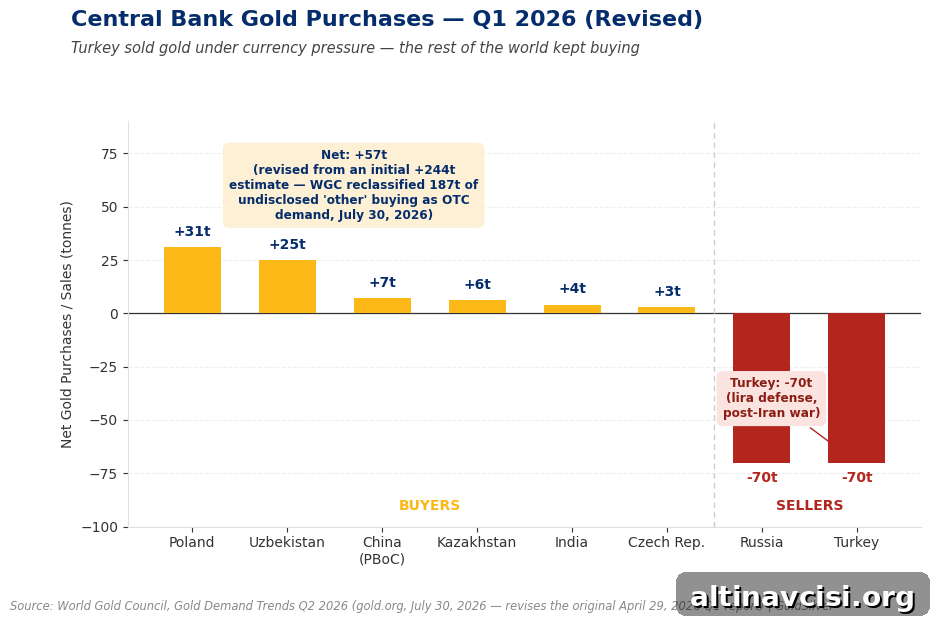
World Gold Council data shows the pace of Turkish selling slowed sharply in Q2 2026: the country recorded only around 4 tonnes of official-sector gold sales in that quarter versus roughly 70 tonnes in Q1. By July, Turkey’s total 2026 drawdown had narrowed to approximately 85 tonnes. Reserve valuations also recovered, with total official reserves rising in value through October 2026.
Historically, Turkey has used gold during acute stress episodes and then rebuilt reserves once conditions eased—in 2018 and again in 2023. These are finite, policy-driven responses rather than a structural pivot away from gold.
Has the Turkish Lira Stabilized Since the Crisis?
As of autumn 2026 the lira remained vulnerable, trading notably weaker year-on-year. A persistently weak lira can slowly erode confidence and eventually force central banks back to gold as a liquidity backstop. That risk is why central-bank gold holdings matter: they provide optionality when foreign-exchange reserves fall short.
What Does the Global Central Bank Data Actually Show?
The broader official-sector picture for 2026 remained positive for gold. The World Gold Council’s Q1 2026 data initially reported strong net purchases by central banks, and although some figures were revised, Q2 saw a sharp rebound. Central banks collectively bought a record 289 tonnes in Q2 2026, led by China and Poland. China’s central bank extended a long buying streak through September 2026, adding significant tonnage through the first nine months of the year.
Even accounting for forced sellers like Turkey and Russia, central-bank net buying has been substantial. The buyers are outpacing sellers and many are accumulating deliberately rather than selling under duress.
What Does Central Bank Gold Selling Mean for the Gold Price?
A central bank selling under distress creates a short-term supply shock and can move prices temporarily. But such sales are fundamentally different from a broad, voluntary shift away from gold by many central banks. Turkey’s concentrated selling was absorbed by the market and then reversed as swaps matured and reserves were rebuilt. Analysts at major institutions characterized those moves as liquidity management rather than the start of a structural selloff.
Historically, forced sales during crises create temporary dips that the market eventually absorbs once acute stress passes. The long-term story for institutional accumulation remained intact in 2026.
What Does Turkey’s Crisis Tell Us About Gold’s Long-Term Role?
Turkey bought gold for years precisely to diversify reserves and reduce reliance on fiat currencies. When crisis forced it to use part of that stockpile, it demonstrated two lessons: first, gold is a meaningful backstop that provides options in emergencies; second, selling gold during a currency collapse is a symptom of monetary failure, not a condemnation of gold itself.
Individuals and institutions that held gold preserved purchasing power better than those who held only the lira during prolonged depreciation. The presence of gold in reserves gave Turkey time and choices that countries without sizable holdings did not have.
Why Is Every Central Bank Watching Turkey’s Gold Strategy?
The political risk attached to dollar-denominated reserves since 2022—after large-scale freezes of some nations’ assets—has underscored a key point: fiat reserves can be neutralized by political decisions; gold cannot. Turkey’s experience reinforces that message from the opposite angle: running low on gold reduces policy options in a crisis. That dynamic explains why many central banks continue deliberate gold accumulation despite intermittent forced selling by a few nations.
SOURCES
1. Reuters — Turkish Gold Reserves in Largest Drop in 7 Years, Data Shows.
2. World Gold Council — Central Bank Gold Statistics and Gold Demand Trends Q1 2026.
3. Türkiye Today — Turkish Central Bank Rebuilds Gold Reserves, Closes Swap Positions.
4. Trading Economics — Turkish Lira Historical Exchange Rate Data.
5. Historical reporting on Turkey’s economic crises and central-bank reserve use (2018–2026).
6. UBS analysis of official sector gold markets and central-bank demand in 2026.
7. Industry reporting on global central-bank gold buying momentum through 2026.
By the GoldSilver Editorial Team — helping investors understand sound money since 2005. This article is informational only and does not constitute financial, investment, or tax advice. Consult a qualified financial advisor before making investment decisions.
You May Also Like:
- Why Gold Spikes Every Time Hormuz Opens — And Why It Never Holds
- Oil Hits $100 and OPEC Is Fracturing — What It Means for Gold
- How China Restricts Silver Supply Without Touching Silver
- Powell’s Press Conference: What It Means for Gold
- Iran Blinked — And One Word From Powell Decides What Happens Next
- COMEX Silver First Notice Day: What to Watch
- What a Warsh Fed Chair Could Mean for the Gold Price
- Five Signals the Mainstream Gold & Silver Narrative Missed
Popular Topics
Picked from the archive
-
01
 Topics
5 Economic Red Flags Gold Investors Need to Watch Now
-
02
Topics
Why Gold Drops During an Oil Price War
-
03
Topics
Is the Gold Price Correction Over? Rebound Signals for Investors
-
04
Topics
Why CME Margin Hikes Sparked the Silver Crash
-
05
Topics
Stagflation 2026: Hidden Signs in Today’s Data
-
06
Topics
U.S. Jobs and GDP Strengthen Ahead of Fed Decision
-
07
Topics
Bessent Urges Next Fed Chair to Do More Than Monetary Policy
-
08
Topics
Wholesale Prices Jump Most in 3 Years as Tariffs Hurt US Economy