Gold Prices Ahead of April 29 FOMC: What Traders Should Watch

Gold and silver market update — April 23, 2026
Key Takeaways
- Gold traded near $4,707 per ounce on Thursday, April 23, down from opening highs around $4,740. Silver slipped from the high $77s toward $75.
- A firmer dollar at one-week highs and rising inflation expectations drove the declines.
- Initial jobless claims rose to 214,000 for the week ending April 18, an increase of 6,000 from the prior week and slightly above consensus.
- The FOMC meets April 28–29. Markets see a 99.5% probability the Fed will hold the target range at 3.50%–3.75%. The University of Michigan sentiment report on Friday is the last major data point before the meeting.
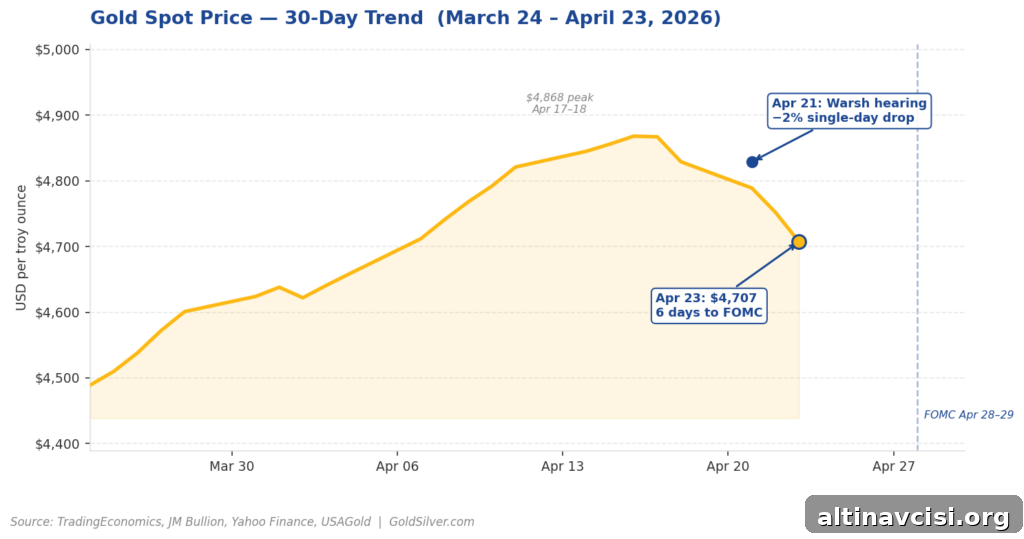
As of Thursday, April 23, 2026, spot gold was trading near $4,707 per ounce. The Federal Reserve’s policy meeting is six days away, and investors are parsing every data release for clues about the path of rates through the rest of the year.
This week’s key inputs — Thursday’s jobless claims and Friday’s final University of Michigan consumer sentiment reading — are the last meaningful data points before the April 28–29 FOMC decision. CME Group’s FedWatch tool shows a 99.5% probability the Fed will pause at a 3.50%–3.75% policy range. Markets now focus not on whether the Fed will hold but on the language Chair Powell uses to describe future policy and the economic outlook.
What Did Today’s Jobless Claims Data Mean for Gold?
Weekly initial jobless claims rose to 214,000 for the week ending April 18, up 6,000 from the prior week’s revised figure of 208,000 and marginally above consensus estimates near 210,000. While the level is not cause for alarm, the data matters for monetary policy because it reinforces the narrative of a resilient labor market.
A strong jobs picture reduces the Fed’s urgency to cut rates. When the Fed remains on hold, real yields tend to stay elevated, increasing the opportunity cost of holding non-yielding assets such as gold. Each week of robust labor-market data allows the Fed to justify patience — and that dynamic keeps a ceiling on gold prices.
The dollar index traded around 98.5 on Thursday, reaching one-week highs. A stronger dollar makes dollar-priced commodities more expensive for buyers using other currencies, heightening the pressure on gold. On Thursday, higher real yields and a firmer dollar combined to weigh on the metal.
“Elevated oil is anchoring inflation expectations and reinforcing the case for a higher interest rate environment, with markets pricing in no rate cuts through 2026, posing a headwind for non-yielding bullion,” said Kaynat Chainwala, AVP Commodity Research at Kotak Securities.
Stay On Top of Gold & Silver Prices
Receive timely market alerts and concise analysis directly to your inbox.
What Did the Warsh Hearing Confirm — and Why Did Gold Drop 2%?
On Tuesday, April 21, gold experienced its largest single-day decline since March 26, falling just over 2%. Market commentary attributed the drop largely to hawkish signals at the Senate Banking Committee hearing for Federal Reserve Chair nominee Kevin Warsh.
At the hearing, Warsh declined to pre-commit to any particular path for rates and emphasized that while inflation is improving, “there’s more work to do.” That testimony reinforced market expectations for sustained restrictive policy. The immediate reaction was a price re-rating: traders adjusted positions to reflect a higher-for-longer interest-rate outlook, and gold fell accordingly.
In short, the hearing confirmed a hawkish scenario markets had feared, and prices adjusted swiftly to that news.
What Will the Fed Decide on April 29?
The outcome of the April 28–29 meeting is largely priced in: a hold on policy rates at 3.50%–3.75%. This will be Chair Powell’s final FOMC meeting before a leadership change scheduled for mid-May. The market’s focus is therefore on the statement and Powell’s press conference language — not on an unexpected rate move.
What Powell Says Matters More Than What He Does
Investors are listening for any conditional language suggesting that a drop in oil prices or an easing of other inflation pressures could open the door to rate cuts later this year. The Fed’s March dot plot showed one 25-basis-point cut penciled in for 2026, but April’s jump in one-year inflation expectations makes that cut contingent on future developments.
Because this is a non-SEP meeting with no updated dot plot, market participants must infer intentions from the statement and the press conference. Any signal that policy could become less restrictive if inflation risks recede would support higher gold prices; language that emphasizes continued patience would keep a lid on bullion.
Why Does Tomorrow’s University of Michigan Reading Matter for Gold?
The University of Michigan releases its final April consumer sentiment reading on Friday, April 24, at 10:00 a.m. ET. The preliminary April survey showed sentiment at 47.6 — the lowest in the survey’s history — and one-year inflation expectations spiked to 4.8%, up one full percentage point from March.
Because most interviews for the preliminary release occurred before major geopolitical developments eased, the final reading could shift. What matters for markets is the direction of any revision. A higher reading would reinforce a hawkish Fed stance and maintain pressure on gold. A lower reading would suggest inflation expectations are peaking, easing the path toward rate cuts and giving bullion more upside.
Is Gold’s Current Pullback a Problem — or the Setup?
Gold’s all-time nominal high was roughly $5,590 on January 28, 2026. At about $4,707, the metal sits roughly 16% below that peak but remains more than 40% higher year over year. The recent pullback reflects the reality of a rate environment the Fed finds difficult to exit without trade-offs.
The underlying constraint is fiscal. The U.S. fiscal deficit and rising debt-service costs limit the Fed’s flexibility. Raising rates aggressively would make refinancing more expensive for the Treasury; cutting too soon risks reigniting inflation. That tension keeps the Fed in a position of limited options and keeps gold investors attentive to longer-term fundamentals.
Put differently: the upcoming Fed meeting is short-term noise; the structural fiscal backdrop is the longer-term signal for precious metals.
Why Are Central Banks Still Buying Gold?
Central banks purchased 863 tonnes of gold in 2025, marking the fourth consecutive year of elevated official buying and nearly double the pre-2022 annual average. Those purchases reflect strategic balance-sheet decisions and concern over long-term fiscal and monetary risks rather than short-term ceasefire timelines.
For institutions and long-term investors, gold serves as a hedge against policy risk and the erosion of real purchasing power. While real yields create a short-term cap on prices, the persistent fiscal backdrop provides a structural floor to gold demand. Holding physical gold through Powell’s final meeting is less speculative than it might appear; many buyers view it as a conviction play tied to macro risks that outlast a single policy statement.
Key Dates to Watch
Friday, April 24 — 10:00 a.m. ET — University of Michigan final April consumer sentiment and inflation-expectations reading. The preliminary 4.8% one-year inflation expectation is the figure to watch; any revision will shape market expectations heading into the FOMC.
April 28–29 — FOMC meeting and Powell press conference. A hold is widely anticipated. Markets will focus on any conditional language linking future easing to lower oil prices or a sustained decline in inflation pressures.
The Catalyst Without a Deadline — Developments affecting the Strait of Hormuz remain the most powerful near-term variable for oil, inflation expectations, and therefore gold. A credible reopening that brings oil lower would ease inflation pressure and remove the cap on gold, but there is no fixed timeline for that outcome.
SOURCES
1. TradingEconomics — Gold Spot Price, April 23, 2026
2. TradingEconomics — Silver Spot Price, April 23, 2026
3. Federal Reserve Bank of St. Louis (FRED) — Initial Claims (ICSA), Week Ending April 18, 2026
4. Bloomberg — US Jobless Claims Rise to 214,000, Signal Low Layoffs
5. Goodreturns — Gold & Silver rates commentary including Kotak Securities analysis
6. Yahoo Finance — Coverage of Kevin Warsh’s confirmation hearing, April 21, 2026
7. PBS NewsHour — Kevin Warsh testimony before the Senate Banking Committee
8. Heygotrade / Bloomberg — Gold price rebound and recent volatility analysis
9. CME Group — FedWatch tool and FOMC meeting probability analysis
10. CNBC — Coverage of the Kevin Warsh confirmation hearing, April 21, 2026
11. Charles Schwab — FOMC meeting primer and policy context
12. Federal Reserve — FOMC calendar and meeting information for 2026
13. University of Michigan Surveys of Consumers — Preliminary April 2026 release and historical series
14. Federal Reserve Bank of St. Louis (FRED) — University of Michigan consumer sentiment series (UMCSENT)
15. CBS News — Historical coverage of gold’s all-time nominal high in January 2026
16. Congressional Budget Office — Budget and Economic Outlook: 2026 to 2036
17. Committee for a Responsible Federal Budget — CBO and deficit commentary for FY 2026
18. World Gold Council — Gold Demand Trends, full-year 2025
By the GoldSilver Editorial Team — helping investors understand sound money since 2005. This article is informational only and does not constitute financial, investment, or tax advice. Consult a qualified financial advisor before making investment decisions.
You May Also Like:
- What’s Driving Gold Prices? Oil, PMI, and Newmont
- Dollar Weakens, Gold Falls — and That’s Actually Bullish
- Why Chinese Silver Imports Hit a Record in 2026
- What Drives Gold Prices? 5 Forces Investors Are Watching Now
- The Gold-Silver Ratio Signal: What Silver’s Lead Means
- Gold Drops to $4,681 — Iran Ceasefire Expires Today
- The Real Reason Gold Is Down During an Oil War
- What the Warsh Hearing Means for Gold Prices
Popular Topics
Picked from the archive
-
01
 Topics
Oil Drops 11% as Gold Rises: What Investors Need to Know
-
02
Topics
Gold Prices Slip as Fed Officials Delay December Rate Cut
-
03
Topics
Is Gold Overpriced or Undervalued? What 3 Models Reveal
-
04
Topics
Why Turkey Sold Its Gold and What It Means for Sound Money
-
05
Topics
Gold and Silver Prices: Short-Term Volatility, Long-Term Trend
-
06
Topics
Switzerland’s Gold Freeze: What Investors Need to Know
-
07
Topics
Inside the Fed’s Most Contentious Jackson Hole Meeting
-
08
Topics
Silver Price Forecast 2026-2027: Bull and Bear Scenarios