How the Current Gold Rally Compares to Past Bull Markets
Where We Are in the Cycle
If you’re worried that recent record highs mean you’ve missed the gold rally, history offers a calmer perspective: gold bull markets typically last much longer than many investors expect. By historical measures, the current cycle may still be in its early stages.
A useful way to gauge today’s position is to compare the current rally to past gold bull markets, looking at both price moves and duration. Patterns don’t repeat exactly, but they often rhyme. When we measure by time as well as magnitude, the evidence suggests there could still be more room to run.
How Today’s Rally Compares to Past Bull Markets
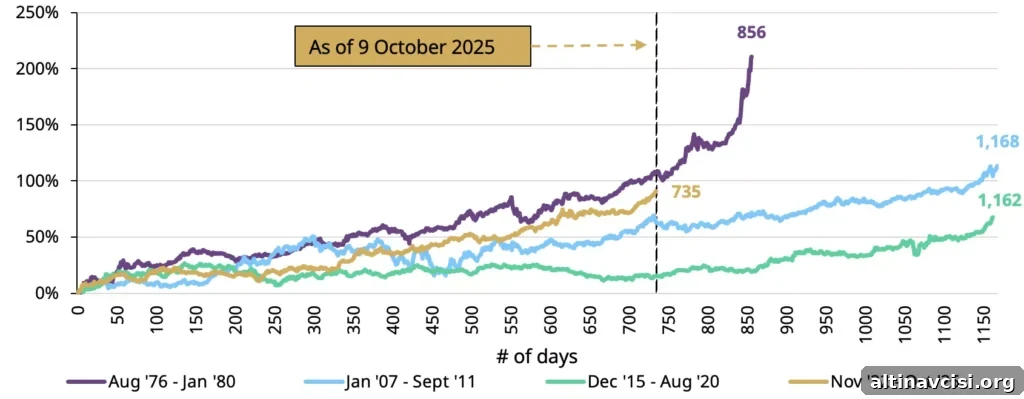
Source: Bloomberg, World Gold Council | Data as of 10/09/2025. Based on the LBMA Gold Price PM.
As of October 9, 2025, the current gold rally is roughly 735 days old. That feels meaningful, but major gold bull markets have averaged about 1,062 days in duration — nearly three years. Importantly, prior bull markets often reached new highs relatively early, then continued to climb for years afterward.
The chart above compares three major past bull markets to the present rally, indexed from their starting points. It highlights that duration matters as much as price change — and by that measure, the present cycle still appears to have runway.
The 1970s: When Gold Rose ~2,300% Over a Decade
The 1970s remain the most dramatic example of gold’s response to monetary and geopolitical instability. At the start of the decade, gold traded at a fixed price near $35 per ounce. After the U.S. ended the dollar’s convertibility to gold in 1971, gold’s price began a long ascent that saw it break well above previous highs and, by January 1980, trade past roughly $850 per ounce — a multi-thousand-percent increase from its fixed price starting point.
Crucially, gold’s initial breakout came early in that cycle. The metal then spent years consolidating and steadily climbing before the final parabolic surge. The drivers were high inflation, growing budget deficits, oil shocks, and a broader loss of confidence in fiat currencies — conditions that share notable parallels with today’s macro environment.
The 2001–2011 Rally: A Decade-Long Climb
The next major gold bull market began around 2001 after roughly two decades of low and range-bound prices. This rally was steadier and longer than many previous episodes. Gold rose from lows near $250 around 1999 and reached new nominal highs by 2006. Rather than peaking, the rally continued: over the next five years gold roughly tripled from those early highs and peaked near $1,900 in September 2011.
That decade-long climb was driven by the 2008 financial crisis, unprecedented monetary easing, sovereign debt concerns, and widespread worry that central banks were eroding currency value. In each case, the rally extended until the core economic pressures began to ease.
What Actually Ends a Gold Bull Market
Gold rallies don’t end simply because prices look high. They typically conclude when the fundamental forces that supported the rally reverse. Today, several of those drivers remain in place or are intensifying, which keeps the macro backdrop supportive for precious metals.
Key fundamentals that tend to support gold include:
- Mounting sovereign debt across developed economies
- Persistent inflation that erodes purchasing power
- Currency debasement through expansionary monetary policy
- Rising geopolitical instability that increases safe-haven demand
Until these trends reverse — and there’s little sign they will in the near term — the macro environment will likely remain constructive for gold.
Why This Cycle May Still Be Early-Stage
Measured by duration, today’s rally still looks younger than many previous gold bull markets. If history is any guide, the greater risk for some investors may be being under-allocated to gold rather than entering at current levels. Gold bull markets have historically rewarded patience: staying invested through multi-year trends has often outperformed attempting to time every dip.
The takeaway is not to chase short-term moves or to time each pullback. Instead, consider whether a strategic, diversified allocation to gold fits your long-term asset mix, especially while the underlying macro pressures remain in place.
Investing in Physical Metals Made Easy
Explore straightforward options for holding physical gold and silver as part of a balanced portfolio.
People Also Ask
How long do gold bull markets typically last?
Major gold bull markets have historically averaged roughly 1,062 days, or nearly three years. Some episodes, like the 1970s and the 2001–2011 cycle, ran much longer. As of October 2025 the current cycle was about 735 days old, suggesting it may not have reached its full potential.
Can gold continue rising after hitting all-time highs?
Yes. In past bull markets, reaching new record highs was often an early indicator rather than the end point. Historical examples show sustained gains after initial breakouts when the macro drivers remained in place.
What causes a gold bull market to end?
Gold bull markets typically end when their supporting factors reverse: falling inflation, stabilizing government debt, stronger confidence in fiat currencies, or reduced geopolitical risk. When those conditions take hold, demand for gold as a hedge often subsides.
Is it too late to buy gold in 2025?
History suggests it may not be too late. If the current rally follows earlier patterns, we could be in the middle chapters rather than the final act. For many investors, establishing a core allocation to gold as a long-term hedge may outweigh attempts at precise market timing.
How does the current gold rally compare to the 1970s bull market?
The 1970s rally was far larger in percentage terms and stretched across a longer period marked by runaway inflation and major geopolitical shocks. Today’s rally shares similar fundamental pressures — fiscal deficits, currency concerns, and geopolitical risks — but it has been shorter so far, which implies there may still be upside if those pressures persist.
Get Gold & Silver Insights Direct to Your Inbox
Join thousands of investors who receive expert analysis, market updates, and exclusive offers each week.
Popular Topics
Picked from the archive
-
01
 Topics
Gold Prices Near $4,000 as Job Cuts Reach 20-Year High
-
02
Topics
Bessent Urges 1.5% Rate Cut, Boosting Gold Prices
-
03
Topics
Why Wealthy Investors Allocate 11% of Portfolios to Gold
-
04
Topics
10-Year Treasury Yield Tops 4.4% on Resilient Labor Market
-
05
Topics
US Dollar Strengthens Ahead of Major Trade Policy Announcements
-
06
Topics
ECB Reaches 2% Inflation Target in June as Eurozone Prices Hold
-
07
Topics
Consumer Prices Rise as Trump Trade War Hits Home
-
08
Topics
Visa Adds PayPal USD, Global Dollar and New Blockchains