Gold Prices Fall as CPI Doubts Spur Profit-Taking

Daily News Nuggets | Today’s top stories for gold and silver investors
October 22nd, 2025
Government Shutdown Hits Workers — Presidential Wishlist Marches On
Day 22 of the federal government shutdown has left vital programs vulnerable. Nutrition programs for women and children are running short of funds, federal employees are filing for unemployment, and many essential services are slowing or stopping entirely. At the same time, demolition work began this week on a reported $250 million ballroom addition to the White House — a 90,000-square-foot, glass-walled space said to hold 999 people.
Meanwhile, a demand for $230 million from the Justice Department — reportedly to cover costs tied to investigations pursued while out of office — has added to the headlines. White House officials say the ballroom project is privately funded, but the contrast is striking: core government functions can’t be fully financed, yet high-profile projects and personal claims continue to advance. That mismatch of priorities and resources undermines public confidence and fuels doubts about the reliability of official information coming from Washington.
Friday’s Inflation Report Comes With an Asterisk
September’s Consumer Price Index (CPI) report is due Friday, and investors are watching with unusual caution. The Bureau of Labor Statistics has already faced scrutiny following large downward revisions to jobs data that contributed to the agency’s commissioner leaving in August. Now a partial government shutdown and reduced staffing during data collection have raised fresh questions about the cleanliness and completeness of this month’s inflation reading.
“Skeptics like me are going to be focused on how clean is this data,” says Vishal Khanduja of Morgan Stanley Investment Management. If confidence in official inflation metrics weakens — or if the numbers surprise in either direction — markets could see renewed volatility. For gold investors specifically, uncertainty about inflation data tends to strengthen the case for bullion: when policy signals and statistics are contested, physical metals often attract buyers as a neutral store of value.
Gold Slides as Investors Book Profits
After a blistering rally this year, spot gold eased this week, dipping below $4,080 an ounce and interrupting a roughly 55% year-to-date advance. Traders describe the move as classic profit-taking after one of gold’s strongest stretches in recent memory. The pullback looks like a near-term correction rather than a change in the underlying trend.
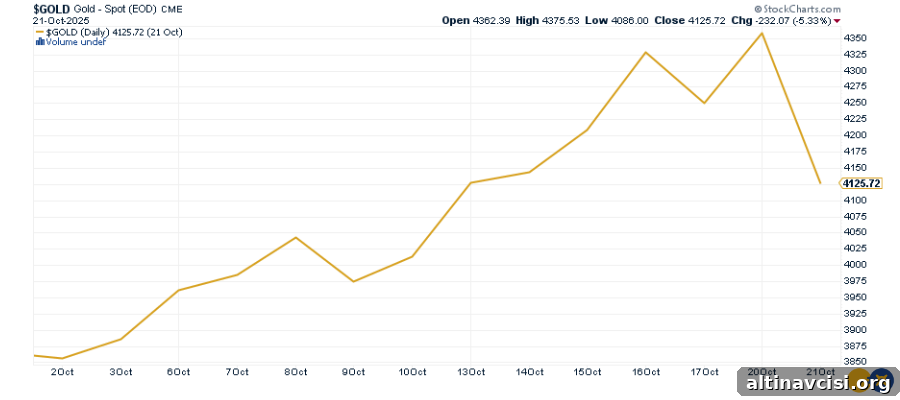
The fundamental drivers behind gold’s surge remain intact. Concerns about unsustainable government debt, shifting investor appetite away from traditional bonds and currencies, and widespread expectations for aggressive Federal Reserve rate cuts all support demand for hard assets. Lower real yields and persistent geopolitical and political uncertainty continue to make bullion attractive. For investors seeking an entry point or looking to add to existing positions, a temporary dip after a historic rally can present an opportunity.
Queues Around the Block for Bullion in Sydney
Sydney’s bullion market is seeing extraordinary demand. Reports indicate as many as 1,000 people per day lining up — sometimes waiting hours — outside a major bullion dealer to buy physical gold and silver. Storage requests reportedly surged in September, nearly tripling year-over-year, as retail buyers sought to take possession of coins and bars.
Gold is trading near record levels in Australian dollars, and silver has broken multi-decade highs, prompting many buyers to cite protection against U.S. political dysfunction, geopolitical tensions, and expectations for further Fed easing. The visible lines at bullion shops are a stark reminder that when uncertainty spikes, many investors prefer tangible, physical hedges over paper assets. Those retail purchases provide real-world support for bullion prices, even when futures traders step back to book profits.
India Tightens Gold Loan Rules — And Signals Deeper Trust in Physical Metal
India’s central bank has issued a unified set of rules for lending against gold and silver collateral, consolidating decades of fragmented regulation into a clearer framework set to take full effect by April 2026. The new guidelines include tiered loan-to-value ratios — higher LTVs for smaller loans (up to 85%) that decline for larger loans (to around 75%) — and stricter prohibitions on lending against certain paper proxies such as bullion ETFs. Lenders that fail to return collateral in a timely manner face daily penalties.
India represents a substantial share of global gold demand, and gold-backed lending in the country totals many billions of dollars each year. These regulatory moves are not a rejection of gold lending but a tightening of standards that underscore physical gold’s importance to financial stability and household wealth in the world’s most populous nation. For international investors, India’s emphasis on physical metal over paper substitutes highlights where long-term, tangible value is perceived to reside.
Investing in Physical Metals Made Easy
Consider physical bullion as part of a diversified strategy to hedge against inflation, political risk, and currency uncertainty.
Popular Topics
Picked from the archive
-
01
 Topics
Dollar Steadies After Jobs Data Shock Sends 90% Odds of Fed Cut
-
02
Topics
Consumer Confidence Hits 4-Month High as Inflation Eases
-
03
Topics
Gold Price Falls Below $3,340 Ahead of Fed Comments
-
04
Topics
Global Oil Prices Steady as Travel Demand Rises, Sanctions Loom
-
05
Topics
Silver Prices Eye Record Highs as Fed Signals Rate Cuts
-
06
Topics
AI Bubble Fears Surge as Gold Price Falls Below 4,000 USD
-
07
Topics
Tariff-Driven Inflation Clouds Fed’s September Rate Decision
-
08
Topics
10-Year Treasury Yield Rises After Tariff News, Services Data