

There was no Federal Open Market Committee meeting this week, yet gold prices fell. Two Federal Reserve presidents used a Monday afternoon to make clear how much further they think interest rates may need to rise, and the market responded.
As of September 22, gold trades near $4,335 an ounce, down about 0.2% from the morning’s open. Silver slipped more, trading around $65.68, off roughly 0.7%. Both metals surrendered an early intraday bounce: gold briefly approached $4,380 during Asian hours before hawkish Fed commentary pushed prices lower once U.S. trading desks opened.
Key takeaways:
- Gold and silver retreated after hawkish remarks from two Fed officials reinforced a more restrictive path for policy, despite no FOMC vote this week.
- The channel behind the move is real yields: Fed commentary changes expectations for future real interest rates, and a 25-basis-point shift in real yields typically moves gold roughly $40–$60 per ounce.
- Ongoing hopes for Iran diplomacy tied to the UN General Assembly are limiting a deeper slide in gold, but they are not the primary reason prices fell.
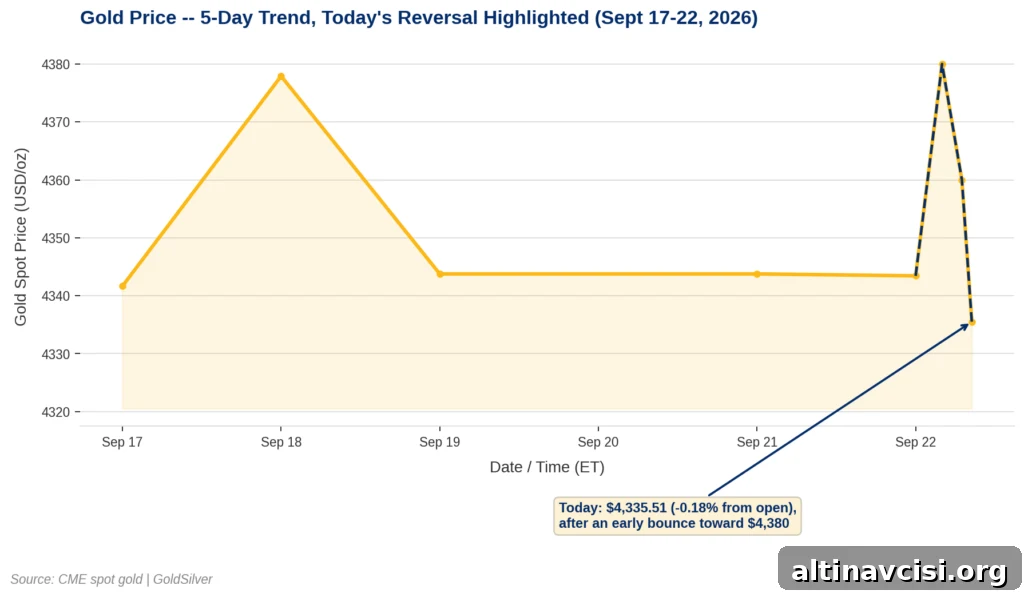
Why Did Gold Fall Today?
Two Fed officials — St. Louis Fed President Alberto Musalem and Chicago Fed President Austan Goolsbee — used public appearances to warn that additional policy restraint may be needed to bring inflation back to the Federal Reserve’s 2% objective. Musalem suggested more rate increases could be necessary to avoid inflation remaining well above target 18 months out. Goolsbee cautioned that persistent supply shocks complicate the outlook and that restoring price stability could require higher rates and the growth slowdown that accompanies them.
Neither of these officials cast a vote this week, but their comments reprice market expectations for future Fed policy. Investors treat each senior Fed official’s remarks as incremental information about the path of rates, which can move prices before any formal Fed decision is scheduled to occur.
Why Does Fed Speech Move Gold Without a Meeting?
Gold does not pay interest, so its opportunity cost is tied to real interest rates — the nominal rate minus expected inflation. When real yields rise, the return on safe interest-bearing assets improves relative to holding bullion, reducing gold’s appeal. When real yields fall, gold becomes more attractive in comparison. Historically, a 25-basis-point change in real yields has shifted gold by roughly $40 to $60 per ounce.
Markets had already priced in the Fed’s September 16 decision to raise rates to 3.75%–4.00%, but they had not fully priced how many additional hikes might be required or how quickly they might come. Comments from officials like Musalem and Goolsbee alter those expectations. For example, futures-based measures and Fed odds indicators reacted by increasing the probability of another quarter-point hike at the October 27–28 meeting and of at least one more hike before year-end. Each shift in expectations changes the present-day real-yield outlook and therefore immediate pressure on gold prices.
What Are the Fed’s Own Numbers Saying?
The Fed’s internal projections continue to support a relatively hawkish stance. The FOMC dot plot — the distribution of participants’ rate forecasts — shows a majority of participants projecting at least one more quarter-point hike before the end of the year, and the median projection for year-end 2026 has ticked higher compared with earlier in the year. Those official projections reinforce market expectations that policy will remain restrictive for some time.
On the market side, the 10-year real yield as measured by TIPS remains elevated compared with its position before the current hiking cycle resumed. This persistent elevation in real yields is the concrete measure behind the phrase “hawkish Fed,” and it is the immediate driver of downward pressure on precious metals.
None of this undermines the long-term structural case for owning physical gold and silver for investors who view them as a hedge against currency debasement, persistent supply-driven inflation, or political and fiscal risks. Instead, the recent moves reflect short-term repricing as market participants reassess the timing and magnitude of future rate moves.
Is Silver Following Gold Today, or Breaking Away?
Today silver underperformed gold: silver declined around 0.7% while gold fell roughly 0.2%. That divergence pushed the gold-silver ratio higher to about 66.0 from Monday’s close near 65.8. A higher ratio indicates silver has become cheaper relative to gold. While a single session’s movement does not confirm a durable trend, it is worth monitoring because silver tends to be more volatile and can both lead and lag gold depending on industrial demand, positioning, and momentum-driven flows.
Investors using the gold-silver ratio as an allocation signal should treat short-term swings as noise unless the ratio sustains a move over several sessions. Tracking the ratio over time helps separate transient market reactions from meaningful directional shifts.
What’s the Real Story Here?
The easy headline is: hawkish Fed comments pushed gold down. That is accurate but incomplete. The deeper dynamic is that markets are repricing the distribution of possible Fed policy paths between scheduled meetings. Gold is reacting to updated probability assessments of future rate moves rather than to a single decision. With the formal vote already priced in for mid-September, the speeches that occur in the intervening weeks are performing the marginal work of shifting expectations and moving markets.
Expect more trading sessions like this in the weeks leading up to the October FOMC meeting. Every Fed official’s public appearance has greater potential to change odds for another hike, which in turn alters the real-yield outlook and precious-metals prices. This makes for a higher frequency of short-term volatility as the market repeatedly recalibrates its view of the Fed’s reaction function.
What Should Investors Watch Next?
Watch forthcoming Fed speeches, particularly from officials who influence market expectations, such as New York Fed President John Williams and Richmond Fed President Thomas Barkin, both scheduled to speak later in the day. Their remarks could shift odds for an October hike.
Beyond speeches, the next scheduled FOMC meeting on October 27–28 is a focal point; it is a non-SEP meeting with no new dot plot, so market attention will focus on any updated guidance and the press conference. The next full Summary of Economic Projections, including the updated dot plot, is due at the December 8–9 meeting.
On the geopolitical front, monitor UN General Assembly developments and any signs of progress or setbacks in Iran diplomacy tied to key addresses. Diplomatic progress can influence energy markets and inflation expectations, which feed back into real-yield dynamics and precious-metals prices.
Stay On Top of Gold & Silver Prices
Get timely market alerts and analysis delivered to your inbox.
SOURCES
1. FXStreet — market coverage and price action reports.
2. Benzinga — reporting on Fed comments and market reactions.
3. CNBC — coverage of the Fed’s September rate decision.
4. Market commentary and commodity strategist notes referenced for context on positioning and technical behavior.
Disclaimer: This article is informational only and does not constitute investment advice. Past performance does not guarantee future results. Consult a qualified financial advisor before making investment decisions.
You May Also Like:
- Bernstein Just Cut Its Gold Forecast — By Breaking Gold’s Oldest Rule to Defend It
- The Fed Just Hiked. Wall Street Keeps Getting More Bullish on Gold Anyway.
- Gold Dips, Silver Holds as Iran Diplomacy Hopes Sink Oil Before a Bigger Week
- Silver Round-Trip: Real Yields, Not Inflation, Drove a Nine-Day Move
- Iran Hits a Tanker in Hormuz and Geopolitical Tension Fails to Move Oil Much
- Rates Rose Twice. Why Gold Still Attracted Demand.
- Bank of Japan’s Move to a Multi-Decade High and the Metals’ Reaction