Key Takeaways
- The Federal Reserve (the Fed) is the United States central bank, created by Congress in 1913 to stabilize the banking system and reduce the risk of financial panics.
- The Fed operates under a dual mandate from Congress: maintain price stability (with a 2% inflation goal) and foster maximum sustainable employment.
- Its most influential tool is the federal funds rate — the overnight interbank lending rate that affects mortgages, consumer loans, and savings returns across the economy.
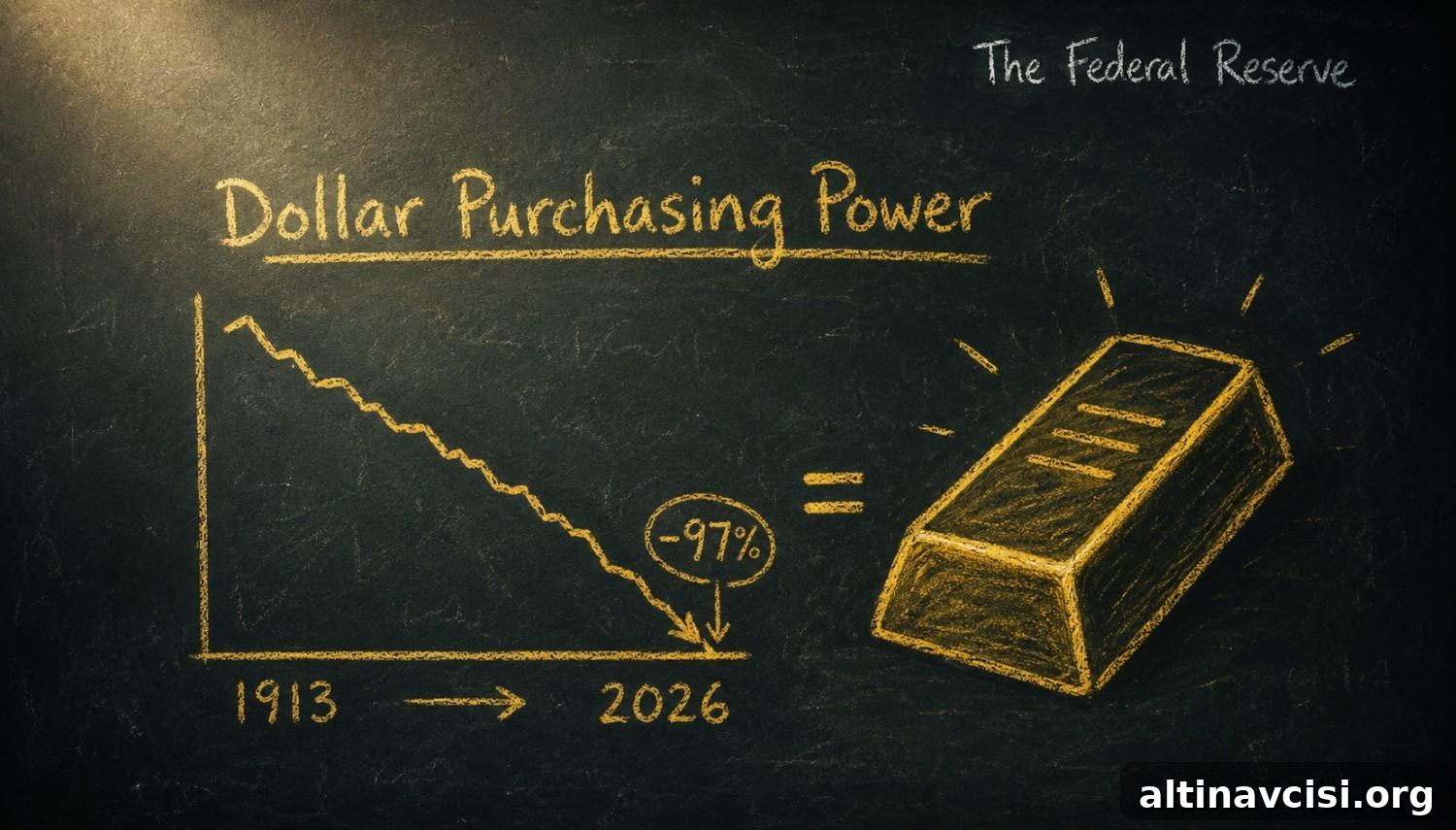
- Since the Fed’s founding in 1913, the U.S. dollar has lost substantial purchasing power. Over long periods, this erosion is reflected in rising gold prices.
- As of July 29, 2026, the Fed left its policy rate at 3.50%–3.75% for the fifth consecutive meeting, with three members dissenting in favor of a hike.
The Federal Reserve is a powerful institution that many people use every day without fully understanding. It effectively sets the price of money in the world’s largest economy. Fed decisions influence mortgage rates, savings yields, retirement portfolios, and commodity prices such as gold and silver.
Why does gold often react when the Fed speaks? Why do savings accounts sometimes offer yields well below inflation? The answers lie in how the Fed conducts monetary policy and how those choices translate into real yields and currency purchasing power. This article explains the mechanics, history, and implications.
What Is the Federal Reserve?
The Federal Reserve is the U.S. central bank, created on December 23, 1913, when President Woodrow Wilson signed the Federal Reserve Act. Before the Fed, the U.S. banking system experienced frequent crises; the Panic of 1907 was a key catalyst for reform and the establishment of a central banking system.
The Fed is a hybrid institution formed through political compromise. Its structure includes:
- 12 regional Reserve Banks located across the country, serving as operational and research hubs.
- The Board of Governors — seven members appointed by the President and confirmed by the Senate, serving staggered 14-year terms; the Chair serves a renewable four-year term.
- The Federal Open Market Committee (FOMC) — a 12-member policy body that meets regularly to set interest rate policy.
The regional design was intentional: early 20th-century political divisions made decentralization necessary for consensus. Today, regional Reserve Bank presidents rotate as voting members of the FOMC, and their disagreements are public. For example, on July 29, 2026, three regional presidents publicly dissented from the decision to hold rates steady, favoring a hike instead.
The Knowledge That Changes Everything
Two essential guides — free. Learn why gold matters and why fiat currencies can fail over time.
What Is the Fed’s Job? The Dual Mandate Explained
Congress has instructed the Fed to pursue two objectives at once: maximum employment and price stability. The Fed defines price stability as 2% annual inflation, measured by the Personal Consumption Expenditures (PCE) index. Maximum employment has no single numerical target because the labor market evolves over time.
These goals sometimes conflict. Lower unemployment can push wages higher, which may increase prices. To combat rising inflation the Fed raises interest rates, which tends to slow hiring. Conversely, to stimulate employment the Fed may cut rates, which can lift inflation. Policymakers constantly balance these trade-offs.
In recent years there has been debate about whether the Fed’s employment goal should remain equal in priority to price stability. That conversation reflects differing views about the best way to preserve long-term purchasing power while supporting labor markets.
How Does the Fed Control the Economy?
The Fed’s main policy instrument is the federal funds rate — the short-term rate banks use when lending reserves to one another overnight. Though technical in definition, that rate shapes borrowing costs throughout the economy. When the Fed raises the rate, borrowing costs for mortgages, credit cards, and business loans typically rise. That reduces spending and hiring, which can lower inflation. When the Fed lowers the rate, borrowing becomes cheaper, which can stimulate growth.
Beyond the federal funds rate, the Fed uses other tools:
- Open market operations: buying or selling Treasury securities to add or remove liquidity from the banking system.
- Quantitative easing (QE): when short-term rates are near zero, the Fed buys longer-term securities to push down long-term yields and support financial conditions. QE expands the Fed’s balance sheet.
- Reserve policy: historically the Fed set reserve requirements for banks; this has been less central as a policy tool in recent years.
Markets react most strongly to changes in the federal funds rate and to messaging about future policy. As of late July 2026, the FOMC voted to keep the policy range at 3.50%–3.75% with a 9–3 vote, reflecting ongoing concerns about inflation and global uncertainty.
Is the Federal Reserve Independent?
The Fed occupies a unique legal position. Created by Congress, its governors are nominated by the President and confirmed by the Senate, yet it operates with institutional independence to insulate monetary policy from short-term political pressures. It does not rely on annual congressional appropriations for its funding.
Independence is intended to allow the Fed to make difficult decisions that preserve long-term price stability, even if those choices are unpopular in the short term. Tensions between the Fed and the executive branch are a recurring theme in U.S. history and can increase uncertainty about monetary policy, which in turn affects investor behavior.
How Does the Fed Affect Gold Prices?
Gold’s price moves largely in response to real yields — nominal yields on long-term Treasuries minus expected inflation. Gold generates no coupon; it offers value primarily as a store of wealth. When real yields rise, bonds offer a comparatively attractive return and gold tends to fall. When real yields fall, or inflation expectations rise faster than yields, gold becomes more attractive.
Over long horizons, the expansion of the money supply contributes to a decline in dollar purchasing power and a corresponding rise in gold measured in dollars. Since the U.S. left the gold standard in 1971, gold’s dollar price has increased substantially. For savers, the implication is that money held in cash can lose real purchasing power over decades, which motivates some investors to hold assets outside the dollar system.
Dollar purchasing power
−97%
since 1913 · BLS CPI-U
Gold indexed to 1913
+19,800%
$20.67 → ~$4,109 · spot price
Dollar purchasing power (indexed, 1913 = 100)
Both series indexed to 1913 = 100. Dollar purchasing power uses historical CPI data. Gold price reflects long-term spot values, demonstrating how the purchasing power of the dollar has declined while gold has appreciated in nominal terms.
What Has the Fed Actually Delivered? A 112-Year Track Record
The Fed was created to reduce banking instability and act as a lender of last resort. Since 1913 the U.S. has gone through severe shocks — the Great Depression, world wars, the 1970s inflation surge, the 2008 financial crisis, and the 2020 pandemic. In each episode, the Fed used a mix of lower interest rates and balance-sheet expansion to stabilize markets.
Large-scale programs of asset purchases expanded the Fed’s balance sheet, especially during deep downturns when short-term rates approached zero. Those actions supported financial markets and the economy but also contributed to increases in the money supply. Over long periods, repeated monetary expansion has correlated with the dollar’s loss of purchasing power.
The historical record — measured by consumer price indices and the long-term price of gold — shows significant erosion of dollar value since 1913. That empirical observation is the core argument for investors who seek to diversify into assets that do not rely solely on fiat currency stability.
Stay On Top of Gold & Silver Prices
Get important market alerts sent straight to your inbox.
People Also Ask
The Federal Reserve is the U.S. central bank, created in 1913 to provide a safer, more flexible, and more stable monetary system. Its roles include setting monetary policy, supervising banks, managing the payments system, and acting as a lender of last resort during crises. Its creation reduced the frequency and severity of bank runs and financial panics.
Congress tasked the Fed with two goals: maximum employment and stable prices. The Fed targets 2% annual inflation as its definition of price stability. In practice, policymakers balance the trade-offs between promoting employment and preventing inflation, adjusting policy tools to respond to evolving economic conditions.
The Federal Open Market Committee (FOMC), composed of Board governors and rotating regional Reserve Bank presidents, meets regularly and sets a target for the federal funds rate. That overnight rate serves as a benchmark for borrowing costs across the economy, influencing everything from mortgage rates to corporate borrowing and savings yields.
Normal monetary policy adjusts short-term interest rates. Quantitative easing is used when short-term rates are near zero and additional stimulus is needed: the central bank purchases longer-term securities to lower long-term yields and support financial conditions. QE expands the central bank’s balance sheet and injects liquidity into markets.
Gold is sensitive to real yields — nominal Treasury yields minus expected inflation. As real yields rise, bonds become more attractive relative to gold, which has no interest payments. When real yields fall, or when inflation expectations increase faster than yields, gold generally becomes more appealing, supporting higher prices.
The Fed was established by Congress and its leaders are appointed by the President and confirmed by the Senate, but it operates with statutory independence to insulate monetary policy from short-term political pressures. This unique status aims to promote long-term economic stability.
The federal funds rate influences what banks pay on deposits and what they charge for loans. When inflation exceeds nominal interest earned on savings, real returns can be zero or negative, reducing purchasing power. That is why some investors diversify into assets like precious metals to hedge against long-term currency erosion.
SOURCES
Federal Reserve historical materials; Congressional Research Service analyses; St. Louis Fed explanations of the dual mandate; Federal Reserve H.6 money stock release; contemporary reporting on FOMC decisions; long-term gold price records and historical CPI series.
Disclaimer: This article is informational only and does not constitute financial advice. Consult a qualified financial adviser before making investment decisions.
You May Also Like:
- Class 3 Vault: The Two-Hour Attack Standard That Protects Your Gold
- American Gold Eagle Coin: The Complete Investor Guide
- The Petrodollar System Explained: What It Is, How It Worked, and What’s Replacing It
- What Is a Self-Directed IRA? The Complete Guide for Precious Metals Investors
- Kiyosaki Gold Prediction: Buy the Dip or Wait?
- Gold Risk-Reward Calculator: Is Your Portfolio Actually Safe?
- What Are the Best Physical Precious Metals Products to Buy During a Correction?