Key Takeaways
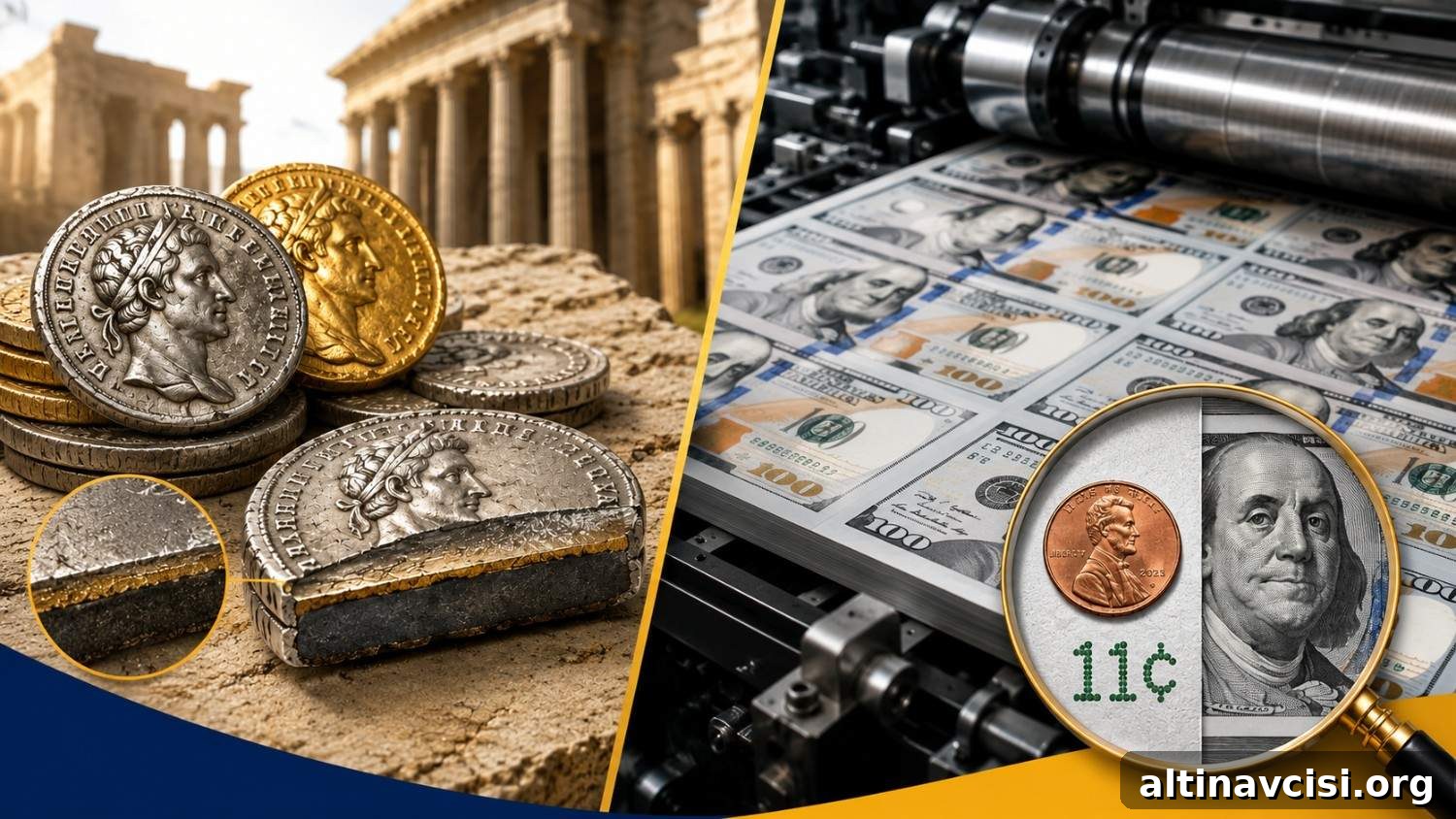
- Seigniorage is the government’s profit from issuing currency — effectively an inflation tax on every dollar you hold. A $100 bill costs only a few cents to produce; the government captures the difference as seigniorage.
- Under the classical gold standard (roughly 1880–1914), inflation was minimal. After 1971, when the dollar was no longer convertible to gold, the dollar lost a large share of purchasing power over decades.
- The Federal Reserve recorded large accumulated shortfalls in recent years, recorded as a “deferred asset.” Remittances to the Treasury paused while that shortfall was carried on the Fed’s books.
- Historically, Rome debased its silver coinage dramatically over two centuries, producing severe inflation and economic disruption.
- Physical gold carries no seigniorage. It cannot be printed, diluted, or debased by policy decisions.
There is a form of tax you pay that rarely appears on a bill or paycheck. It does not require a vote or a new law. It is collected automatically when money is created and the purchasing power of the currency declines.
That tax is seigniorage — the profit a government earns whenever the currency it issues is worth more than it costs to produce or maintain.
What Is Seigniorage?
Seigniorage measures the gap between a currency’s face value and the cost to produce it. For modern paper currency and digital reserves, production costs are tiny compared with face value. The government or central bank acquires purchasing power at far lower cost than the nominal value recorded on notes or electronic balances. That gap is effectively revenue for the issuer, but when money supply expands faster than goods and services, those gains come at the expense of holders of the currency in real terms.
The term derives from the Old French seigneur, meaning lord — historically the feudal authority that had exclusive rights to issue coin and benefit from minting. The principle is ancient: whoever controls the supply of money can extract value from the economy by increasing that supply.
The Knowledge That Changes Everything
Two essential guides — yours free. Understand why gold matters and why fiat currencies are vulnerable.
How Does Seigniorage Work in a Modern Fiat System?
Under a gold standard, seigniorage is constrained by the physical supply of metal. Money supply can only expand as fast as gold production, which historically limited inflation. That constraint was removed when major currencies ceased gold convertibility in the 20th century. In a fiat system, central banks and treasuries can expand the monetary base through asset purchases, reserve operations, and deficit financing. The central bank acquires interest-bearing assets and records liabilities. Net earnings are typically remitted to the treasury, and the difference between what the issuer pays to create money and the purchasing power that money commands is seigniorage.
When the supply of money grows faster than the economy’s output, each unit of currency buys less. That loss of purchasing power affects everyone who holds the currency — consumers, savers, and wage earners — even if the process is gradual and largely unseen month to month.
What Happens When Governments Abuse Seigniorage?
History offers clear examples. Rome debased its silver denarius over centuries to finance military and administrative costs. The coin’s silver content fell from near-pure silver under Augustus to a fraction of that by the third century. As the coin lost intrinsic metal value, prices rose, confidence fell, and barter and alternative media of exchange reappeared. Economic activity that had relied on a trusted currency began to break down. That pattern — raise spending, reduce money’s real value, temporary fiscal relief followed by longer-term damage — repeats when issuing authorities expand money to cover persistent deficits.
Modern tools differ, but the arithmetic is the same. Instead of shaving metal, a government can create bank reserves, buy securities, and run large deficits. The result is more units of currency chasing the same goods, which reduces each unit’s purchasing power.
What Is the Federal Reserve’s Deferred Asset?
In recent years, the Federal Reserve recorded a cumulative shortfall driven by a mismatch between long-term assets acquired at low yields and rising interest expenses on liabilities. Rather than report a formal loss that would reduce capital, the Fed records a deferred asset representing the gap it expects to recover over time. During the period when the Fed incurred these shortfalls, remittances to the Treasury were reduced or suspended until the balance sheet returned to net positive earnings. The deferred asset represents past income forgone and delays the flow of seigniorage to government budgets.
While technical, this accounting choice has practical implications: government revenues temporarily fell, public finances absorbed the shortfall, and ordinary taxpayers faced the indirect effects through broader fiscal pressures.
Why Can’t Gold Be Debased?
Gold is a physical commodity with no government face value. It cannot be created by decree. Global mine production grows at only a small percentage each year, and that supply cannot be increased on a whim by any central authority. Because gold is not a liability of a government or bank, it sits outside the seigniorage mechanism entirely. Across monetary regimes, gold has preserved purchasing power far more reliably than fiat units that can be issued in unlimited quantities.
What Does This Mean for You?
Every dollar in a bank account is an IOU from a central bank. When authorities expand the money supply, that IOU buys less over time. The cost appears in higher prices for everyday goods, housing, and services. Over years and decades, small changes compound into significant erosion of savings.
You do not directly vote on reserve rates, balance-sheet operations, or the pace of money creation. Those decisions rest with appointed officials and institutions. Given that, many people choose to diversify part of their savings into assets that are not subject to seigniorage — assets with no counterparty and no policy committee that can increase supply. Historically, precious metals have served that role for those seeking a structural hedge against currency debasement.
Stay On Top of Gold & Silver Prices
Get important market alerts sent straight to your inbox.
People Also Ask
Is seigniorage the same as inflation?
No. Seigniorage is the revenue mechanism that arises when new money is issued at a cost below its face value. Inflation is the outcome when money creation outpaces the production of goods and services, causing general price levels to rise. Modest seigniorage in a growing economy may cause little inflation; excessive use of seigniorage to finance deficits tends to produce notable inflation.
How much seigniorage does the U.S. government earn each year?
In typical years, central bank earnings remitted to the Treasury can be tens of billions of dollars and represent a major component of modern seigniorage. That amount varies with balance-sheet size, interest rates, and operating income of the central bank.
Why can’t gold be subjected to seigniorage?
Gold has no government-assigned face value and cannot be created at will by monetary authorities. Its supply increases only via mining, which is relatively limited and predictable. An ounce of physical gold is therefore a fixed claim on real resources and cannot be diluted by policy decisions.
What happened to Rome when it abused seigniorage?
Roman emperors repeatedly reduced the silver content of the denarius to cover costs, which led to rising prices, wage demands, refusals to accept debased coin, and increased barter. Over time the monetary system broke down, demonstrating the long-run costs of financing deficits through currency debasement.
How does holding physical gold protect against seigniorage?
Physical gold sits outside the monetary system as a tangible asset with no liability attached. It cannot be issued by a government, and its supply cannot be increased by policy. Over long periods, gold has preserved purchasing power where fiat units have declined.
SOURCES
Expert reports, historical numismatic records, central bank publications, and official price and inflation series inform the facts and figures summarized here. Data cited in the original reporting come from central bank publications, congressional research materials, historical coinage studies, and official economic statistics.
Disclaimer: This article is informational and does not constitute financial or investment advice. Consult a qualified adviser before making financial decisions.
You May Also like:
- Gold Has a 0% Risk Weight and an 85% Funding Penalty. Banks Are Finally Asking Why.
- Deutsche Bank Found Gold’s Price Floor. It’s Not the Buyers You Think.
- 23 Questions to Ask Before Choosing a Gold Storage Provider
- Goldman Just Changed Its Model. Should You Change Yours?
- Gold Is Down 25%. Morgan Stanley Says One Number Unlocks $5,200.
- Solar Cut 19% Silver. The Deficit Widened Anyway.