
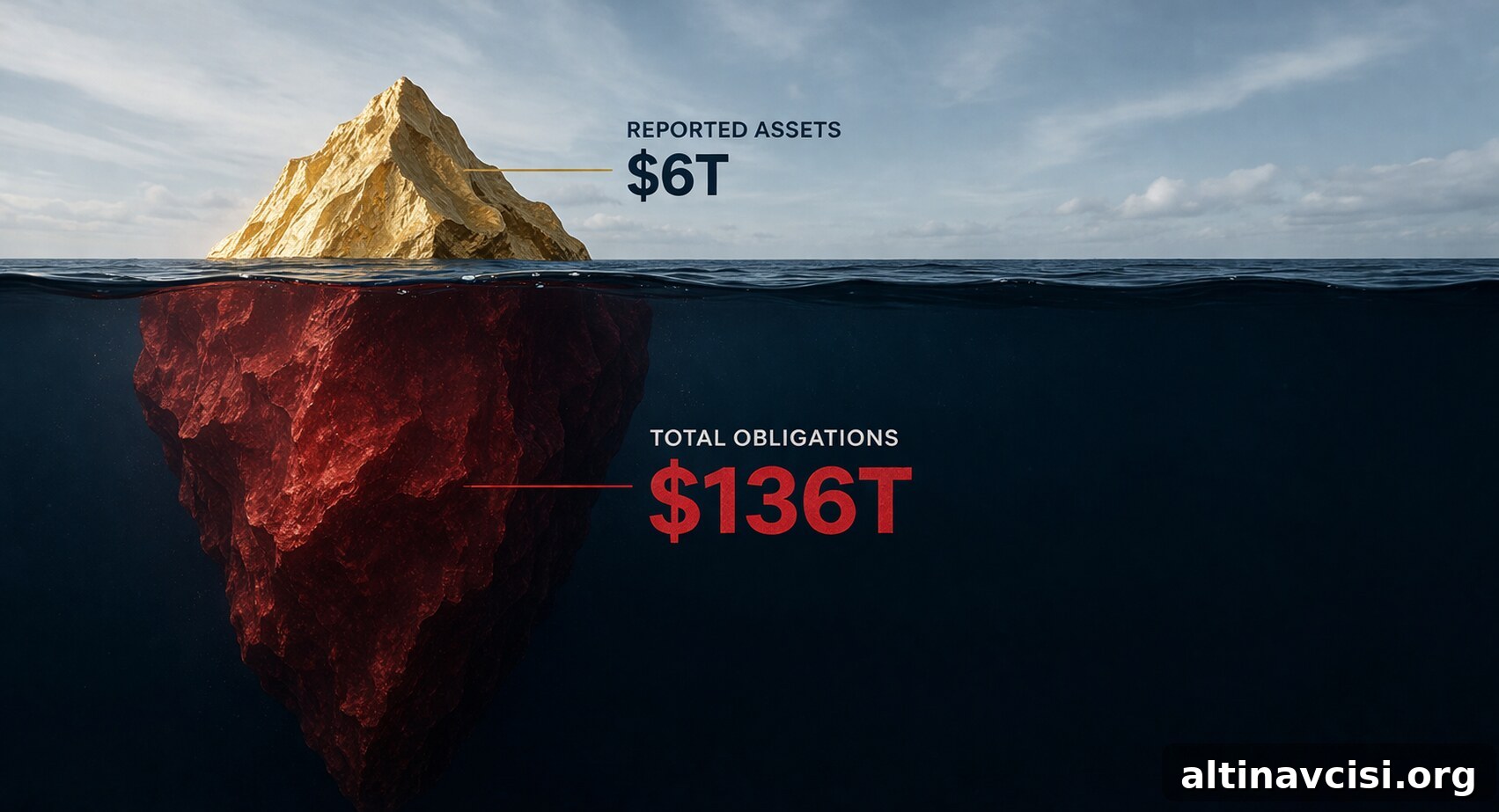
Key Takeaways:
— The U.S. Treasury’s FY2025 consolidated financial statements report a negative net position of $41.72 trillion.
— When unfunded Social Security and Medicare obligations are included, total federal promises exceed $136.2 trillion.
— The Government Accountability Office declined to certify the government’s financial statements for the 29th consecutive year.
The U.S. government’s own accounts reveal a deeply weakened fiscal position.
Rather than a public declaration or congressional hearing, the admission appears inside the Treasury Department’s consolidated financial statements for fiscal year 2025, released recently with little mainstream attention.
Two experienced analysts — economist Steve Hanke and former U.S. Comptroller General David Walker — reviewed the numbers and reached a stark conclusion: the Treasury reports $6.06 trillion in assets against $47.78 trillion in liabilities, producing a negative net position of $41.72 trillion.
What Do the Treasury’s Own Numbers Actually Show?
The consolidated balance sheet is sobering. Total liabilities are now roughly eight times reported assets. Major contributors to the gap include a roughly $2 trillion increase in federal debt and interest payable — now about $30.33 trillion — and a $438.8 billion rise in federal employee and veteran benefit obligations.
Those balance-sheet figures, however, do not capture long-term social insurance commitments.
The Treasury’s Statement of Social Insurance reports a 75-year unfunded liability for Social Security and Medicare that jumped by $10.1 trillion in a single year, from $78.3 trillion to $88.4 trillion. That increase was driven largely by an updated estimate of Medicare Part B shortfalls.
Combine those off‑balance-sheet social insurance obligations with the official liabilities on the balance sheet and total federal promises exceed $136.2 trillion — roughly five times U.S. annual GDP.
One more important detail: the Government Accountability Office issued a disclaimer of opinion on the FY2025 statements, marking the 29th straight year the GAO could not provide reasonable assurance that the financial statements were fairly presented, largely due to unresolved issues at the Department of Defense.
What Does $136 Trillion Actually Look Like?
Trillions are abstract for most people. Hanke and Walker offer a clearer analogy: divide every figure by 100 million to create a household budget equivalent.
In that scaled example the household earns $52,446 a year and spends $73,378, producing a $20,932 annual deficit. The household’s total liabilities and unfunded promises equal $1,361,788 while assets are just $60,554. That household is not merely overspending — it is structurally insolvent.
The analysts use the word “insolvent” intentionally: the country’s obligations exceed its reported and expected ability to pay under current policy assumptions.
U.S. Treasury · FY2025 Financial Statements
The U.S. Balance Sheet: What the Numbers Actually Show
Scale adjusted to show relative size — all figures in trillions of U.S. dollars.
Official liabilities are now nearly 8× reported assets. When off-balance-sheet Social Security and Medicare obligations are included, total federal promises exceed $136 trillion — roughly 5× U.S. annual GDP.
Assets ($6.06T)
Official liabilities ($47.78T)
Total obligations incl. unfunded ($136.2T)
Source: U.S. Treasury Dept. FY2025 Consolidated Financial Statements · Statement of Social Insurance · Fortune / Hanke & Walker, March 2026
Does “Insolvent” Mean the U.S. Is About to Default?
Not necessarily. The United States issues the world’s primary reserve currency, has access to deep capital markets, and can borrow at scale or, if pushed, expand the money supply. A classic sovereign default — missing scheduled payments on a wide scale — is not the most likely short‑term outcome.
Those policy tools, however, have consequences. When obligations grow faster than the economy’s ability to fund them, adjustment often occurs through gradual currency debasement: expanding the money supply faster than real output, which erodes purchasing power over time.
That erosion can be slow and hidden in nominal asset returns. Portfolios may look stable while their real purchasing power declines.

What Happened in 1971?The guide that explains the moment our financial system changed.
Why Is the Debt Problem Getting Harder to Solve?
Raising interest rates is the standard tool to control inflation, but higher rates also increase the government’s debt‑service costs. As borrowing costs rise, deficits tend to widen, requiring more issuance of debt, which can push rates higher still. That feedback loop makes the fiscal situation more sensitive to both inflation and interest rates.
Decades of exceptionally low rates encouraged large-scale borrowing across governments, corporations, and households. The system is now adjusting to a higher-rate environment, narrowing policy options and increasing the risk that shifts in monetary conditions will have larger effects.
At the same time, geopolitical fragmentation, trade tensions, and changing global alliances affect confidence in monetary systems. Those pressures accumulate and can reshape how policymakers and markets respond.
Why Are Central Banks Buying Gold at a Record Pace?
Many central banks, especially in emerging markets, have been increasing gold reserves. This shift reflects a strategic preference: gold carries no counterparty risk and exists outside the credit system. It cannot be defaulted on or frozen and is not a liability on anyone’s balance sheet.
Because of those characteristics, gold often gains appeal during periods of currency concern, monetary stress, or geopolitical uncertainty. Central banks treating gold as a core reserve asset — rather than a speculative holding — reflects a broader quest for diversification and risk management.
What Should Investors Actually Do With This Information?
The article’s point is not to predict an imminent crisis. Rather, it is to note a shift in the long‑term fiscal trajectory now reflected in official accounts.
When obligations persistently outpace a government’s capacity to fund them through growth and policy, the likely adjustments include higher inflation, currency debasement, and forms of financial repression. These outcomes tend to occur gradually, not instantly.
For investors, the question is whether portfolios are positioned for a world where those forces slowly intensify. Assets that exist outside government promises — for example, physical assets with low counterparty exposure — can serve as insurance rather than speculation.
Stay On Top of Gold & Silver Prices
Get important market alerts sent straight to your inbox.
People Also Ask
Not via a formal announcement, but the Treasury Department’s FY2025 consolidated financial statements, released in March 2026, show $6.06 trillion in assets against $47.78 trillion in liabilities, a negative net position of $41.72 trillion. Analysts reviewing those numbers conclude the accounts indicate insolvency under standard accounting definitions.
It does not necessarily mean missed payments. The U.S. can borrow and create currency, which reduces the chance of a classic default. The more likely adjustment, historically, is gradual currency debasement — a steady reduction in purchasing power that erodes real savings over time. Assets outside the credit system can provide a hedge in such environments.
The Treasury’s FY2025 Statement of Social Insurance reports $88.4 trillion in 75‑year unfunded social insurance obligations, up $10.1 trillion year over year. Adding that to the $47.78 trillion in on‑balance‑sheet liabilities yields total federal promises exceeding $136.2 trillion, or roughly five times annual U.S. GDP.
Central banks, particularly in emerging markets, have added significant amounts of gold to reserves. Gold offers no counterparty risk and sits outside the credit system, making it attractive as a reserve asset when confidence in fiat currencies weakens.
Currency debasement is the gradual loss of a currency’s purchasing power, often caused by monetary expansion that outpaces real economic growth. For investors, the risk is that nominal returns mask declines in real value, so preserving purchasing power becomes a primary concern over time.
Disclaimer: This article is informational and is not financial or investment advice. Past performance does not guarantee future results. Consult a qualified financial advisor before making investment decisions.
You May Also Like:
- UBS Forecasts Gold Above $6,000 — Should You Buy Now?
- Gold and Silver Mining Stocks: What Most Investors Miss
- Is There a Silver Shortage in 2026? The Data Is Alarming
- The Seven Stages of Empire: Why Every Great Currency Eventually Collapses
- When Should You Sell Gold and Silver? (And What to Buy Next)
- Could the US Revalue Its Gold Reserves to Pay Down Debt?