Why Metals Led Markets in 2025 and What It Means for 2026
The performance of gold and silver in 2025 was extraordinary by any measure. Far from a modest bounce, that year produced one of the most powerful relative runs for precious metals in decades.
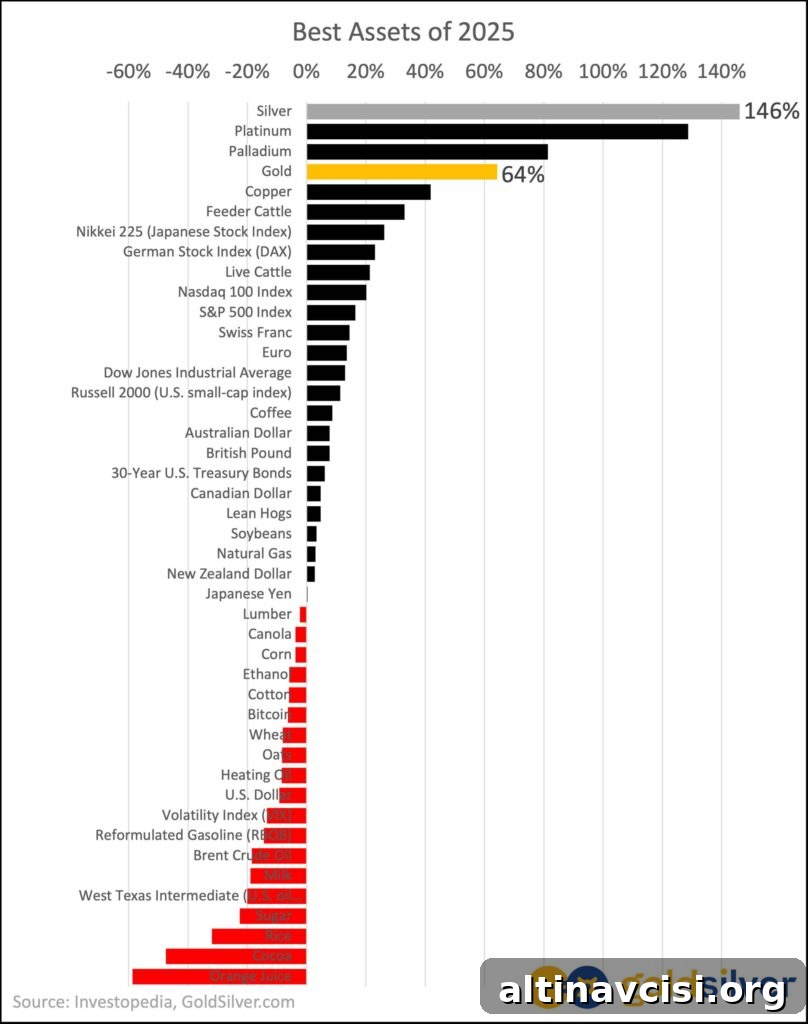
Silver surged 146%, while gold climbed 64%. Those are once-in-a-generation moves for assets many investors still consider “defensive” or “boring.”
Placed alongside other major asset classes, the picture becomes unmistakable: precious metals didn’t merely perform well — they dominated.
Metals Swept the Asset Leaderboard
The top five assets of 2025 were all metals, which is a striking detail rather than a coincidence:
- Silver — 146% gain
- Platinum — 129% gain
- Palladium — 81% gain
- Gold — 64% gain
- Copper — 42% gain
Every one of these top performers was a metal. That matters because it indicates capital was flowing into tangible, hard assets — not speculative meme trades or leverage-driven rallies. Metals carry distinct characteristics: they can’t be printed, they aren’t dependent on someone else’s solvency, and they serve both industrial and monetary roles that have persisted for centuries.
Why This Was a Structural Shift, Not a One-Off Rally
What made 2025 notable wasn’t just the scale of the gains, but how many different asset classes metals outpaced. The year rewarded assets that share a few critical traits:
- They can’t be created on a central bank’s balance sheet.
- They can’t be defaulted on.
- They don’t depend on complex financial engineering or political promises to retain value.
Several macro factors fed into this reallocation of capital: inflation uncertainty, rising sovereign debt loads, geopolitical stress, and growing skepticism about monetary policy effectiveness. More broadly, investors adjusted what they trusted. When confidence in paper claims and financial intermediaries weakens, demand shifts toward assets that don’t require someone else to perform.
Old Money Beats New Money in Uncertain Times
One of the quieter lessons of 2025 is that, during system-wide stress, “old money” tends to outperform “new money.” Gold and silver are not novel financial innovations; they are physical stores of value that do not rely on promises, accounting, or persistent liquidity. They don’t have to “work” in the way engineered financial products do. They exist independently.
Newer financial instruments and narratives can deliver large gains while trust is strong, but they are also more vulnerable when that trust is questioned. In 2025, uncertainty exposed which assets depended on faith and which stood on their own merits.
Counterparty Risk: The Risk Most Investors Overlook
At the core of this shift is counterparty risk — the risk that someone else must act, pay, or remain solvent for an asset to retain value. Stocks, bonds, bank deposits, ETFs, derivatives and many asset proxies all carry this dependency. Physical precious metals do not.
Physical gold and silver carry essentially no counterparty risk: they are not a claim on another party’s balance sheet, and they do not require an intermediary, custodian, clearinghouse or government guarantee to exist. They settle instantly and do not default. That distinction may seem academic in calm markets, but it becomes crucial when confidence erodes.
The Practical Takeaway
Many observers will remember 2025 as “a great year for metals.” A more important question for long-term investors is whether they were positioned to benefit before the move. The year’s results were not only a recap of returns but a clear signal about what the market rewarded and what it punished.
For anyone focused on preserving purchasing power over time, 2025 reinforced a simple message: hard assets are not merely an optional allocation — they can be an essential part of a diversified portfolio. Investors who recognized that early not only avoided losses in other asset classes, they also substantially grew their wealth.
If you’re re-evaluating portfolio allocations after 2025’s shift, consider the role tangible assets play in reducing exposure to counterparty and policy risk. Review educational resources on precious metals investing or consult a qualified advisor or specialist to discuss how physical metals might fit your long-term strategy.
People Also Ask
What was the best performing asset in 2025?
Silver was the top-performing asset in 2025, rising 146% over the year and outpacing major asset classes including equities, bonds, real estate and cryptocurrencies.
How much did gold rise in 2025?
Gold increased by 64% in 2025, placing among the top-performing assets for the year and outperforming many traditional investment categories.
What were the top five performing assets in 2025?
The top five were all metals: silver (146%), platinum (129%), palladium (81%), gold (64%), and copper (42%). This metal-led performance reflected a broader investor shift toward hard, tangible assets.
What is counterparty risk and why does it matter?
Counterparty risk is the possibility that another party must fulfill an obligation for your asset to hold value. Physical gold and silver carry negligible counterparty risk because they are not dependent on any third party’s balance sheet or promises.
Are precious metals a good investment during economic uncertainty?
Precious metals have historically held up well during periods of economic stress because their value does not depend on policy decisions or counterparty performance. The 2025 results highlighted their role as a portfolio hedge when confidence in financial systems is strained.
Popular Topics
Picked from the archive
-
01
 Topics
June CPI Jumps 2.7 Percent as Tariffs Push Up Consumer Prices
-
02
Topics
Gold Prices Rise as Dollar Slips Ahead of Fed Rate Decision
-
03
Topics
Gold Purity Guide for Investors: Karats, Fineness and Value
-
04
Topics
Gold Prices Surge as Middle East Tensions Escalate
-
05
Topics
Russia Taps $1B Chinese Gold Market Amid Geopolitical Shift
-
06
Topics
Gold’s Bull Run: Fed Rate Cuts and China Buying Drive $5K Target
-
07
Topics
Treasury Yields Jump After May Inflation Tops Estimates at 2.7%
-
08
Topics
5 Factors That Drive Gold Spot Prices