
Daily News Nuggets | Today’s top stories for gold and silver investors
February 23rd, 2026 | Brandon Sauerwein, Editor
Two major banks have updated their gold price forecast for 2026 — and the numbers are hard to ignore.
Gold Gains as Trump Tariff Plan Hits Legal Roadblock
Gold prices rose after a federal court blocked former President Trump’s effort to expand tariffs. The decision briefly unsettled markets and reintroduced uncertainty around U.S. trade policy. With the proposed duties on hold, investors must weigh both the legal outcome and the wider political implications.
Markets reacted quickly: the U.S. dollar softened, Treasury yields fell, and precious metals — including gold and silver — ticked upward.
The dynamics are straightforward. Tariffs can lift prices by increasing import costs, but prolonged trade disputes can also slow global growth. That creates a tension for markets: inflationary pressures on one side and growth risks on the other. Historically, this combination tends to support demand for gold.
When policy direction is unclear, capital often shifts toward assets perceived as stable and politically neutral. Gold fits that role, and a legal pause on tariffs removes near-term escalation risk without resolving the deeper uncertainty.
BMO Equity Research: Gold Could Reach $6,500 in 2026
BMO Equity Research released a notably bullish forecast for 2026, suggesting that gold could climb to $6,500 an ounce. The projection is driven by three converging trends: persistent inflation risk, heightened geopolitical tensions, and ongoing central bank purchases. Emerging-market authorities, in particular, continue to diversify away from the U.S. dollar, supporting structural demand for gold.
Importantly, BMO argues this upside does not rely solely on rapid interest-rate cuts. Even with gradual policy adjustments, structural demand and central-bank accumulation could sustain a strong gold market. At the same time, the bank is more cautious on silver, noting industrial demand uncertainty and tighter supply as constraints on near-term gains.
If BMO’s view holds, gold’s role may shift from crisis hedging to a strategic allocation within diversified portfolios, reflecting wider concerns about currency stability and reserve management.
JPMorgan Lifts Gold Target to $6,300, Makes Case for $8,000
JPMorgan offered one of the most bullish Wall Street calls, raising its target to $6,300 per ounce and outlining scenarios in which gold could reach $8,000. The bank points to sustained central-bank buying — particularly by emerging economies — rising fiscal deficits in developed markets, and growing concerns over long-term currency debasement.
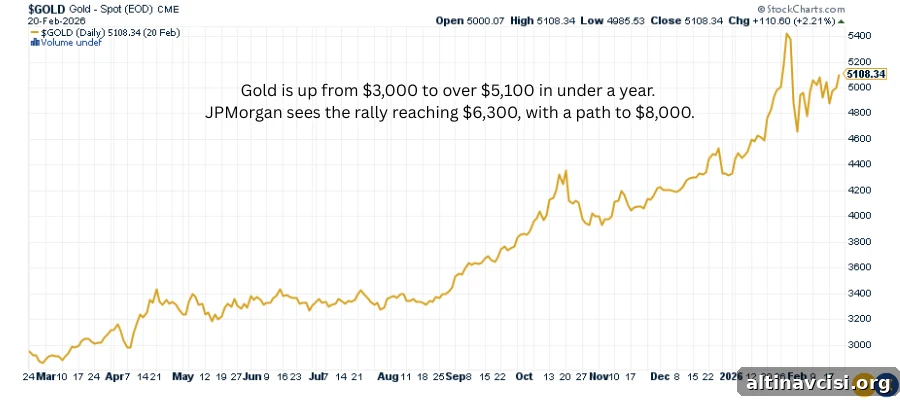
JPMorgan emphasizes that this outlook is not simply a play on falling rates. Instead, the bank sees gold increasingly anchored to systemic risks such as sovereign debt sustainability, changes in global reserve strategy, and waning confidence in fiat systems. If gold’s rally becomes less dependent on traditional real-rate dynamics, its upside potential could be substantially higher.
Such a shift would change how investors think about gold: not merely as a hedge against short-term shocks, but as a strategic asset in portfolios facing long-term structural risks.
UBS CIO Sees Resilient Growth — But Advises Defensive Positioning
UBS’s Chief Investment Office counsels a balanced approach. While the firm acknowledges resilient economic growth and selective investment opportunities, it urges caution in light of elevated fiscal deficits, uncertain central-bank trajectories, and geopolitical tensions. UBS recommends diversified portfolios that combine quality equities, high-grade bonds, selective alternatives, and geographic diversification.
The message is clear: stay invested but protect capital. UBS does not predict a sharp downturn, nor does it rule one out. For investors, the priority should be building portfolios that can withstand policy surprises or macro shocks while remaining positioned for growth.
Stay On Top of Gold & Silver Prices
Get important market alerts sent straight to your inbox.
America’s Retirement Gap Gets Harder to Ignore
A new report highlights a widespread problem: the median retirement savings for many American households is just $955. Millions approaching retirement have under $1,000 saved, yet will need funds to last two to three decades.
The causes are familiar: limited access to employer retirement plans for many workers, inconsistent contributions among those with access, and persistent inflation that raises the cost of essentials like housing, healthcare, and groceries. These factors make saving more difficult at exactly the time it matters most.
Social Security provides a baseline but typically replaces only around 40% of pre-retirement earnings for many households. That shortfall forces difficult choices: work longer, cut spending, or lower retirement expectations.
Beyond accumulating savings, the bigger challenge is preserving purchasing power. For many Americans, diversification and inflation-resistant assets are not optional strategies but necessities to prevent erosion of wealth over time.
You May Also Like
- Gold Hits $5,000. Is This the Next Leg Higher?
- Gold Support Levels Firm as Washington Backs Minerals
- Gold Slips Below $5K as Jobs Revisions Rattle Markets
- Gold Near $5,000 as Fed Faces Sticky Inflation
- Markets Eye Friday’s CPI, Credit Card Debt Hits Record High