Gold and silver market update — May 12, 2026
Key Takeaways
- The Bureau of Labor Statistics reported April 2026 CPI at 3.8% year‑over‑year — the hottest reading since May 2023 and slightly above the 3.7% consensus. Rising energy prices tied to the Middle East conflict pushed gasoline up 28.4% annually.
- Gold fell 1.5% following the report not in spite of higher inflation, but because traders quickly repriced Fed expectations toward tighter policy. That lifted the U.S. dollar index (DXY) and pressured dollar‑priced gold.
- BLS Real Earnings data showed real wages turned negative for the first time in three years, meaning the purchasing power of cash and savings is eroding at roughly 3.8% per year.
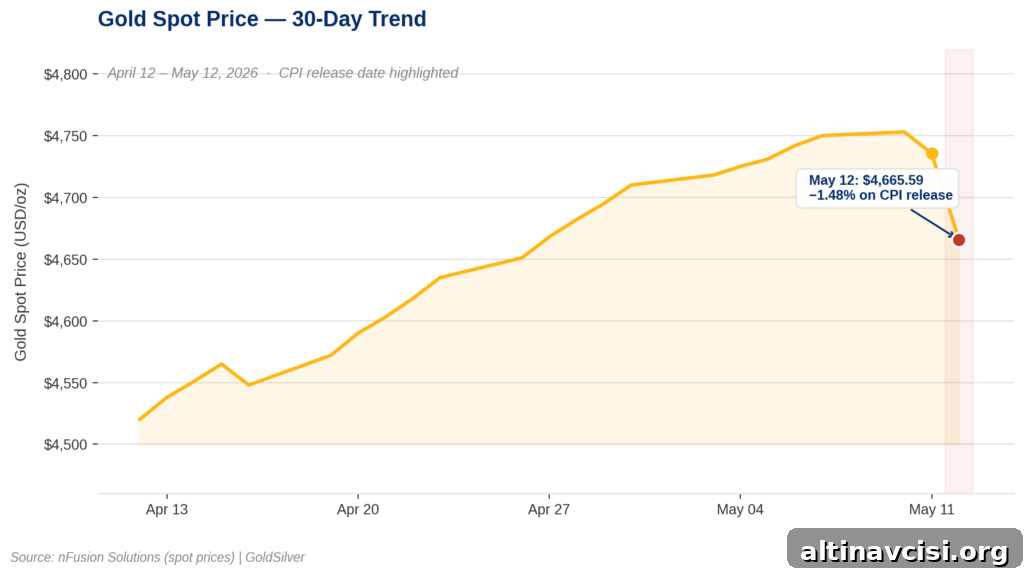
On May 12, 2026, gold declined about 1.5% to $4,665. The same morning the Bureau of Labor Statistics released April CPI at 3.8% year‑over‑year — the strongest reading since May 2023. This can feel counterintuitive: higher inflation does not automatically lift gold immediately. The market reaction typically runs through expectations for the Federal Reserve. In this case, traders shifted toward a more hawkish Fed, and that chain reaction hit gold.
Why Does Hot Inflation Push Gold Down?
When inflation surprises to the upside, markets rapidly adjust their outlook for Fed policy. Before the CPI print, traders expected no rate cuts in 2026. After the 3.8% release, CME FedWatch data on May 12 showed roughly a 30% probability of a rate hike by December 2026 and more than 70% by April 2027. That represents a meaningful repricing in a short period.
Higher expected policy rates tend to boost nominal Treasury yields and strengthen the U.S. dollar. Because gold is priced in dollars, a stronger dollar makes gold more expensive for holders of other currencies and typically triggers selling. The chain is: hot CPI → hawkish Fed repricing → stronger dollar → gold sold. This is largely a futures‑market and positioning move, not a reassessment of gold’s long‑term role.
The Edge Every Investor Needs
Smarter precious metals investing starts here. The Nuggets Newsletter brings essential market insights, Fed updates, global trends, educational videos, and more.
Is This the Beginning of an Inflation Problem?
April’s 3.8% reading marks a second consecutive acceleration. March was 3.3% and February 2.4% — the latter before the current Middle East conflict began. Over two months inflation rose roughly 1.4 percentage points, with gasoline the largest contributor at a 28.4% year‑over‑year increase.
Shelter costs rose 0.6% in April. Some of that may reflect timing effects in BLS rent data collection following the government shutdown in late 2025, rather than a sharp new jump in rents. Still, the broader direction is clear: inflation is accelerating.
Major banks expect inflation to stay elevated. JPMorgan Global Research projects inflation above 3% into early 2027, and Bank of America has pushed its forecast for the first Fed rate cut into the second half of 2027. That leaves the Fed in a difficult position: it cannot cut with inflation running near double its 2% target, yet aggressive hikes risk further slowing growth. Meanwhile, real wages are negative and purchasing power is eroding at roughly the CPI rate.
Isn’t Gold Supposed to Be an Inflation Hedge?
Over long horizons, gold has preserved purchasing power against inflation. Short term, however, gold responds to real yields — nominal Treasury yields minus inflation expectations. When an inflation surprise leads traders to expect higher nominal rates, nominal yields can rise faster than inflation expectations, lifting real yields. Higher real yields make interest‑bearing dollar assets relatively more attractive and can pressure gold in the near term. That dynamic explains today’s decline even as the long‑term case for gold as an inflation hedge remains intact.
The Second Corner
The immediate selloff is largely a positioning event: traders long gold ahead of the CPI release were forced to unwind when the report spurred hawkish repositioning. That’s the noise. The signal is that inflation is accelerating, real wages are negative, and the Fed faces constrained options. Gasoline is sharply higher, geopolitical risks remain unresolved, and the dollar’s real purchasing power is eroding at a pace the Fed cannot easily reverse without trade‑offs.
In short, gold didn’t fall because the inflation story weakened; it fell because short‑term rate expectations shifted against gold. Confusing short‑term price action with the long‑term case is how strategic holders can be shaken out at inopportune times.
What to Watch
The PCE deflator, the Fed’s preferred inflation gauge, is due later this month. A print above 3% would reinforce a baseline of no cuts in 2026 and could push FedWatch hike odds higher. For now, watch $4,600 as near‑term support for gold and monitor the DXY for early indications of the dollar‑gold relationship. Keep an eye on energy prices and shelter data for the next directional signals on inflation.
Stay On Top of Gold & Silver Prices
Get important market alerts sent straight to your inbox.
SOURCES
1. Bureau of Labor Statistics — Consumer Price Index, April 2026
2. Bureau of Labor Statistics — Real Earnings, April 2026
3. Bureau of Labor Statistics — CPI Historical Releases (March & February 2026)
4. CME Group — FedWatch Tool, as of May 12, 2026
5. nFusion Solutions — Precious Metals Spot Price Feed
6. JPMorgan Global Research — Inflation Outlook, May 2026 (proprietary)
7. Bank of America Research — U.S. Rate Forecast, May 2026 (proprietary)
Disclaimer: This article is for informational purposes only and does not constitute financial or investment advice. Always consult a qualified financial adviser before making investment decisions.
You May Also Like:
- CPI Hits 3.8%. Gold Falls. The Mechanism Nobody Explains
- Why the Gold Silver Ratio Is Falling — and What It Means
- What’s Moving Gold Prices This Week: CPI, Seoul & Beijing
- Silver Jumps 6% Before Trump‑Xi Summit. Here’s Why
- April Jobs Beat 115K. Gold Held. The Dollar Didn’t. Here’s Why
- Jobs Beat, Ceasefire, Deficit: What It Means for Gold
- Gold Price Outlook: Oil Futures Disagree With Stock Markets
- Why Silver Hit $82 Today: Iran, Oil, and the Fed