Key Takeaways
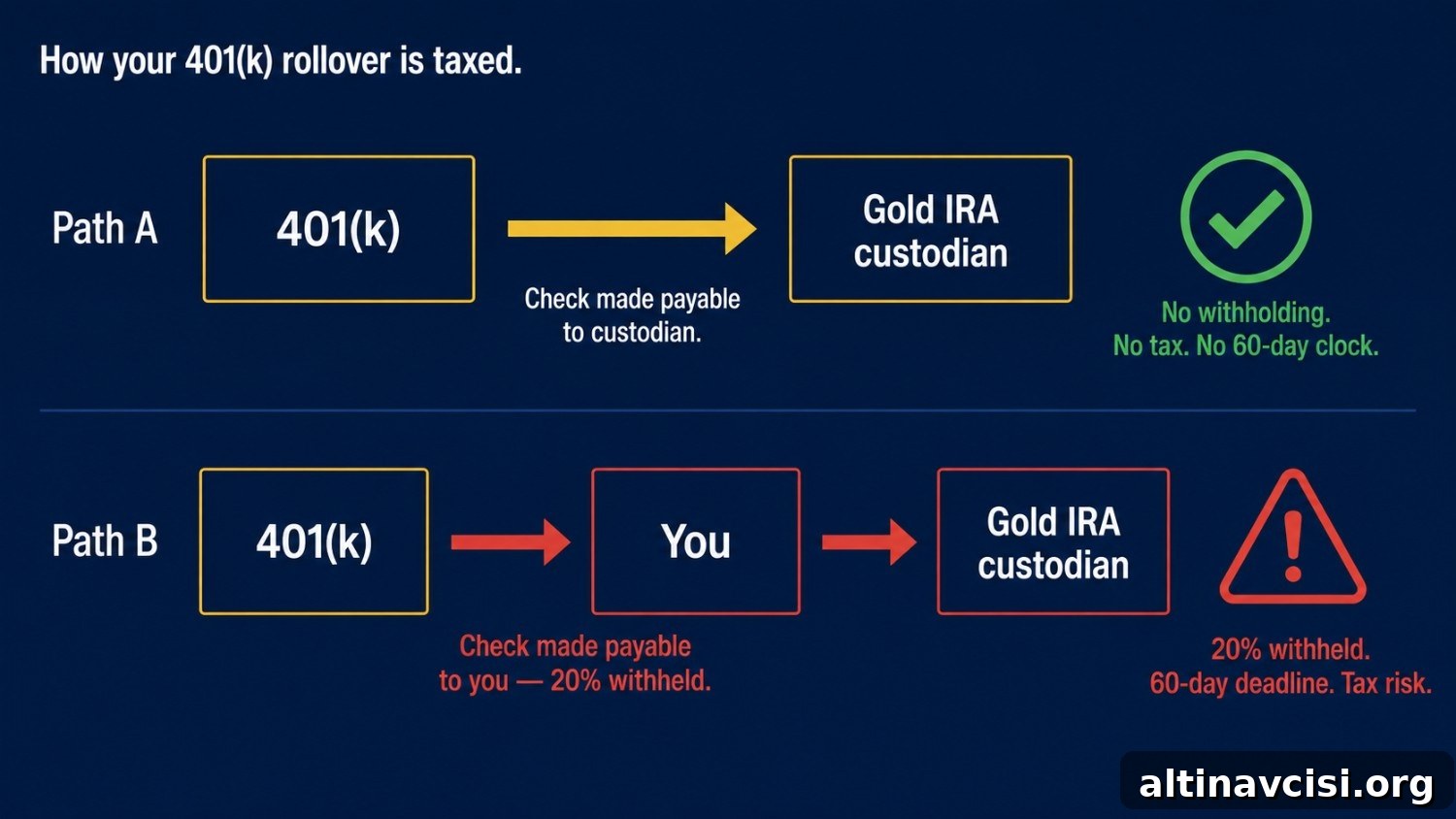
- A direct rollover from a 401(k) to a gold IRA is tax-free when funds move directly between institutions — no withholding, no penalty, and no taxable distribution.
- An indirect rollover where the check is made payable to you triggers mandatory 20% federal withholding. You then have 60 days to replace any withheld amount to avoid taxation on the shortfall.
- Trustee-to-trustee transfers (IRA to IRA) are not subject to the one-rollover-per-year limit and do not carry withholding risk.
- Converting a traditional 401(k) to a Roth gold IRA is a taxable event; the amount converted is included in your gross income for that year.
- IRA-eligible gold must meet IRS purity standards. Generally that means 99.5% purity, with certain legislated exceptions for specific coin types.
A 401(k)-to-gold-IRA rollover can be completed without incurring taxes if you execute a direct rollover. The Internal Revenue Service does not treat a direct transfer between a qualified retirement plan and an IRA as a taxable distribution, so no taxes are withheld and no penalties apply. The key detail is how the funds are paid: if the plan sends the check directly to the receiving custodian, the transfer remains tax-free; if the plan pays you, the situation changes.
This article explains the IRS distinctions between transfer types, identifies the approach that avoids withholding risk, and highlights the common errors that can turn a tax-free rollover into a taxable event.
Why Are More Retirement Savers Moving Into Physical Gold?
Many retirement savers are adding physical gold to their portfolios as a hedge against currency debasement and inflation. Gold preserves purchasing power differently than cash and bonds because it reflects long-term value storage rather than promises denominated in a particular currency. Recent research and market observations suggest that traditional portfolio mixes may be less effective during persistent inflationary periods, which has led advisors and investors to consider allocating a portion of retirement assets to gold.
Gold and silver typically do not “rise” in isolation; instead, they reflect the relative value of the currency in which they are priced. Over long periods, fiat currencies can lose purchasing power against gold. For investors seeking to protect real wealth, holding a modest allocation in physical gold within an IRA can be part of a diversified strategy that preserves purchasing power across decades.
Importantly, moving funds into a gold IRA does not mean losing tax protections. The IRS permits rollovers from qualified employer plans into IRAs under specific conditions that preserve tax-deferred status when handled correctly.
The Knowledge That Changes Everything
Two essential guides — yours free. Understand why gold matters and why fiat currencies face long-term pressure.
What Is the Difference Between a Direct Rollover, a Transfer, and an Indirect Rollover?
Under IRS rules these terms are distinct and the difference determines whether taxes or withholding apply.
Direct rollover: Your 401(k) administrator sends funds directly to the receiving IRA custodian. The check is made payable to the receiving institution, not to you. A direct rollover is not treated as a taxable distribution and is not subject to withholding.
Trustee-to-trustee transfer: This applies when you move an existing IRA from one custodian to another. The funds move directly between custodians, never touching your hands. The IRS does not treat a trustee-to-trustee transfer as a rollover for the one-per-year limit, and withholding is not required.
60-day (indirect) rollover: The plan distributes the funds to you. You then have 60 days to deposit the full amount into a new IRA. This method creates the risk of mandatory withholding and potential taxation if you fail to replace withheld funds within the 60-day window.
What Triggers the 20% Withholding Problem — and How Do You Avoid It?
When a distribution from a 401(k) is paid directly to you rather than to your receiving custodian, the plan administrator is required to withhold 20% for federal income tax. This withholding is mandatory and cannot be waived.
For example: if you receive a $10,000 distribution and the plan withholds $2,000, you receive $8,000. To roll over the full $10,000 tax-free you must make up the withheld $2,000 from non-retirement funds and deposit the entire $10,000 within 60 days. If you deposit only the $8,000, the $2,000 withheld is treated as taxable income and may be subject to early withdrawal penalties if you are under age 59½. The simplest way to avoid this trap is to arrange a direct rollover so the plan sends the funds straight to your IRA custodian.
How Many Rollovers Can You Do Per Year?
The IRS limits IRA-to-IRA indirect rollovers to one per 12-month period across all IRAs you own. This rule does not apply to direct rollovers from employer plans to IRAs, trustee-to-trustee transfers, or Roth conversions. If you move a 401(k) directly to a gold IRA via direct rollover, the one-per-year limit does not apply. Similarly, trustee-to-trustee transfers are not treated as rollovers under IRS guidance.
Does a Rollover to a Roth Gold IRA Trigger Taxes?
Yes. Converting pre-tax retirement funds to a Roth IRA is a taxable event. The converted amount is included in your taxable income for that year and taxed at ordinary income rates. Many investors consider Roth conversions because qualified Roth withdrawals in retirement are tax-free, including any appreciation in the metals. Whether a conversion makes sense depends on your current tax bracket, anticipated tax rate in retirement, and longer-term objectives.
If you roll pre-tax 401(k) dollars into a traditional gold IRA (i.e., remain pre-tax), there is no immediate tax consequence; taxes are deferred until you take distributions in retirement.
What Gold Can You Actually Hold in an IRA?
Not all coins and bars qualify for IRA ownership. The IRS sets fineness standards for precious metals held in IRAs. Gold generally must meet a minimum fineness standard (for example, 99.5% purity) to be eligible. Silver, platinum, and palladium each have their own purity thresholds. Some coin types are explicitly approved despite lower purity because of legislative exception; others do not meet the standard and cannot be held in an IRA.
IRA-owned metals must be held by an approved custodian and stored at an IRS-approved depository. Taking personal possession of IRA metals is treated as a distribution and can trigger income tax and penalties where applicable.
What Are the Required Minimum Distribution Rules for a Gold IRA?
Required minimum distributions (RMDs) apply to gold IRAs the same as any traditional IRA. Current rules set the starting age for RMDs according to recent legislation; consult current IRS guidance for the precise age that applies to you. RMDs cannot be rolled over. If you are subject to an RMD in a given year, it must be withdrawn before you roll remaining funds into another retirement account.
How Do You Actually Execute a Tax-Free 401(k)-to-Gold-IRA Rollover?
The steps to complete a tax-free direct rollover are straightforward when you follow the proper process.
Step 1: Open a self-directed IRA. A self-directed IRA is required to hold physical precious metals. Select an IRS-approved custodian experienced with precious metals IRAs.
Step 2: Request a direct rollover from your 401(k) administrator. Ask the plan administrator to send the funds directly to your new custodian and provide the custodian’s details. Make clear in writing that you want a direct rollover, not a distribution to you.
Step 3: Purchase IRS-eligible metals through your custodian. Once the IRA is funded, instruct your custodian to acquire qualifying gold or silver. The metals will be delivered to an approved depository under the custodian’s control. You never take physical possession if you want to maintain the IRA’s tax status.
A typical trustee-to-trustee direct rollover can take one to three weeks, depending on how quickly the releasing plan processes requests and transfers funds.
Stay On Top of Gold & Silver Prices
Get important market alerts sent straight to your inbox.
People Also Ask
Is a 401(k) to gold IRA rollover taxable?
A direct rollover from a 401(k) to a gold IRA is not taxable. The IRS treats a direct transfer between institutions as non-distributive, so no income is recognized and no penalty applies. An indirect rollover paid to you first triggers mandatory 20% withholding and creates a 60-day deadline to redeposit the full pre-withholding amount to avoid taxation on the withheld portion.
How long does a 401(k) to gold IRA rollover take?
A direct rollover typically completes in one to three weeks after the paperwork is submitted. Timing depends primarily on how quickly the releasing plan administrator processes the request.
Can you roll a 401(k) into a gold IRA without a penalty?
Yes. A properly executed direct rollover avoids both the mandatory 20% withholding and the 10% early withdrawal penalty because the transfer is not treated as a taxable distribution.
What is the one-rollover-per-year rule, and does it apply to 401(k) rollovers?
The one-rollover-per-year limitation applies to indirect IRA-to-IRA rollovers and restricts them to one per 12-month period across all your IRAs. It does not apply to direct rollovers from employer plans to IRAs or to trustee-to-trustee transfers.
Can I store my gold IRA metals at home?
No. IRA-held metals must be stored by an approved custodian at an approved depository. Taking personal possession of IRA metals is treated as a distribution and can trigger taxes and penalties.
SOURCES
1. IRS guidance on rollovers and distributions; publications covering rollovers, IRA contributions, and pension/annuity income.
2. Legislative and regulatory guidance on IRA-eligible precious metals and required minimum distributions.
3. Industry research and market reports on gold as a store of value and portfolio allocation considerations.
Disclaimer: This article is informational only and does not constitute investment advice. Past performance does not guarantee future results. Consult a qualified financial advisor or tax professional before making retirement or investment decisions.
You May Also Like:
- Gold Just Climbed to a 7-Week High. One Number Changed Everything.
- The Jobs Report Did What Geopolitics Couldn’t: Move Gold and the Fed in the Same Direction
- China Has Been Buying Gold for Months and Is Strengthening Its Position
- Tariff Decisions and Industrial Demand: How Policy Moves Affect Silver
- Short-Term Rallies and Long-Term Trends: What to Watch in the Gold Market