
Gold has reached record prices this year as powerful macro forces reshape the market. As investors seek a clear gold price prediction for 2026, one signal stands out: institutional investors broadly expect gold to keep rising.
A Goldman Sachs Marquee survey of more than 900 institutional clients conducted November 12–14 found that nearly 70% believe gold prices will be higher by the end of 2026, with the largest cohort—36% of respondents—predicting gold will exceed $5,000 per ounce within the next year.
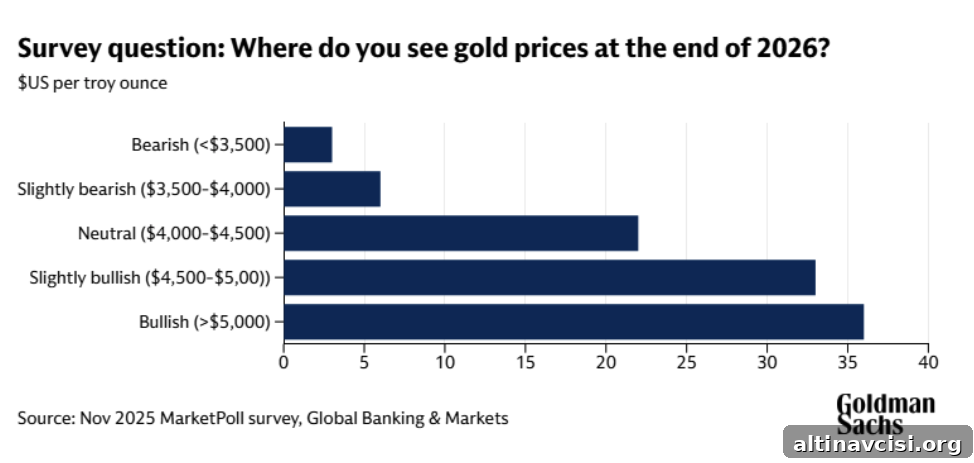
This bullish sentiment reflects a growing view that gold’s role is expanding in modern portfolios. With central banks accumulating unprecedented amounts of metal, fluctuating real rates, and rising geopolitical tensions, many investors view gold as a resilient asset that performs well when conventional models struggle. Those same drivers pushed gold into new territory through 2024 and 2025 and continue to build momentum.
What makes this shift notable is not only the bullishness but the conviction. Institutional desks, typically conservative, are increasingly treating gold as a strategic allocation rather than a purely defensive holding.
If the world’s largest financial institutions expect higher gold prices, is your portfolio positioned for that environment?
Why Institutions Are Bullish on Gold
Institutions rarely make aggressive projections, so their widespread expectation of rising gold suggests deep structural drivers are influencing the market and shaping the gold price forecast for 2026.
1. Gold is behaving differently than traditional models predicted.
Historically, higher real interest rates weighed on gold. Over the past two years, however, gold has decoupled from that pattern and continued to climb despite aggressive rate moves. This shift points to demand driven more by central banks and emerging markets than by Western financial investors.
2. Macro uncertainty is persistent rather than episodic.
Markets now navigate a mix of sticky inflation, sovereign debt pressures, shifting monetary frameworks, trade realignments, and geopolitical fragmentation. In such an environment, institutions are reallocating toward assets with no counterparty risk—placing gold in a distinct category.
3. Structural demand is outweighing price-sensitive demand.
Central banks and consumers in emerging markets tend to be less price-sensitive than ETF-driven Western investors. When those buyers step in, dips are bought quickly, creating a natural floor and reinforcing longer-term price stability.
Together, these factors create a powerful setup: gold is viewed not only as a hedge but as an asset with sustained upside driven by global structural shifts.
Central Bank Demand Hits Multi-Decade Highs
Sovereign accumulation is one of the most influential drivers of gold prices today. Central bank buying is at the highest sustained level in modern history, and the trend continues to accelerate.
Why are central banks increasing gold holdings?
- Diversification away from USD assets
- Protection against sanctions and political risk
- Strengthening national reserves
- Insurance against currency volatility
- Preference for assets without counterparty risk
Central banks are buying for strategic reserve diversification rather than short-term gains. Because sovereigns rarely sell once they add gold, this demand exerts a lasting influence on the gold price outlook for 2026.
Notable trends:
- Net global purchases have roughly doubled compared with pre-2022 levels.
- China has reported extended consecutive months of buying, and analysts believe actual volumes may be even higher.
- Countries such as India, Poland, Turkey, and several Gulf states are actively rebuilding reserves.
This steady, strategic buying provides a strong structural floor for prices and supports bullish forecasts into 2026.
Stay On Top of Gold & Silver Prices
Get important market alerts sent straight to your inbox.
Geopolitical Drivers: A World Reordering Around Risks
Geopolitical fragmentation is another key factor shaping the 2026 gold price outlook. As alliances shift and conflicts rise, gold remains a politically neutral store of value.
1. East–West tensions are reshaping trade.
U.S.–China rivalry, sanctions, tariff changes, and friend-shoring are rewiring global trade, creating currency volatility and inflationary pressures that historically favor gold.
2. Conflicts and instability boost safe-haven demand.
Regional wars and geopolitical flashpoints have repriced risk across markets. When uncertainty rises, gold tends to outperform other assets.
3. De-dollarization and emerging blocs influence reserve choices.
New and expanding economic blocs are diversifying away from dollar-dominated reserves and increasingly treating gold as a neutral settlement and reserve asset. This is a long-term trend that supports ongoing demand.
4. A multipolar world increases the value of stateless assets.
In an era of greater geopolitical unpredictability, gold’s traits—no counterparty risk, no liability, lack of political attachment, and no default risk—become especially attractive.
Inflation, Debt, and Policy Uncertainty
Inflation, high debt levels, and monetary policy uncertainty remain central gold price drivers.
Inflation is proving persistent.
Even if headline inflation cools, structural inflation—driven by services, wages, and energy—remains elevated, eroding purchasing power and nudging investors toward real assets.
Rising global debt amplifies pressure on real rates.
Government borrowing surged after 2020, and higher debt burdens often imply lower real interest rates over time—a historically supportive environment for gold.
Monetary policy uncertainty is elevated.
Debates over central bank independence and rapid policy shifts make it harder to price long-term stability, and policy volatility has often served as a tailwind for gold.
What This Means for Investors
When institutional forecasts, sovereign accumulation, geopolitical realignment, and inflationary pressures all point the same way, the long-term setup for gold is unusually strong. For investors, the takeaway is straightforward:
If global institutions and sovereign buyers expect higher gold prices, consider whether your portfolio is positioned for that environment.
The gold price forecast for 2026 is less about speculative upside and more about recognizing the structural forces already driving the market.

The Financial System Isn’t Safer — And You Know It
As risks mount, see why gold and silver are projected to keep shining in 2026 and beyond.
People Also Ask
What is the gold price forecast for 2026?
Most institutional investors expect gold to rise into 2026, with some forecasting levels above $5,000 per ounce. The outlook is supported by strong central bank demand, geopolitical uncertainty, and inflationary pressures.
Why do institutions think gold will go up in the next few years?
Nearly 70% of surveyed institutions point to persistent demand from central banks and emerging markets, combined with geopolitical instability and mounting debt, as reasons to expect higher long-term prices.
How do central banks influence the gold price?
Central banks buying gold at scale reduce available supply and establish a long-term support level. Their purchases are typically strategic—driven by diversification and geopolitical considerations—which makes their demand particularly impactful.
What geopolitical events could push gold higher by 2026?
Escalating tensions between major powers, regional conflicts, and expanding economic blocs that diversify reserves away from the dollar can all increase safe-haven demand for gold. Historically, such uncertainty has favored precious metals.
How does inflation affect the gold price forecast for 2026?
Persistent structural inflation reduces purchasing power and pushes investors toward hard assets like gold. Even if headline figures moderate, ongoing price pressures in wages and services support continued interest in precious metals.