J.P. Morgan projects gold near $6,000 by year-end. That headline number is memorable, but the forecast rests on a much deeper data point: central bank buying that official reports substantially understate.
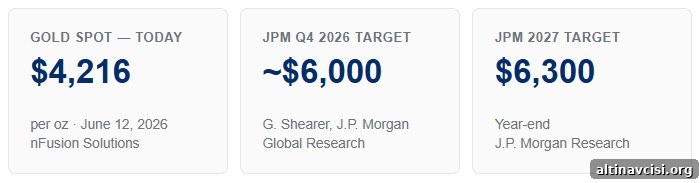
J.P. Morgan Global Research now expects gold to approach $6,000 per ounce by Q4 2026 and to reach about $6,300 by the end of 2027. Its revised full-year 2026 average forecast is $5,243 per ounce, down from an earlier estimate, while spot gold trades around $4,216. What drives the bank’s projection is large, ongoing central bank demand that the IMF’s voluntary reporting system misses — the World Gold Council estimates actual central bank purchases at 244 tonnes in Q1 2026 versus just 16 tonnes shown in official IMF net-purchase data. China’s accumulating role, via the People’s Bank of China and institutional buyers such as insurance companies, is a key structural factor many investors underappreciate.
Key takeaways
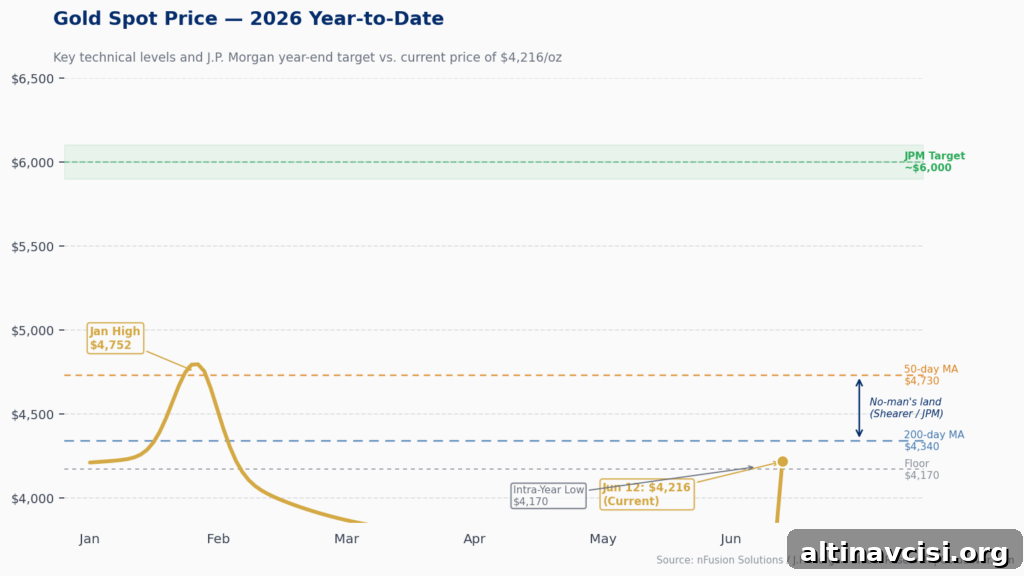
- Gold trades near $4,216/oz — about 12% below January’s peak of roughly $4,752. J.P. Morgan’s year-end path implies a roughly 42% upside from current levels.
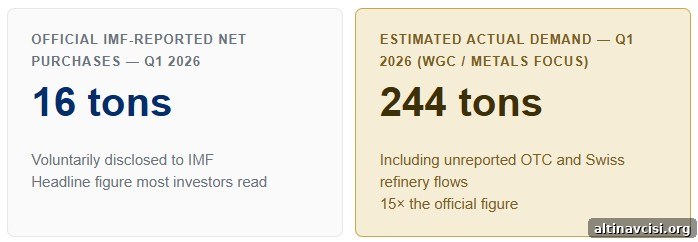
- Official IMF-reported Q1 2026 central bank net purchases: 16 tonnes. World Gold Council estimated actual demand: 244 tonnes. The discrepancy exists because reporting to the IMF is voluntary.
- China’s disclosed central bank buying rose from ~1 tonne per month to 8 tonnes in April 2026. Chinese net gold imports totaled 317 tonnes in Q1 — nearly triple the previous quarter.
- Ten major Chinese insurers received regulatory approval to allocate up to 1% of assets to physical gold, representing roughly 200 tonnes of potential demand at current prices.
- The main downside risk is a Fed hiking cycle driven by energy-led inflation, which would push real yields higher, compress Western ETF demand and weigh on prices.
What is the real data behind the $6,000 gold price forecast?
The crucial input behind the $6,000 narrative is central bank buying that is materially larger than the IMF’s voluntary, self-reported numbers. The World Gold Council’s estimate of 244 tonnes of central bank demand in Q1 2026 stands in sharp contrast to the 16 tonnes recorded in IMF data. That roughly 15x gap is the foundation for the flow-based price model many analysts use.
What is J.P. Morgan’s gold forecast for 2026 — and what drives it?
J.P. Morgan’s view: gold should trade toward $6,000 by late 2026 and continue higher into 2027, with an average of $5,243 for 2026. That average was lowered from a previous call because of softer near-term investor participation and lighter ETF positioning. The bank highlights that while gold has traded in a sideways range, structural demand from central banks and large sovereign buyers is persistent.
Gregory Shearer, Head of Base and Precious Metals Strategy at J.P. Morgan, describes the market as “in a technical no-man’s land,” with prices oscillating between moving averages amid concerns that the Fed could respond to energy-led inflation with higher rates. That dynamic has dampened short-term investor enthusiasm, even as long-run structural buyers continue to accumulate.
Other institutions echo cautious optimism: Goldman Sachs’ year-end projection is around $5,400, Wells Fargo has flagged an $8,000 scenario for 2027 as a possibility, and a Reuters survey of analysts placed the median forecast above current spot. The convergence of these forecasts points to materially higher prices than today, driven largely by flows rather than short-term trading sentiment.
Are central banks still buying gold? The official answer and the real one
Official Q1 2026 IMF-reported net purchases appear small — 16 tonnes — and the gross figures show notable sales as well. Taken at face value, that suggests buying has cooled. But the World Gold Council’s analysis using London OTC flows and Swiss refinery data points to 244 tonnes of central bank demand in Q1 2026, up from 208 tonnes in Q4 2025. The difference reflects voluntary reporting: sovereigns are not required to disclose gold purchases to the IMF, so a significant portion of accumulation often goes unreported.
That persistent reporting gap is not a one-off: it reflects how the market functions. The World Gold Council’s OTC methodology aims to capture flows that voluntary disclosure misses, revealing a more complete picture of sovereign demand.
Why is China buying so much gold — and who is doing the buying?
China figures prominently among the larger, less-visible buyers. Net Chinese gold imports totaled 317 tonnes in Q1 2026, nearly triple the prior quarter, while the People’s Bank of China increased its disclosed monthly purchases from about one tonne to five tonnes in March and eight tonnes in April. The shift looks strategic: after the freezing of Russian reserves in 2022, many sovereigns reassessed the conditional safety of dollar reserves and moved to diversify into assets that cannot be frozen or debased.
China’s insurance sector is another emerging source of demand. In February 2025, regulators permitted ten major insurers to allocate up to 1% of assets to physical gold. At scale, that policy implies roughly 200 tonnes of potential demand; some estimates put the annual potential even higher. These insurers are not yet required to disclose holdings, so their accumulation could be substantially larger than public data shows.
What are the risks to gold’s price outlook in 2026?
Gold’s primary vulnerability is its lack of yield. If real returns on competing assets — especially US Treasuries and cash instruments — rise, gold tends to underperform. The specific bearish scenario highlighted by analysts is a US macro environment with strong growth and rising inflation that forces the Federal Reserve into a sustained rate-hiking cycle. Higher real yields in that situation would likely trigger outflows from Western gold ETFs and create downward pressure on prices.
Geopolitical developments add nuance: a de-escalation of conflicts would remove some tail risks supporting gold, while prolonged tensions can reinforce structural drivers like higher inflation expectations and fiscal uncertainty. Both dynamics influence the premium investors assign to gold.
What gold’s sideways move is actually telling you
The recent range trade — roughly $4,170 to $4,730 — is better described as absorption than indecision. The market has digested large sales (such as Turkey’s 60-ton sale), softer Western ETF inflows, and the prospect of a more hawkish Fed, yet prices have held up relatively well. The drawdown from January’s highs is around 12%, smaller than historical corrections under similar headwinds.
The structural backdrop has shifted: central bank buying averaged roughly 225 tonnes per quarter from 2021–2025, about double the prior five-year pace. New institutional buyers, including China’s insurance sector, add another steady source of demand. These are strategic, long-duration allocations that do not reverse on a single Fed statement or one monthly inflation print. The consolidation suggests major buyers are accumulating on the pause rather than exiting.
What should gold investors watch for the rest of 2026?
Key signals to monitor:
- Federal Reserve communications and FOMC meeting language — any sign of renewed rate hikes, particularly from energy-driven inflation, could trigger ETF outflows.
- PBOC monthly disclosures — sustained higher disclosed monthly purchases would establish a stronger structural floor independent of Western investor flows.
- First public disclosures from Chinese insurers — required or voluntary reporting of holdings would reveal how far institutional accumulation has progressed.
The case for higher gold prices through 2026 rests on steady, non-trading demand from sovereigns and long-term institutional buyers. The $6,000 pathway is not a speculative guess; it is a flow-driven model that depends on the scale and persistence of those underlying accumulations, much of which is not fully visible in official reports.
The Knowledge That Changes Everything

Two essential guides — yours free. Understand why gold matters and why fiat currencies always fail.
Stay On Top of Gold & Silver Prices
Get important market alerts sent straight to your inbox.
People Also Ask
What is J.P. Morgan’s gold price forecast for 2026?
J.P. Morgan expects gold to approach $6,000 per ounce by Q4 2026 and to reach about $6,300 by the end of 2027. Its revised full-year 2026 average forecast is $5,243 per ounce, reflecting expectations of softer near-term investor participation and reduced ETF flows. Spot gold traded near $4,216 as of mid-June 2026.
Are central banks still buying gold in 2026?
Yes. Official IMF-reported net purchases were modest in Q1 2026, but alternative estimates using OTC and Swiss refinery flows suggest total central bank demand reached about 244 tonnes in that quarter, far above the official 16 tonnes. Because IMF reporting is voluntary, a sizable share of sovereign accumulation often goes unrecorded in official data.
Why is China buying so much gold?
China appears to be diversifying away from dollar-denominated reserves toward physical gold that cannot be frozen or debased. The PBOC increased disclosed monthly purchases in early 2026, and Chinese net imports surged in Q1. Regulatory permission for insurers to hold gold creates an additional, structural source of demand.
What is the biggest risk to gold prices in 2026?
The main risk is a stronger-than-expected Fed hiking cycle driven by energy-led inflation. Rising real yields would make yield-bearing assets more attractive relative to gold, likely prompting outflows from ETFs and creating sustained downward pressure on prices.
Why does official central bank gold data understate actual buying?
Reporting to the IMF is voluntary. Many sovereign buyers do not disclose purchases promptly, if at all. The World Gold Council and other analysts use OTC market data and refinery trade flows to estimate total demand, which typically exceeds official figures because it captures unreported transactions.
SOURCES
Industry research and market reports cited by analysts and institutions informed this summary. Please consult primary sources or a qualified financial adviser before making investment decisions.
Disclaimer: This article is for informational purposes only and does not constitute financial or investment advice. Always consult a qualified financial adviser before making investment decisions.
You may also like:
- Silver Eagle vs. Maple Leaf vs. Britannia: Which Gives You More Silver?
- Gold Price Outlook June 2026: What CPI and the Fed Mean
- How Gold Price Is Set: The East-West Tide Explained
- Does Physical Gold Have Counterparty Risk? The Facts
- Why Is Gold Still a Safe Haven? Switzerland’s Biggest Refiner Just Answered.
- Rate Hike Odds Just Hit 85%. Gold Is Up. Here’s Why.
- Gold Confiscation: Could the Government Take Your Gold Again?
- Gold Price History: From $35 to $4,500 in 100 Years
- The Debasement Trade Explained: Mechanism, History, and What It Means for Gold