
Key Takeaways
- The United States holds the largest official gold stockpile at 8,133.5 tonnes, but it has not been a net buyer for decades. Meanwhile, active accumulation is led by countries such as Poland (582t, with a 700t target), China (officially 2,313t but likely higher), and Uzbekistan (416t, about 87% of its reserves). [World Gold Council, Gold Demand Trends Q1 2026]
- Central banks added a net 244 tonnes in Q1 2026, above both the previous quarter and the five-year quarterly average. The 2022 freezing of roughly $300 billion in Russian reserves prompted a durable change in how reserve managers think about risk and asset allocation. [World Gold Council; Brookings Institution]
- The US and Germany each hold about 69% of their reserves in gold, while China and Japan hold about 9% and 5%, respectively. This gap between legacy Western holders and many emerging economies is currently the most significant structural source of demand in the gold market. [World Gold Council; IMF IFS]
The United States still ranks first in official gold reserves, with 8,133.5 tonnes stored mainly at Fort Knox and the Federal Reserve Bank of New York. That stockpile has not changed materially since the early 2000s. But the headline for 2026 is not who holds the most gold — it’s who is accumulating it, and why.
In Q1 2026, central banks bought a net 244 tonnes of gold, surpassing both the previous quarter and the five-year quarterly average. This is deliberate strategic accumulation by sovereign institutions rather than speculative trading, and it signals long-term shifts in how monetary authorities manage risk.
Which Countries Hold the Most Gold?
Below are the top official gold holders as of Q1 2026, according to World Gold Council and IMF International Financial Statistics:
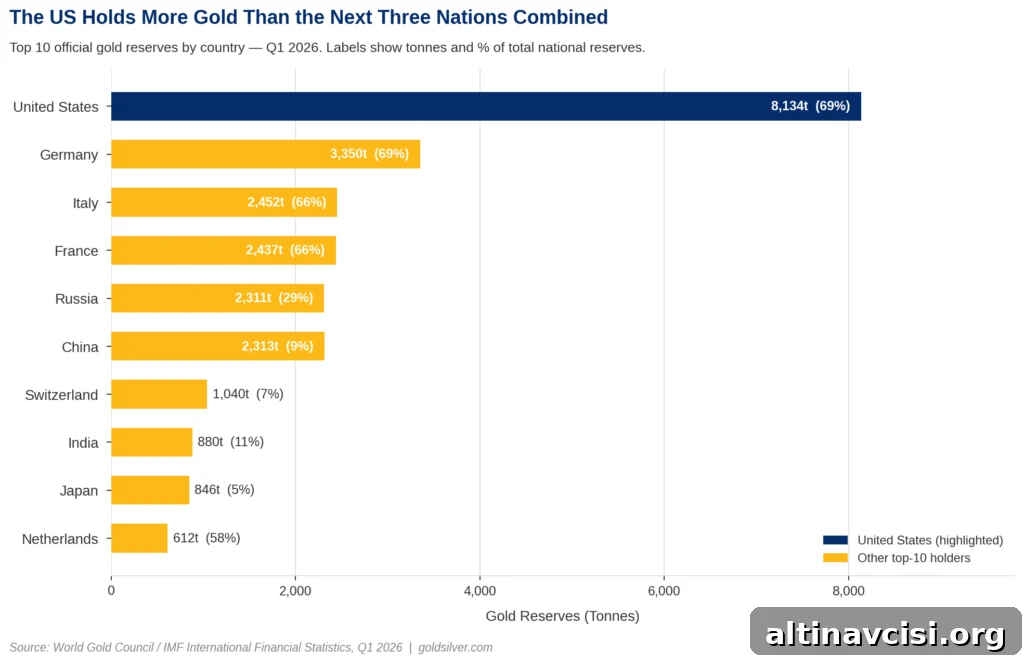
The top ten official holders control roughly 70% of global official gold reserves, and the United States and Europe together account for more than 60% of the total. That concentration reflects gold’s continued relevance as a monetary reserve asset for many legacy economies.
Two figures stand out. The US and Germany each maintain about 69% of their foreign reserves in gold, a carryover from the Bretton Woods era. By contrast, China holds around 9% and Japan only 5%. That divergence between Western legacy holders and many Eastern economies is the most consequential structural dynamic in the gold market today.
The Knowledge That Changes Everything

Two concise guides — free. Learn why gold remains a core store of value and why some currencies struggle to maintain purchasing power.
Why Are Central Banks Buying Gold at Record Pace?
The modern buying wave began in 2022 and has continued since. Central banks bought a net 1,082 tonnes in 2022 — the largest annual total in over 50 years — followed by about 1,037 tonnes in 2023. Q1 2026’s net 244 tonnes continued this elevated trend and remains above recent historical averages.
The decisive moment was February 2022, when Western governments froze roughly $300 billion of Russian central bank assets held abroad. That event made clear to reserve managers that foreign-held dollar assets can be vulnerable to political actions by the jurisdiction that controls the clearing and custody systems.
Gold stored in sovereign vaults does not rely on another country’s political will. It cannot be frozen or directly controlled by a foreign government, which elevated gold’s appeal as an operationally secure reserve asset. The same reasoning has influenced gold accumulation strategies across a range of emerging economies.
Who Is Buying the Most Gold in 2026?
Poland led purchases in Q1 2026, adding 31 tonnes to reach 582 tonnes. The National Bank of Poland has set a 700-tonne target, and leadership has framed accumulation as a defensive measure given Poland’s position on NATO’s eastern flank.
Uzbekistan increased reserves by 25 tonnes in Q1 2026, bringing its total to 416 tonnes — about 87% of its foreign reserves, one of the highest gold-to-reserve ratios globally.
China’s central bank added 7 tonnes in Q1 2026, extending a buying streak that has lasted more than 17 months. Official holdings are listed at 2,313 tonnes (about 9% of reserves), but some analysts estimate true holdings may be substantially higher due to purchases routed through state-controlled entities and the Shanghai Gold Exchange.
India has also been a steady buyer, using gold to help manage currency volatility and diversify reserve composition away from heavy dollar concentration.
Why Aren’t Western Countries Buying?
Many Western countries already hold large legacy gold positions accumulated during and after the Bretton Woods era. These legacy holdings have appreciated substantially in market value. For example, the US records its gold at a statutory price far below market levels, meaning the book value is a tiny fraction of the current market value.
Because these countries already hold significant gold cushions, they have less immediate incentive to add large net purchases. The meaningful structural story today is that countries less tied to the legacy system are increasing their allocations.
How Much Gold Does China Actually Hold?
Officially, China reports 2,313 tonnes of gold, which places it among the top global holders and represents about 9% of its foreign reserves. However, China has a history of intermittent disclosure: a sudden revision in 2015 revealed a large unannounced increase. Indicators such as Shanghai Gold Exchange flows, domestic mine output (the world’s largest), and policy directives suggest actual holdings could exceed the official figure.
If China’s true holdings were closer to 4,000–5,000 tonnes — an estimate some analysts consider plausible — gold would represent a much larger share of its reserves, making gold-backed or gold-referenced trade arrangements more operationally feasible.
What Does the Buying Pattern Actually Signal?
Reserve rankings show who owns the most gold; buying patterns show who is rethinking trust in the current system. Rapid increases in gold holdings — such as Poland’s rise from about 103 tonnes in 2018 to 582 tonnes in 2026 — reflect strategic “fortress” behavior rather than simple diversification.
Central banks making multi-decade decisions are not trading on short-term price charts. Three consecutive years of annual net purchases above 1,000 tonnes is indicative of structural reallocation, not short-term momentum. Individual investors should observe these shifts and consider their implications rather than simply copying sovereign strategies.
Stay On Top of Gold & Silver Prices
Get important market alerts sent straight to your inbox.
People Also Ask
Has the US gold reserve ever been independently audited?
There has been no comprehensive independent audit covering the entire US gold reserve in recent decades. The last full independent audit dates to the Eisenhower era. Since then, audits have been internal to the Treasury and Mint, and the Federal Reserve Bank of New York conducts verification for foreign custodial holdings. No credible public evidence has suggested a discrepancy in total holdings.
Which country holds the highest percentage of its reserves in gold?
Uzbekistan has one of the highest gold-to-reserve ratios among major holders, with gold making up about 87% of its foreign reserves. The US and Germany each have around 69% of reserves in gold, while China, Japan, and Switzerland report roughly 9%, 5%, and 7% respectively. Higher percentages indicate a stronger structural commitment to gold versus dollar-denominated assets.
Does the IMF hold gold reserves?
Yes. The IMF holds about 2,814.1 tonnes of gold, which would rank the IMF third globally if considered a single entity. These holdings are owned by the institution itself rather than any individual member state. The IMF also ran a notable sales program in 2009–2010 that redistributed several hundred tonnes.
Why is China’s gold-to-reserves ratio so low?
China’s foreign exchange reserves exceed $3 trillion and are dominated by dollar assets, so even a few thousand tonnes of gold represent a relatively small percentage. Possible explanations include strategic under-reporting to avoid signaling a rapid dollar exit, and a deliberate decision to keep sizeable dollar holdings for trade flexibility. Regardless of the ratio, China’s consistent net purchases indicate a clear directional shift toward more gold exposure.
What happens to gold if central banks stop buying?
Since 2022, central banks have absorbed roughly one-third of annual global mine production by purchasing over 1,000 tonnes per year. A sustained reversal to net selling would remove a major institutional demand floor and could put downward pressure on prices. However, the geopolitical and strategic drivers that prompted recent buying — concerns about asset security and diversification away from dollar exposure — have not materially reversed, so most analysts do not expect a rapid return to net selling.
What Does This Mean for Investors in Physical Gold and Silver?
Central bank buying has established a structural demand floor by diverting a significant portion of annual mine supply into long-term official holdings. Institutions that accumulate for reserve purposes are unlikely to sell based on short-term market moves, which changes the supply-demand calculus for investors.
The key takeaway is not to copy sovereign buying exactly, but to understand the motivation behind it. Central banks plan over decades and build positions gradually. Individual investors can take a similarly long-term, measured approach when considering physical precious metals exposure.
SOURCES
1. World Gold Council — Gold Demand Trends Q1 2026: Central Banks; Gold Reserves by Country; Central Bank Gold Reserves Survey 2025; Global Mine Production by Country.
2. IMF — International Financial Statistics, December 2025 edition.
3. IMF — Gold in the IMF factsheet and historical press releases on gold sales programs.
4. Brookings Institution — analysis of frozen sovereign assets and related policy implications.
5. National Bank of Poland — 700-tonne gold reserve target resolution, January 2026.
6. Historical public reporting from the People’s Bank of China and mine production data.
7. US Treasury — reserve asset data and reporting.
Disclaimer: This article is for informational and educational purposes only and does not constitute investment advice. Consult a qualified financial adviser before making investment decisions.
You may also like:
- Gold Portfolio Allocation: Why Wall Street Is Rewriting the 60/40
- What Does the SILVER Act Mean for Precious Metals Investors?
- What Backs the US Dollar? Not Gold. Not Silver.
- Why Is Gold Valuable? The 5,000-Year Answer Most Investors Get Wrong
- 72% of Family Offices Hold No Gold. What They’re Missing.
- Gold Remonetization: Six Forces Restoring Gold’s Monetary Role
- Silver Industrial Demand: Solar, EVs, and the Supply Gap
- Bank of America’s $6,000 Gold Forecast Isn’t a Price Call. It’s a System Call.