Gold and silver market update — April 30, 2026
Key Takeaways
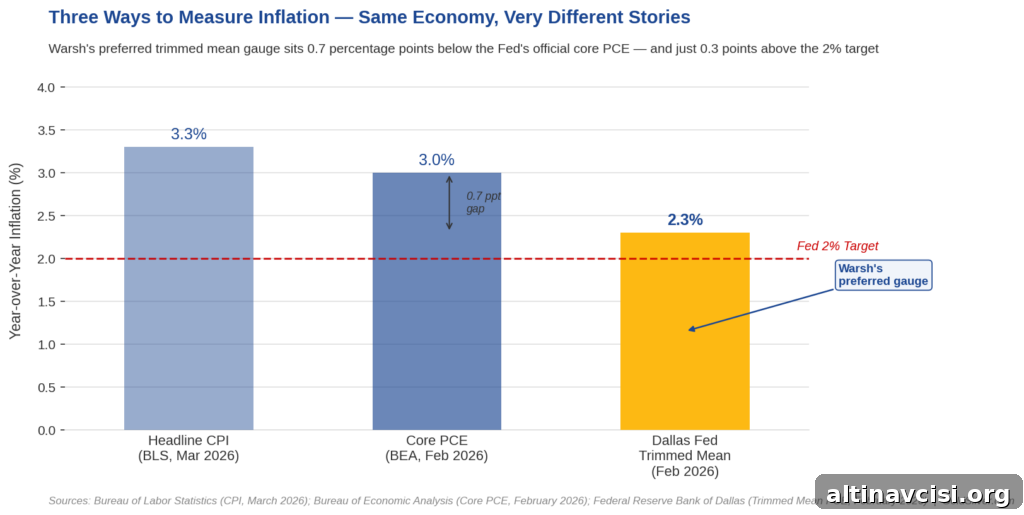
- Incoming Fed Chair Kevin Warsh prefers the Dallas Fed’s “trimmed mean” inflation gauge, which currently reads 2.3%, versus the official core PCE at 3.0%. That difference could lead him to treat inflation as already near the Fed’s 2% goal.
- If Warsh adopts the trimmed-mean framework, the case for rate cuts strengthens. Lower policy rates tend to compress real yields, and compressed real yields are a primary structural tailwind for gold.
- Yesterday’s FOMC vote was the most divided since October 1992 — an 8–4 split with four dissenters — and Warsh will inherit those divisions when he assumes office on May 15.
At his April 21 Senate Banking Committee hearing, Kevin Warsh said he does not fully trust the Fed’s current inflation measure and prefers a trimmed-mean approach. That alternative, published by the Federal Reserve Bank of Dallas, shows 12‑month inflation of 2.3%. The official core Personal Consumption Expenditures (PCE) index sits at 3.0%. That 0.7 percentage-point gap is meaningful: it can be the difference between a Fed that keeps policy tight and one that has room to ease. For gold, Warsh’s measurement preference is the most market-relevant signal to come out of Washington this month.
Gold rose to around $4,600 in early U.S. trading, rebounding more than 2% from yesterday’s one‑month lows as markets repriced the likely path of monetary policy under incoming leadership.
What Is the Trimmed Mean PCE, and Why Does Warsh Prefer It?
The official PCE aggregates price changes across many spending categories. The trimmed mean excludes the largest outliers on both ends of the distribution and averages the remaining observations, producing a measure that smooths extreme swings. Think of it like dropping the highest and lowest judges’ scores in a competition to get a cleaner central estimate.
In February 2026 the Dallas Fed’s trimmed‑mean calculation excluded extreme moves such as a 384% jump in moving and storage services and a 50% drop in telephone equipment prices. After removing those outliers, the trimmed mean printed 2.3% year‑over‑year, versus the official core PCE at 3.0%.
Warsh argues that transitory shocks — oil swings, tariff-driven spikes, and similar one-off moves — should not determine monetary policy. At his hearing he called core PCE a “rough swag” and said the Fed no longer needs to rely on rough estimates. The practical implication: if Warsh adopts the trimmed mean as his preferred gauge, inflation would be judged much closer to the 2% target, making rate cuts more politically and technically defensible even as the official PCE remains higher.
How Does a Change in Inflation Measurement Move the Gold Price?
The transmission to gold runs mainly through real yields: nominal interest rates minus inflation expectations. When real yields fall, gold typically rises; when real yields rise, gold tends to struggle. That relationship has been robust across regimes.
The Fed’s policy rate is currently 3.50%–3.75%. Measured against core PCE at 3.0%, the implied real yield is modestly positive. Measured against a 2.3% trimmed mean, the same nominal rate implies a higher real yield, which paradoxically gives the Fed more room to cut because inflation would be seen as nearer target. Each cut thereafter compresses real yields further, lowering the opportunity cost of holding non‑yielding assets like gold and encouraging central bank and institutional purchases.
Central bank demand matters: the World Gold Council reported strong net central bank purchases in Q1 2026. If the policy stance shifts toward accommodation under Warsh’s framework, those buyers are likely to remain active or increase purchases, supporting the gold price.
The Edge Every Investor Needs
Smarter precious metals investing starts here. The Nuggets Newsletter brings you essential market insights, Fed updates, global trends, educational videos, and much more.
Does Today’s GDP and PCE Data Change the Picture?
This morning the Bureau of Economic Analysis released its advance estimate for Q1 2026 GDP and March PCE at 8:30 a.m. ET. Wall Street expected roughly 1.8% annualized GDP growth while the Atlanta Fed’s GDPNow model had tracked lower. Slower growth paired with persistent inflation raises stagflation concerns — an environment in which gold historically outperforms many asset classes.
Viewed through official core PCE, stagflation looks acute and rate cuts appear unlikely. Viewed through Warsh’s trimmed mean, inflation looks nearer target, which changes the policy calculus: the same economic data can justify very different policy responses depending on the chosen inflation gauge.
The April 29 FOMC vote underscored those divisions. The decision to hold rates at 3.50%–3.75% split 8–4, the most fractured outcome since 1992. Members ranged from calls for an immediate cut to votes opposing any suggestion of dovish language. Warsh will assume the chairmanship of a committee already split between different views of the path for rates. His trimmed‑mean preference will likely align some members with his view while hardening dissent among others.
Isn’t the Trimmed Mean Also Flawed?
Yes. Critics note two main issues: the trimmed mean has sometimes overstated inflation relative to core PCE in certain historical periods, and current energy-driven price pressures are broad rather than isolated outliers, so trimming may not remove all oil-related effects. If energy-driven inflation persists, the trimmed mean could print higher than Warsh expects, weakening the near-term case for cuts.
But for gold investors the salient point is institutional signaling. Warsh’s preference reveals a Fed chair willing to change measurement tools and publicly critique the institution’s recent record. That admission reduces perceived monetary credibility and can be supportive of gold: when central bank credibility is questioned, investors often turn to monetary alternatives that have held value across centuries.
So Where Does This Leave the Gold Price?
Warsh may not cut rates at his first meeting in June, and geopolitical risks and high oil prices could keep stagflation concerns alive. Still, his April 21 remarks changed the policy conversation: by favoring the trimmed mean, he has effectively moved the definition of “near target” closer to today’s readings. That redefinition lowers the policy ceiling and increases the odds of earlier easing or at least lower forward real yields.
Real yields can compress on the expectation of cuts even without an immediate move. As the opportunity cost of holding gold declines, demand from central banks and institutions tends to rise. The morning’s move to around $4,600 reflects markets repricing the next 12 months of monetary policy under a chair who has signaled skepticism of prior measurement choices — not simply reaction to the GDP print.
Stay On Top of Gold & Silver Prices
Get important market alerts sent straight to your inbox.
SOURCES
1. Federal Reserve Bank of Dallas — Trimmed Mean PCE Inflation Rate, February 2026
2. CNBC — Warsh Pushes His Plan for ‘Regime Change’ at Senate Hearing
3. Rev — Kevin Warsh Senate Banking Committee Confirmation Hearing Transcript, April 21, 2026
4. Federal Reserve — FOMC Statement, April 29, 2026
5. Bureau of Economic Analysis — GDP and PCE Release Schedule
6. Federal Reserve Bank of Atlanta — GDPNow Model Estimate, Q1 2026
7. World Gold Council — Q1 2026 central bank demand data
8. CNBC — Coverage of Warsh’s inflation remarks and debate over measurement
9. Trading Economics — Gold spot price, April 30, 2026
By the GoldSilver Editorial Team — helping investors understand sound money since 2005. This article is for informational purposes only and does not constitute financial, investment, or tax advice. Always consult a qualified financial advisor before making investment decisions.
You May Also Like:
- Gold Is Down 19%. This $3.8B Bet Says It Doesn’t Matter
- Gold, Oil, and the Fed: Why the Old Rules Don’t Apply
- Why Turkey Sold Its Gold Reserves — And What It Proves About Sound Money
- Why Gold Spikes Every Time Hormuz Opens — And Why It Never Holds
- Oil Hits $100 and OPEC Is Fracturing. Gold Knows Why
- How China Restricts Silver Supply Without Touching Silver
- Powell Press Conference: What It Means for Gold
- Iran Blinked — And One Word From Powell Decides What Happens Next