Daily News Nuggets | Today’s top stories for gold and silver investors
February 20th, 2026 | Brandon Sauerwein, Editor
Gold Above $5,000, Silver Over $80 — A New Phase for Precious Metals
Gold’s surge in 2026 has become one of the market’s defining themes. Friday’s move back above $5,000 highlighted that the rally still has momentum, while silver crossing $80 underscores growing demand from investors seeking monetary protection and from industries competing for limited supply.
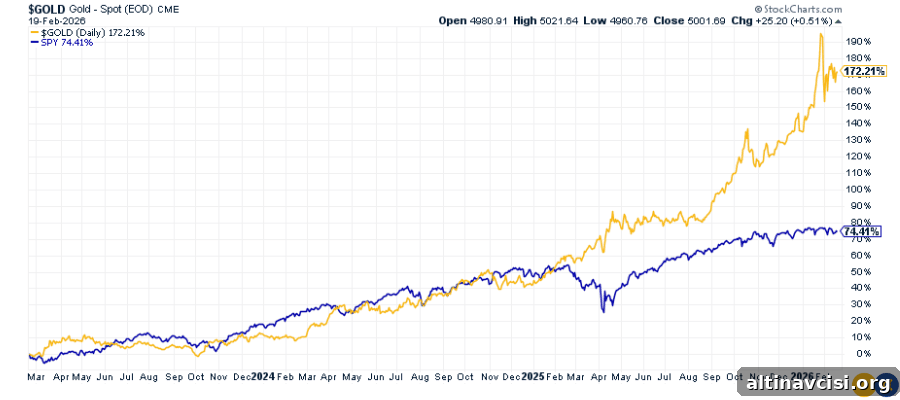
The performance is striking: gold is up more than 70% year-over-year, one of its largest annual advances in recent memory, and roughly 170–175% over the past three years. These moves reflect large-scale capital repositioning rather than short-term momentum chasing.
Gold vs. S&P 500: 3-Year Performance (%)
Investors are reacting to a familiar mix of pressures: sustained geopolitical tensions, heavy government borrowing, and rising questions about central bank independence. When confidence in policy institutions weakens, gold reasserts its role as a neutral reserve asset.
The conclusion is straightforward: when trust in institutions softens, hard assets tend to strengthen. At present, the forces fueling this rally show little sign of abating.
Stay On Top of Gold & Silver Prices
Get important market alerts sent straight to your inbox.
Powell Prioritizes Fed Independence in Final Months as Chair
As Jerome Powell enters the final months of his chairmanship, he has signaled that safeguarding the Federal Reserve’s institutional independence is a top priority. He views the Fed’s credibility as vital, especially as political scrutiny of rate policy intensifies.
Central bank independence supports stable inflation and well-functioning markets. If investors believe monetary policy is being driven by political objectives, long-term yields can rise, the dollar can weaken, and volatility can spread across asset classes.
Timing matters: inflationary pressures persist, federal debt remains high, and geopolitical risks are weighing on markets. In that environment, even modest doubts about Fed autonomy can quickly ripple through equities and bonds.
History shows a consistent pattern: episodes of waning monetary credibility often lead to stronger demand for hard assets, particularly gold. When confidence in policy frameworks falters, investors seek assets that do not rely on institutional credibility to preserve value.
Military Posturing Escalates — What It Means for Markets
The U.S. has increased military positioning amid rising geopolitical tensions, and White House officials have indicated forces are prepared if diplomacy fails. While no final decision has been announced, the visible buildup has drawn investor attention.
Markets price risk as it develops. Defense stocks often gain in the near term while broader equities may falter as traders consider escalation scenarios. Historically, periods of military tension boost demand for safe-haven assets like gold and U.S. Treasuries.
The key concern is not only whether conflict occurs but what prolonged uncertainty does to the global economy. Sustained geopolitical tension tends to push energy prices higher, disrupt trade flows, and add an inflation premium that can be persistent.

The Financial System Isn’t Safer — And You Know It
As risks mount, see why gold and silver are projected to keep shining in 2026 and beyond.
Legal Fight Over Tariffs Could Spark More Volatility
The Supreme Court is reviewing the legality of emergency tariff powers after lower courts questioned whether the administration exceeded authority under IEEPA. If key tariffs are struck down, equities could react sharply as traders price in lost revenue and heightened policy uncertainty.
Analysts differ on the likely fallout. Some expect any market reaction to be short-lived because the administration might use alternative legal tools to reinstate tariffs. Others warn that a ruling against the tariffs could lift Treasury yields and trigger broader risk-off trading.
Either way, the uncertainty itself is the risk. Markets dislike unresolved legal questions about trade policy, and prolonged ambiguity tends to keep investors cautious.
For gold and silver, that caution can create opportunity: volatility—regardless of the source—often spurs renewed interest in hard assets, and policy ambiguity is no exception.
Risk Appetite Back, But Are Investors Getting Too Comfortable?
Global equity funds recently recorded their strongest weekly inflows in weeks as investors rotated back into stocks on easing sector worries and renewed optimism about earnings and economic resilience. Data show notable net purchases across major fund categories, indicating renewed confidence in risk assets after recent turbulence.
Retail participation is also elevated. The combination of institutional inflows and strong retail buying can propel markets higher—but it can also lead markets to get ahead of themselves.
The broader question is how much of current optimism reflects expectations that things will continue to go right, and how much room investors are leaving for things to go wrong. That balance matters for future market vulnerability.
You May Also Like
- $1 Trillion Added to the Debt — What It Means for Gold
- Gold Support Levels Firm as Washington Backs Minerals
- Gold Slips Below $5K as Jobs Revisions Rattle Markets
- Gold Near $5,000 as Fed Faces Sticky Inflation
- Markets Eye Friday’s CPI, Credit Card Debt Hits Record High