Gold Purchasing Power: What an Ounce Could Buy Over Time
Gold recently reached a record high near $5,111 per ounce amid heightened geopolitical uncertainty and questions about the stability of major currencies. For centuries, gold has held a distinctive place in the global economy: as money, a store of value, and a hedge against uncertain times.
Beyond charts, forecasts, or short-term price swings, one of the most revealing ways to understand gold’s value is remarkably simple:
What can one ounce of gold actually buy?
Seen through that lens, a striking pattern emerges. Over long stretches of time, gold’s purchasing power remains surprisingly stable. While paper currencies inflate and lose buying power, a single ounce of gold has preserved value across generations.
A Dinner at the Savoy: Gold vs. Wages Over 50 Years
A recent practical example makes this point clear. The comparison comes from one of London’s most famous restaurants, the Savoy Grill. Financial commentator George Cooper revived a metric originally popularized in the 1970s: the “Savoy Gold Ratio,” first noted by investor Julian Baring. This measure compares how many Savoy dinners one ounce of gold could buy, showing gold’s performance relative to fiat money and wages.
Measured in wages, a dinner for two at the Savoy has remained consistently expensive. From 1971 through recent years, that meal has typically cost roughly three days of average UK wages, meaning nominal wage gains did not make high-end dining substantially more affordable for the average worker.
Measured in gold, the picture is very different.
Gold’s Purchasing Power: One Ounce, Fourteen Dinners
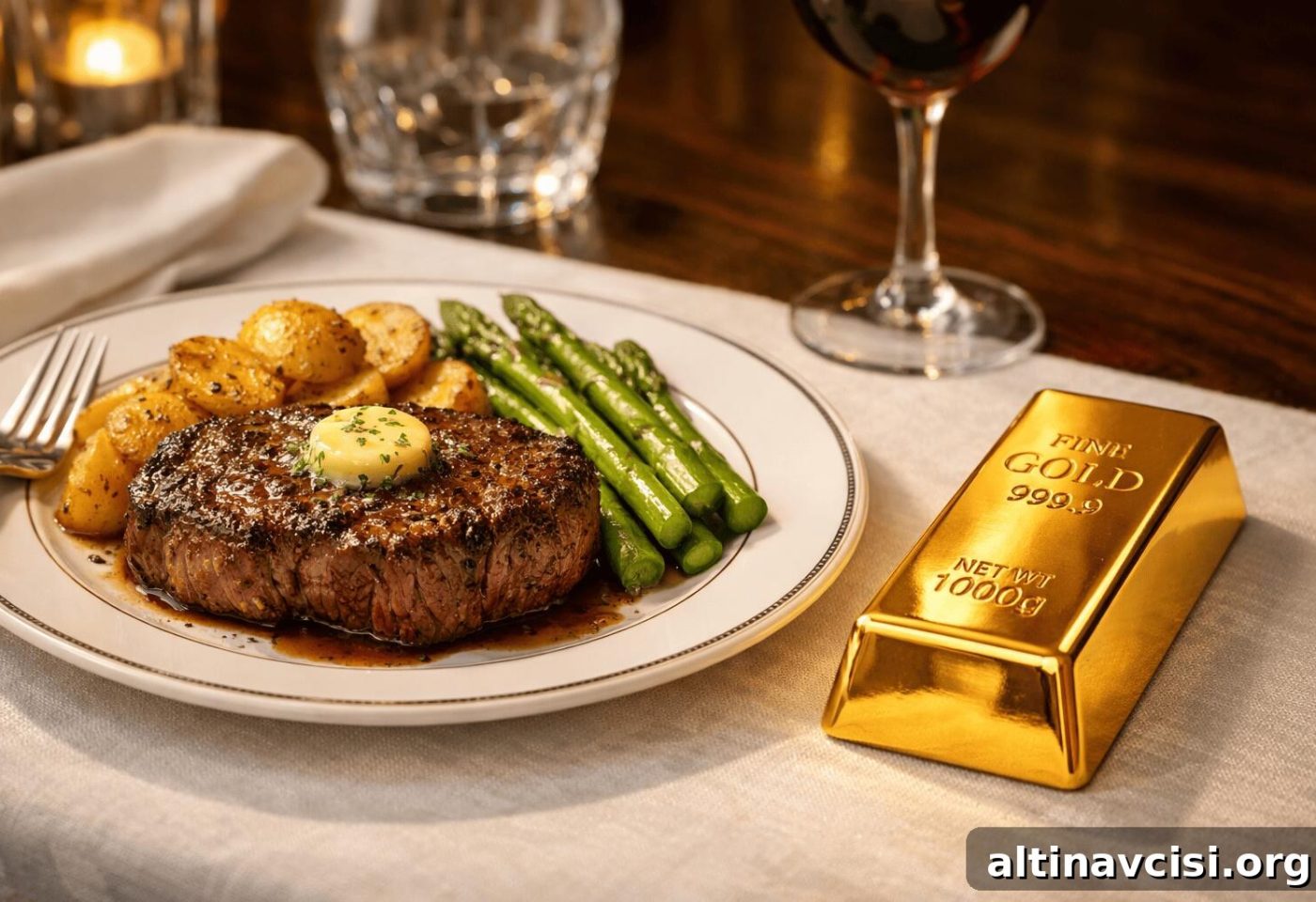
In 1971 a sirloin might cost about £1.55 and dinner for two at the Savoy cost approximately £11.33. At the official gold price then (around $35 per ounce), that bill represented about 0.68 ounces of gold. Fast forward to January 2025: a comparable dinner at the Savoy totaled roughly £472.65. With gold trading near $4,642 per ounce at that time, the same meal required only about 0.14 ounces of gold.
Put simply: one ounce of gold would buy dinner for three people in 1971; today the same ounce buys dinner for roughly fourteen. As gold has climbed above $5,000 per ounce, that purchasing power has grown still further.
Not Just a Metal: A Long-Term Store of Value
Julian Baring described gold as a form of currency and argued that holding an ounce of gold over decades would preserve the ability to buy the same real goods years later. Contemporary data supports that view: gold has not only preserved but in many cases increased its buying power relative to paper money.
The Savoy example illustrates a broader dynamic. The restaurant’s quality and pricing approach did not collapse; instead, the currency’s value shifted. Gold quietly absorbed decades of inflation while fiat money lost ground. Look across many goods and services spanning decades and the same trend appears: measured in gold, prices frequently stay stable or decline; measured in fiat currency, those same prices typically rise significantly.
The Famous “Gold Suit” Example
A classic century-long comparison drives the point home even further. In the 1920s a well-made men’s suit cost roughly $20–$30, similar to the price of an ounce of gold then. A century later, a quality suit from reputable tailors or premium brands can run $4,000–$5,000—again broadly aligned with the price of an ounce of gold today. The craftsmanship and materials are comparable; what changed is the currency used to measure value. The dollar has lost most of its purchasing power over that time, while gold has not.
What About Gold’s Traditional Drawbacks?
Critics point out valid limitations: gold requires secure storage and insurance, pays no dividends, and can lag productive assets like stocks or real estate during long bull markets. Those are real costs and should factor into any allocation decision. But they miss gold’s primary role: protection of purchasing power when currencies are debased. Gold is not meant to outperform every asset class each year; it is designed to preserve wealth over long time horizons.
Why Gold’s Role Matters for Your Portfolio
Most public discussion frames gold in dollar terms—“up” or “down” over days or months. A more useful perspective treats gold as long-term insurance: scarce, durable, and recognized around the world. That is why central banks hold gold and why many investors include it in diversified portfolios.
Over decades, paper currencies tend to lose value while gold tends to maintain buying power. This does not mean gold rises every year, but measured across generations it reliably preserves the ability to purchase tangible goods and services.
Gold as Financial Insurance
When you think of gold less as a speculative trade and more as stored purchasing power, its purpose becomes clearer. Gold complements productive assets like equities and real estate; it protects capital when currencies weaken and provides a hedge in times of systemic uncertainty. The key question remains simple and practical: what will one ounce of gold buy today, and what will it buy in the future?
History suggests that gold’s ability to preserve purchasing power over long horizons is remarkably consistent.
If your goal is to protect wealth across generations, consider how a measured allocation to physical gold can act as insurance against currency debasement and inflation.
Stay On Top of Gold & Silver Prices
Receive timely market updates and alerts to help you monitor precious metals and preserve purchasing power.
People Also Ask
What is the Savoy Gold Ratio?
The Savoy Gold Ratio compares how many dinners at the Savoy Grill one ounce of gold can purchase. First noted in the 1970s, it highlights how gold’s buying power has performed relative to fiat wages and prices over decades.
Does gold maintain its purchasing power over time?
Yes. Historical examples show that one ounce of gold has consistently purchased similar quality goods across long periods. While cash values erode with inflation and currency debasement, gold has preserved purchasing power over decades and even centuries.
How much gold do I need to preserve my wealth?
Allocation needs vary by individual goals and portfolio size. Many advisors recommend 5–10% of a diversified portfolio in physical gold as protection against currency risk. Specific amounts should be tailored to personal objectives and risk tolerance.
Why is gold better than cash for storing value?
Gold resists debasement because it is scarce, durable, and globally accepted. Unlike paper money that can be expanded or devalued, gold has historically held its purchasing power over long periods.
Is gold a good investment during inflation?
Gold has often served as a hedge during inflationary periods. While it is best treated as a preservation tool rather than a primary growth asset, it can help protect real purchasing power when currencies lose value.
You May Also Like:
- Foreign investors and U.S. debt: implications for gold and market flows
- Why metals performed strongly across asset classes in 2025 and what to watch for 2026
- How trading rule changes could influence silver prices
- Analysis: silver’s setup and potential investment opportunities in 2026
- What a falling gold-to-silver ratio could mean for investors
Popular Topics
Picked from the archive
-
01
 Topics
Reuters Poll: Flight to Safety Boosts Gold and Silver Forecasts
-
02
Topics
Silver Pauses After 100% Rally as Gold Traders Watch Fed
-
03
Topics
Markets Flee Risk as US-Iran Tensions Lift Dollar, Push Oil
-
04
Topics
World Gold Council Says Gold Tariffs Unlikely but Possible
-
05
Topics
Why Big Banks Predict Gold Prices Over $6,000
-
06
Topics
Swiss Gold Exports Surge to the US Ahead of 39% Tariff
-
07
Topics
Gold Hits Five-Week High on Trade Uncertainty, Weak Dollar
-
08
Topics
Tariff Deadline Fears Push Gold Prices Up as Other Metals Slide