Gold Prices Steady as Washington Supports Critical Minerals

Daily News Nuggets | Top stories for gold and silver investors
February 18th, 2026 | Brandon Sauerwein, Editor
Gold Stabilizes After January Shock
After the sharp selloff on January 30, gold has settled into a clearly defined trading band between $4,600 and $5,100. That range has established tangible support near the low end and consistent resistance near the high end, suggesting the market is consolidating rather than breaking down.
Gold Price Support Levels — $4,600 to $5,100 Range
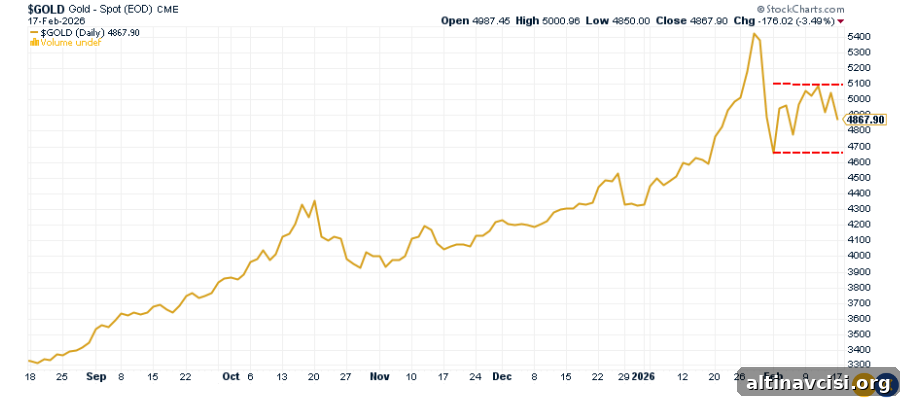
Gold peaked above $5,550 in late January before a rapid liquidation drove prices down to roughly $4,600 — a decline near 17% over a short period. That low area has seen decisive buying on multiple tests, which points to a durable support base.
Rallies toward $5,100 have so far met selling pressure, keeping the upper edge of the range intact. However, there is no clear sign of a structural reversal; the market appears to be digesting gains and reducing leverage rather than capitulating.
Historically, sharp pullbacks inside long-term bull markets often transition into consolidation phases as speculative positions are cleaned out and longer-term capital accumulates. Current price action in gold is consistent with that pattern.
What to watch next: A decisive breakout above $5,100 would likely signal the next leg higher. Conversely, a sustained drop below $4,600 would put the bullish structure at risk and require reassessment.
Silver Swings Wide — But Support Holds
Silver experienced the steepest one-day percentage decline on record in January, and volatility remains elevated. Since the shock, trading has become more structured, but the metal still moves with higher amplitude than gold.
Silver has traded in a broad band of about $70 to $88 — a much wider percentage range than gold — reflecting its higher beta to both risk and momentum.
Silver Trading Range — Support Near $70, Resistance Near $88
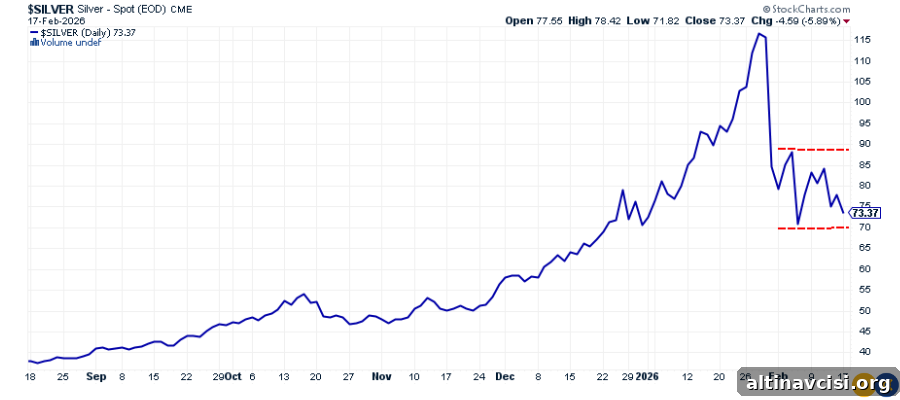
The $70 area has held through several aggressive sell-offs and subsequent buying, suggesting forced liquidation has largely run its course. Resistance in the mid-to-high $80s remains intact; the market appears to be coiling within the range.
Range compression following a sharp drawdown often precedes renewed expansion. Silver’s strong industrial demand — notably from energy and technology sectors — combined with rising monetary uncertainty, creates a backdrop where momentum can re-emerge quickly.
Key level to watch: a sustained break above $88 would likely attract fresh capital and accelerate upside momentum for silver.

The Edge Every Investor Needs
Smarter precious metals investing starts here. The Nuggets Newsletter delivers concise market analysis, Fed updates, global trends, and educational resources to help you make better decisions.
Mining Stocks Show Relative Momentum Despite Volatility
Despite price swings in gold and silver, many mining stocks have held up and even shown relative strength. On the TSX Venture Exchange, companies such as 1911 Gold and Cerrado Gold were noted among the top performers in early 2026 — an uncommon outcome when juniors typically lag during periods of uncertainty.
There are positive operational updates as well: Monument Mining reported promising drill results from its Selinsing expansion program, which could support future resource growth, and Maxus Mining began trading on the OTCQB, increasing access for U.S. investors and improving liquidity.
Mining equities often lead sentiment in the precious-metals complex. When capital begins rotating into junior explorers during consolidation, it can indicate growing confidence in a subsequent commodity cycle.
Washington to Establish Price Floors for Critical Minerals
U.S. agencies have reportedly developed a framework to establish price floors for critical minerals. The system is intended to stabilize domestic supply chains and reduce dependence on foreign producers by guaranteeing minimum pricing for strategic resources such as lithium, nickel, and rare earth elements.
Why this matters: government intervention typically signals strategic concern. Underwriting minimum prices can reduce the investment risk that often deters long-term mining projects, reinforcing the structural value of tangible resources and elevating their role in national strategy.
U.S. Stocks Off to Worst Relative Start Since 1995
U.S. equities are off to their worst relative start versus global markets since 1995. Through early 2026, international markets have outpaced the S&P 500, a gap driven in part by a stronger dollar, high U.S. valuations, and uncertainty around Federal Reserve policy.
That leadership shift doesn’t necessarily mean a permanent decline for U.S. markets, but it does highlight the risks of concentration and the potential benefits of diversification. When dominant trades unwind, investors who broaden their exposure may be better positioned for changing market leadership.
You May Also Like
- Gold Slips Below $5K as Jobs Revisions Rattle Markets
- Gold Near $5,000 as Fed Faces Sticky Inflation
- Markets Eye Friday’s CPI; Credit Card Debt Hits Record High
- Silver Volatile, Gold Resilient After January Jobs Surprise
- Silver’s 7% Bounce Sparks Bullish Calls
- Gold Holds Above $5,000 as Hedge Funds Brace for Turbulence
Popular Topics
Picked from the archive
-
01
 Topics
Trump Imposes 25% Tariff on India’s Oil Imports From Russia
-
02
Topics
How Government Debt Drives Gold and Silver Prices
-
03
Topics
Gold ETFs vs Physical Gold: Hidden Risks Investors Overlook
-
04
Topics
HSBC Survey: Investors Double Gold Allocations as Markets Falter
-
05
Topics
Texas to Recognize Gold and Silver as Legal Tender in 2027
-
06
Topics
Trump Weighs Interim Fed Nominee as Fed Chair Decision Looms
-
07
Topics
Silver Squeeze Pushes Silver Prices Above $51
-
08
Topics
Dollar Surges as Trump Threatens Tariffs on Copper and Chips